poll for
Eventful poll for
Png
Whatever government emerges from Papua New Guinea’s first elec tions since independence, nobody could complain that the elections themselves were without incident.
Even before voting began on June 18, about 500 demonstrators were in the Port Moresby streets de nouncing alleged bias in the elec toral office because only 18 of the country’s 109 electorates would use ballot papers carrying photographs of the candidates. The chief elec toral commissioner, Mr James Mileng, told the crowd that his of fice had attempted to provide photographs of all 871 candidates but the technical problems had been too great.
Then, when the capital’s noisy, carnival-style three days of voting were over, the demonstrators were out again, about 1 500 of them this time, demanding Mr Mileng’s re signation and the extension of the voting period by two more days. But Mr Mileng stood firm again, point ing out that the election time table for the whole country would not permit an extension.
As he spoke, vote-collecting teams were setting out by foot-track, road, aircraft, canoe and ship to try and ensure that everyone in mountains, plains, and along the coasts had the chance to vote.
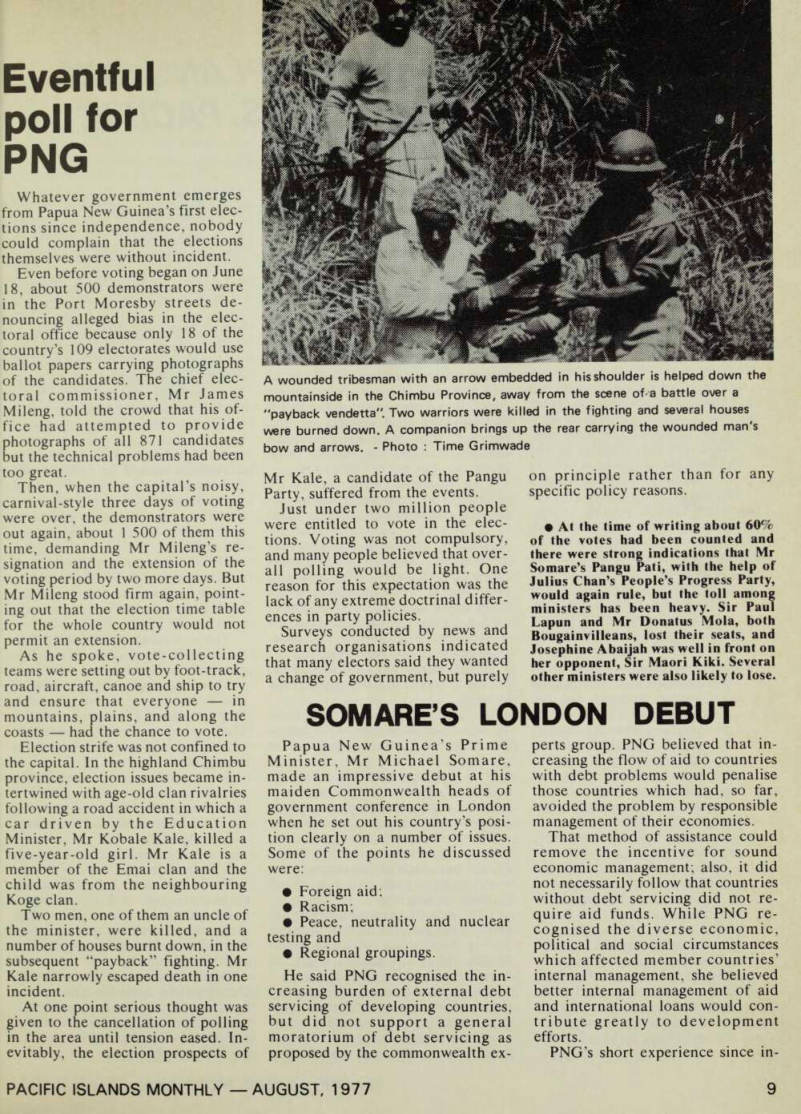
Election strife was not confined to the capital. In the highland Chimbu province, election issues became in tertwined with age-old clan rivalries following a road accident in which a car driven by the Education Minister, Mr Kobale Kale, killed a five-year-old girl. Mr Kale is a member of the Emai clan and the child was from the neighbouring Koge clan.
Two men, one of them an uncle of the minister, were killed, and a number of houses burnt down, in the subsequent “payback” fighting. Mr Kale narrowly escaped death in one incident.
At one point serious thought was given to the cancellation of polling in the area until tension eased. In evitably, the election prospects of
Mr Kale, a candidate of the Pangu Party, suffered from the events.
Just under two million people were entitled to vote in the elec tions. Voting was not compulsory, and many people believed that over all polling would be light. One reason for this expectation was the lack of any extreme doctrinal differ ences in party policies.
Surveys conducted by news and research organisations indicated that many electors said they wanted a change of government, but purely
on principle rather than for any
specific policy reasons.
• At the time of writing about 60% of the votes had been counted and there were strong indications that Mr Somare’s Pangu Pati, with the help of
Julius Chan’s People’s Progress Party,
would again rule, but the toll among ministers has been heavy. Sir Paul Lapun and Mr Donatus Mola, both Bougainvilleans, lost their seats, and Josephine Abaijah was well in front on her opponent, Sir Maori Kiki. Several other ministers were also likely to lose.
A wounded tribesman with an arrow embedded in his shoulder is helped down the mountainside in the Chimbu Province, away from the scene ofa battle over a "payback vendetta". Two warriors were killed in the fighting and several houses were burned down. A companion brings up the rear carrying the wounded man's bow and arrows. Photo : Time Grimwade