Problem - Drug Smuggling
AS A NEW NATION PNG HAS A NEW
From GUS SMALES in Port Moresby
One of the side issues of nation hood in Papua New Guinea has been a dramatic rise in the importance of Port Moresby as an air gateway to Australia.
There’s no need to consult the latest statistics a then-and-now comparison of the crowds using the grossly-overtaxed Port Moresby air terminal tells the story.
The rise in activity has created a fear among authorities at Australian east coast airports that PNG could provide a new staging point for the drug trade or for other illegal op erations which rely on international transport links. And. this, in turn, is worrying PNG authorities who fear that it could well lead to the upsurge of a drug problem in their own country.
Drugs are a problem almost non existent in PNG so far, but the Government and the police re cognise a vulnerability requiring early protective action.
The heavy volume of air traffic which links Port Moresby with Cairns. Brisbane and Sydney is not new in itself and has always formed one of the busiest regional links in the Pacific. And for more than 10 years, too, Qantas has had various Australian-based flights staging through PNG on world links.
But, despite the density of the traffic, PNG for years was little more than a terminus for an Australian regional structure.
Neither the onward opportunities nor the local background existed to develop PNG as an illegal drug gateway to Australia. The past two years have brought a marked change in the situation because of the emergence of PNG as a focal point in a new travel region.
This is a natural result of PNG’s political independence, introducing its own links with other countries and including the establishment of its own airline.
In the high-flown prose of airline public relations, “Air Niugini’s beautiful bird of paradise is a wise old owl” actually a hard-worked Boeing 707 “which spreads its
wings to fly to Japan, the Philip pines. Hong Kong and Australia”.
Qantas has a share of the wider action through Port Moresby, too, and potential exists for reciprocal flying rights to be negotiated or taken up by Cathay Pacific, Philip pine Airlines and Japan.
Papua New Guineans themselves are ranging further afield than ever before. The PNG Chinese com munity is consolidating its links with Hong Kong, Australians in PNG are increasingly looking northwards rather than to their own country for holidays and business, and an as sisted employment scheme for Filipinos has brought close as sociations with Manila.
The result is that Port Moresby, once a sort of airline cul-de-sac, has become a meeting place and gate way between Australia and southeast Asia.
The situation is fine for tourism, for business and for commercial ac tivity in general, but it has also cre ated a drug smuggling potential for Australia and ultimately a poten tial drug problem for PNG itself.
It is typical of PNG’s non-in volvement with the drug scene that the discovery not so long ago of a field of cannabis growing wild (ge nuinely) hardly raised a ripple.
There was no rush to destroy it, no rush to get at it, and very little general interest.
Today, the position is a little tighter, and there have been prosecutions for cultivation, for
possessing seeds and for possessing leaf. There has been a recent prosecution, too, for possession of heroin.
But all in all the number of drug convictions in the past two years or so can be counted on the fingers of two hands, and fines of up to $600 have been the general penalty.
All the prosecutions have involv ed non-nationals of PNG, mainly Australians.
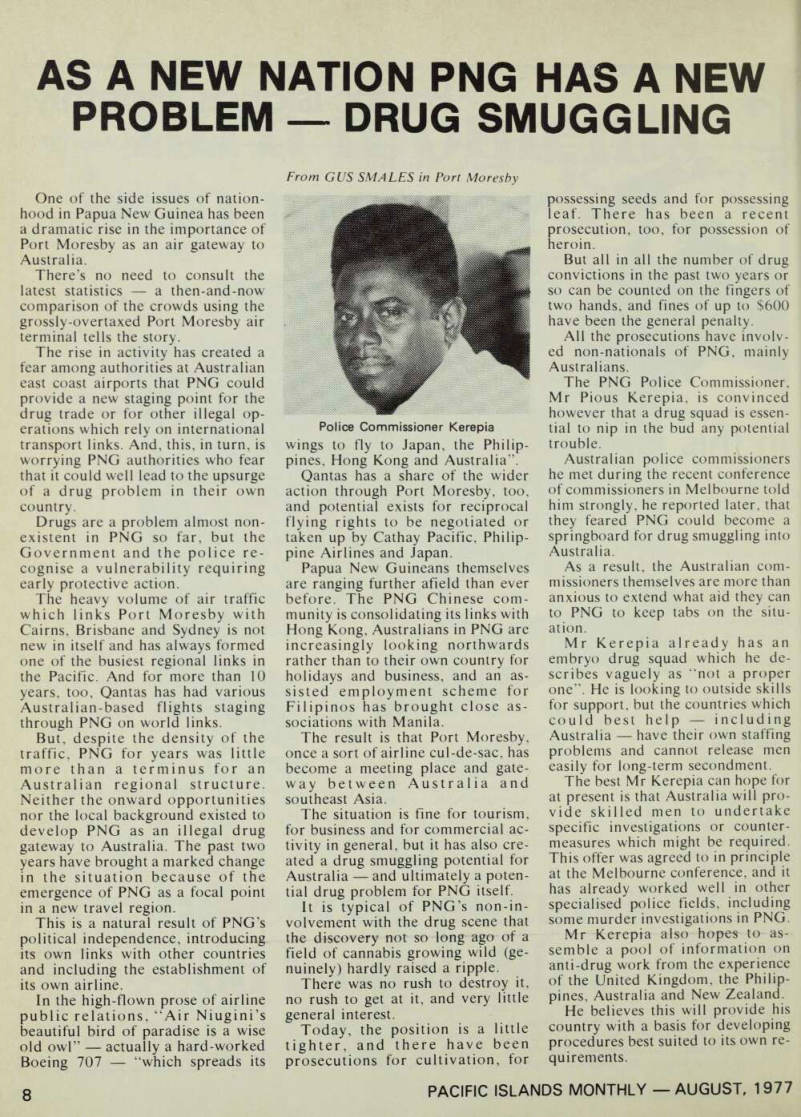
The PNG Police Commissioner, Mr Pious Kerepia, is convinced however that a drug squad is essen tial to nip in the bud any potential trouble.
Australian police commissioners he met during the recent conference of commissioners in Melbourne told him strongly, he reported later, that they feared PNG could become a springboard for drug smuggling into Australia.
As a result, the Australian com missioners themselves are more than anxious to extend what aid they can to PNG to keep tabs on the situ ation.
Mr Kerepia already has an embryo drug squad which he de scribes vaguely as “not a proper one”. He is looking to outside skills for support, but the countries which could best help — including Australia — have their own staffing problems and cannot release men easily for long-term secondment.
The best Mr Kerepia can hope for at present is that Australia will pro vide skilled men to undertake specific investigations or counter measures which might be required.
This offer was agreed to in principle at the Melbourne conference, and it has already worked well in other
specialised police fields, including
some murder investigations in PNG.
Mr Kerepia also hopes to as semble a pool of information on anti-drug work from the experience of the United Kingdom, the Philip pines, Australia and New Zealand.
He believes this will provide his country with a basis for developing procedures best suited to its own re quirements.
Police Commissioner Kerepia