Fiji waterside workers at odds
p. 69 · Read in the full issue
odds with Ports Authority
A lot of bad feeling, including a demand for the sacking of officials, surfaced in preliminary stages of negotiations on claims by the Fiji Waterside Workers and Seamen’s Union for a wage hike, a guaranteed 40-hour week for 1,000 men and the establishment of a permanent pool of dock workers at Lautoka and Levuka. The union also demanded that the Ports Authority re-engage men after they had been convicted for theft at the docks.
Negotiations had been under way for less than three days when the union’s delegates walked out, with the industrial adviser, Mr Taniela Veitata, threatening to give 28 days’ notice of a strike.
The Ports Authority, which lost $lO,OOO in the second half of 1976, introduced economy measures, and was resisting the claims, saying that to attract more ships and trade to Fiji, port services had to be efficient and cheap. Cost increases for the authority would be reflected in higher freight rates and the cost of imports.
The union demanded the dis missal of four top officials of the authority Loh Heng Kee (chair man), Narayan Singh (secretary), Robert Bryson and Inoke Tabua.
Mr Veitata said that at the union’s annual meeting 2,390 dockers had voted to demand the dismissal of the men and to strike unless other claims were met. The union alleged the four men had persuaded dockers at Lautoka and Labasa not to sup port. in 1976, a strike called by the union.
Mr Loh was surprised at the de mand, saying it was “a very ir responsible attempt to belittle the authority management”. The allega tion about interference at Lautoka and Labasa was totally distorted.
All the authority had done was to make sure that dockers, and the public, were fully informed about the authority’s proposal to reorganise the dock labour force under better conditions.
He recalled that Mr Veitata had been a member of the commission, which he (Mr Loh) headed which recommended creation of the
authority, and had asked him to come back to Fiji, from Singapore, to help build up a good and strong dock labour force.
Mr Jonati Mavoa, chairman of the authority, said the union demand would not be met. He added that remarkable results had been ob tained from the reorganisation of the ports. The Fiji system was now internationally recognised for its efficient operation and fast shipping turnaround. That would attract more ships to Fiji as it became ac cepted as a regional shipping hub.
Talks broke down when members of the authority questioned Mr Veitata’s legal position, saying he was ineligible to negotiate on behalf of the union. Under the provisions of the Trades Disputes Act a person convicted of a criminal offence was not allowed to hold office in a trade union for five years after conviction.
Also, the act stated that union of ficials should not delegate negotiat ing powers to any person, other than a barrister and solicitor.
After the union delegates walked out, Mr Veitata said that in the 1971 strike, Mr Norman Docker, of the Australian Waterside Workers’
Union, had been allowed to negotiate on behalf of local dock workers. Also, in 1974, while he was serving a sentence for theft from the dock, the government twice allowed his release from gaol to sit in at arbitration.
After Mr Veitata had given the formal 28 days’ notice of the strike, dictated by law, the Prime Minister, Ratu Sir Kamisese Mara, stepped into the picture, saying the govern ment would keep the ports open if the strike went ahead. He did not say how, but his strong stand left little to the imagination. He said the government hoped that reason would prevail in the dispute.
Mr Veitata, the day before the Prime Minister spoke, said that Fiji sugar sent to Britain would not be unloaded if the army intervened in the strike, scheduled to start on June 20. He had received a letter from the International Transport Federa tion pledging support.
Gilberts Ask For
Loan For Shipping
Changes are on the way for the Gilbert Islands inter-island fleet following a visit by officials from the Asian Development Bank. The Gilbert Islands Government has asked the bank for a loan to replace some of the present ships.
The bank officials drew up a plan to improve shipping services within the group. They considered the Moana Raoi was too big for local needs, while the Temauri and Tautunu were too small. However, as some of them still had years of useful service there was no need to hurry replacements.
The Gilbert Islands asked for ships designed to cater for inter island services, with a bigger one to service Christmas Island.
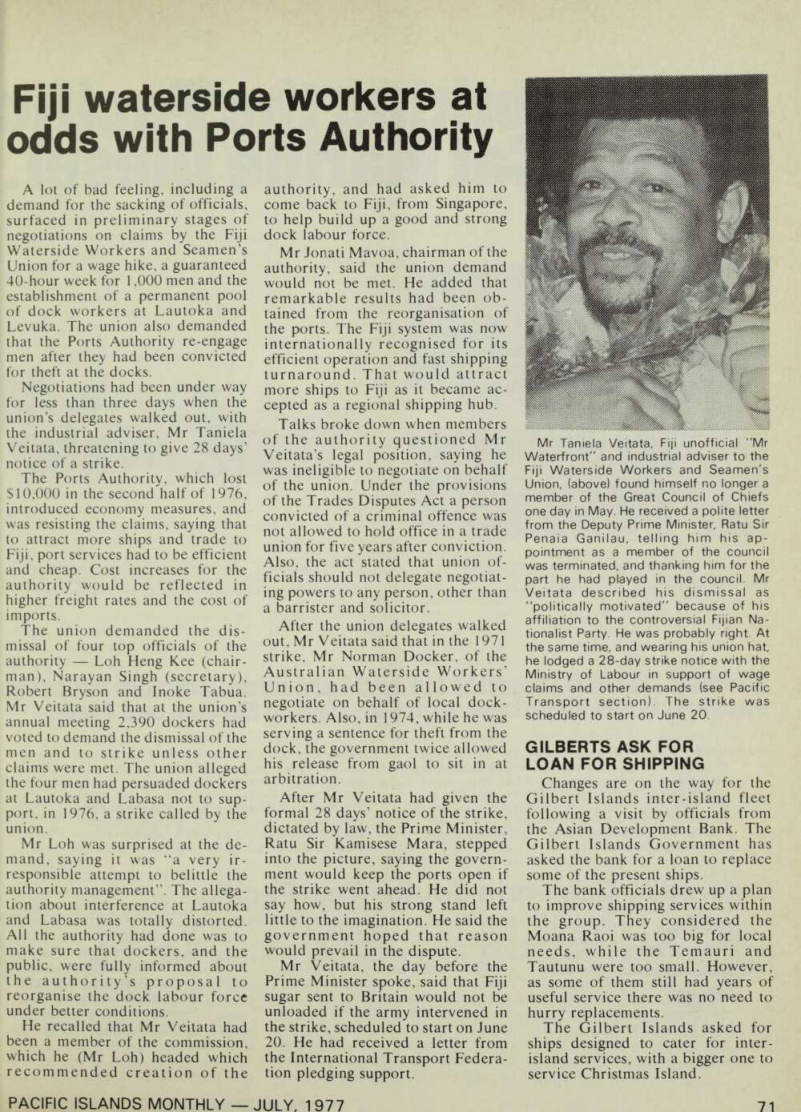
Mr Taniela Veitata, Fiji unofficial "Mr Waterfront" and industrial adviser to the Fiji Waterside Workers and Seamen's Union, (above) found himself no longer a member of the Great Council of Chiefs one day in May. He received a polite letter from the Deputy Prime Minister, Ratu Sir Penaia Ganilau, telling him his ap pointment as a member of the council was terminated, and thanking him for the part he had played in the council. Mr Veitata described his dismissal as "politically motivated" because of his affiliation to the controversial Fijian Na tionalist Party. He was probably right. At the same time, and wearing his union hat, he lodged a 28-day strike notice with the Ministry of Labour in support of wage claims and other demands (see Pacific Transport section). The strike was scheduled to start on June 20.