challenges the Pacific fortress
pp. 65-68 · Read in the full issue

Pacific Transport
Once again Continental Airlines challenges the Pacific fortress
By John Stackhouse
Once more Qantas, Pan American and Air New Zealand are manning the barricades in the South Pacific.
Once more there is a challenger to the hold that the three airlines main tain on what must by now be one of the world’s truly-profitable air routes.
And once more for the third time the would-be challenger is Continental Airlines, the US domestic carrier that has estab lished a foothold in Micronesia and still harbours strong Pacific ambi tions.
If you feel you’ve heard all this before, you’re dead right. In fact, it began back in 1965 when the US Civil Aeronautics Bureau con ducted the Trans-Pacific case. The CAB fell there was inadequate market development in the Pacific and inadequate US flag carrier com petition.
The CAB obviously agreed with this because it nominated Con tinental. then a brash Texas oriented carrier, to run the service.
President Johnson (the President has the right of approval or veto of air rights assignments) confirmed Continental, which wasn’t altogether surprising because the airline which Bob Six ran had as sociations with the Texas estab lishment which was LBJ's original power base.
LBJ stepped down, however, and President Nixon reversed his pre decessor's decision and awarded the route to American Airlines.
The theory was that American would develop the midwest and eastern markets to the Pacific, but, in the event, it turned out that the giant carrier had little expertise in foreign, long-haul multi-stage op erations and lost a packet.
There is a footnote here. The Pacific route was only one of the areas that American stumbled in.
The airline was also shaken by a kick-back scandal involving its
house publications and indicted for making illegal campaign con tributions —to President Nixon’s funds. Some of the money turned up in the Watergate mess and all in all American can hardly be blamed for wanting to get shot of the Pacific.
It agreed to swap the routes for some that Pan Am held in the Carib bean (one of American’s stranger actions was to manage Caribbean and Pacific services in the same division). The US authorities agreed to the exchange but only on the condition that a new hearing was held.
This is where we came in.
In the hearings earlier this year.
Continental emphasised the problems that lack of competition had caused. The airline’s able Washington lawyers made three points: • Pan Am is doing a “wholly in adequate job” of developing the tourist potential of American Samoa. • With the withdrawal of Ameri cal Airlines and British Airways from the Pacific, competition had declined, leading to a situation where “fares are among the highest in the world” and “market promo tion tends to be focused on the gate way cities”. • Pan Am is seriously out scheduled and out-carried. US flag share has dropped from 49.3% in 1971 to 33.3% in 1974 slightly above Pan Am’s all-time low of 31.2% in 1965.
The inference of this is that a sec ond US carrier and specifically Continental —will do more to boost Islands' tourism and step up the US market share.
The positive side of Continental’s case was that it serves cities that already account for 80% of the US- South Pacific traffic: it plans daylight schedules using wide bodies: it proposes a comprehensive marketing programme and it is com
mined to assist in the development of hotels and tourist facilities.
Qantas and Pan Am (taking an Australian view of the challenge) oppose the application on the classic capacity argument. They say the market cannot support more capaci ty and if a new airline comes on. everybody will lose.
Air New Zealand is presumably saying the same thing in NZ.
The upshot is that Australian Transport Minister Peter Nixon and according to some well-sourced reports even Prime Minister Malcolm Fraser will lobby against Continental in the White House with President Carter.
The new president still has to ap prove the CAB recommendation.
It would be a pity, however, to see unthinking protectionism carry the day, with no questions being asked as to whether the interests of Australia necessarily are those of Qantas.
The Australian Tourism Com mission, for instance, has just sent a “task force” to the States, following up a similar one last year.
US visitors, the ATC reports, were up 17.5% to 75,688 in 1976 and the market forecasters are tip ping a rise to a total of more than 100,000 this year.
The ATC tends to support the Continental marketing submission.
It says promotion can be targeted to specific audiences, either those in higher income groups or those with particular interests.
A case in point, the ATC team re ported. is a growing interest in Australia by a firm which markets homosexual tours. Apparently gay groups are a big market already and
growing.
The ATC’s general manager.
Kevin McDonald, won’t be drawn on specific airline cases, however.
But he does favour increased pro
motion and lower fare packages to expand the market.
The ATC and its private en terprise task force members are somewhat turned off by the start of the Qantas campaign against Con tinental. This compared the cost of a cheap US tour against the top of the market Australian one to show Australia just couldn’t compete. The ATC team maintains the visitor to Australia is usually a North American (Canadians form a big part of the market) who incor porates both Australia and New Zealand in a South Pacific tour, generally picking up either Fiji or Tahiti on the way out and NZ and Australia at the southern end.
The typical South Pacific visitor, members say, has visited Europe often several times, knows what he or she wants and is prepared to pay for it.
Indications are that Continental plans an initial four DC 10 services weekly to Sydney and three a week to Auckland. The aeroplanes are medium range DC 10-10 s, not the long range version that Air NZ uses.
This means that flights must call at Pago Pago and Nadi and promo tion of these intermediate points and development of the tourism market is essential for Continental’s viabili ty (if it gets the nod from President Carter).
Pan Am and Qantas, with their non-stoppers are creaming off the lion’s share of the business at pre sent, market sources say. Although there has been something of a slide in passenger numbers in the first months of this year revenue is hold ing up because of the full-fare (often first class) nature of this market.
There is no doubt Continental faces a savage battle if it is to come on to the Pacific and make a profit.
But that’s the worry Continental’s management and shareholders face.
The evidence suggests that the Pacific could do with more promo tion and service and if Continental is prepared to risk its shirt, well ... over to President Carter.
Visiting Sydney late in May, Pan Am’s top man in the Pacific, regional vice-president Ed Swofford, outlined Pan Am market ing plans which effectively stake out the high ground of Pacific routes.
The US airline plans to step up to five its long-range Boeing 7475 P flights a week, all of which will go from Sydney to Los Angeles; two via
Auckland. This will take SP depar tures from New Zealand to three.
Added to this will be four whistle stop 747 jumbos out of Sydney and three out of Auckland.
The tactic is to provide both fre quency and attractive long-range
flights.
“In its evidence before CAB.
Continental claimed Pan Am wasn’t competitive,” Swofford said. “We want to show them we are.’
He also predicted huge losses for Continental if it starts operating probably even more than the SUS 32 millioh American admitted to los ing on the South Pacific.
PlM’s aviation correspondent adds this report: Mr William T. Seawell, chairman of Pan Am, described the CAB deci sion as “unsound and destructive”.
Should President Carter endorse the CAB decision there will be six car riers operating between the American west coast and the South Pacific. The other five are Pan Am, Qantas, UTA, Air New Zealand and Canadian Pacific Airlines.
Mr Seawell forecast that approval for Continental to fly to the South Pacific would bring in its wake im position of frequency restrictions by the Australian and New Zealand governments. Mr Seawell did not say so, but in a rationalisation of services by two US carriers, Pan Am would lose out on the number of flights it operates to the South Pacific.
Continental could claim, with Some justification, that it is entitled to the South Pacific route. In 1968, it passed barriers all the way to the White House, when President Johnson granted qualified approval.
'The presidential election changed all that. Mr Nixon won the 1968 election and in taking office in 1969 rescinded the qualified approval, and granted rights to American Airlines to fly the route from St Louis.
Fiji is prepared to grant landing rights to Continental, even though it would have liked to see Hawaiian Airlines on the route. Fiji had advis ed the CAB it preferred Hawaiian because the airline intended that its flights should terminate at Nandi, as well as arriving in daylight. Con tinental flights through Nadi are ex pected to be at night.
Air Niugini
Pilots’ Dispute
Air Niugini sacked all its 89 pilots on May 18 and reinstated them the same day. The pilots staged a four hour stopwork meeting after being warned not to do so, to discuss superannuation conditions and a training scheme for pilots flying Boeing 7075.
Mr C. B. Grey, general manager of Air Niugini, said there were many pilots wanting jobs who could re place the dismissed men. Fifty Australians were among those sack ed.
Qantas offered to pick up about 150 stranded Australian tourists, in cluding 36 children, but this was re jected.
The PNG Government, Air Niugini and pilots got together and reached an agreement under which the pilots were reinstated.
Stern Words After
Fiji Ship Stranding
Bligh Ltd, owners of the Fiji in ter-island trader. Ika Vuka, the ship’s master, Captain Waqa Qiokata and the mate, Thomas Michael Rouden, were all under fire in a finding by a Fiji Marine Court of Inquiry into the stranding of the ship on a reef in Toberua Passage, off Viti Levu, in February. The president of the court, Mr Kenneth Moore, a magistrate, said Captain Qiokata was guilty of incompetence, and suspended his master’s ticket for a year.
The mate was reprimanded and the owners were described as “dilatory and casual”.
Mr Moore said Captain Qiokata had failed to set a proper course for his ship, he had failed to act com petently after getting a warning from
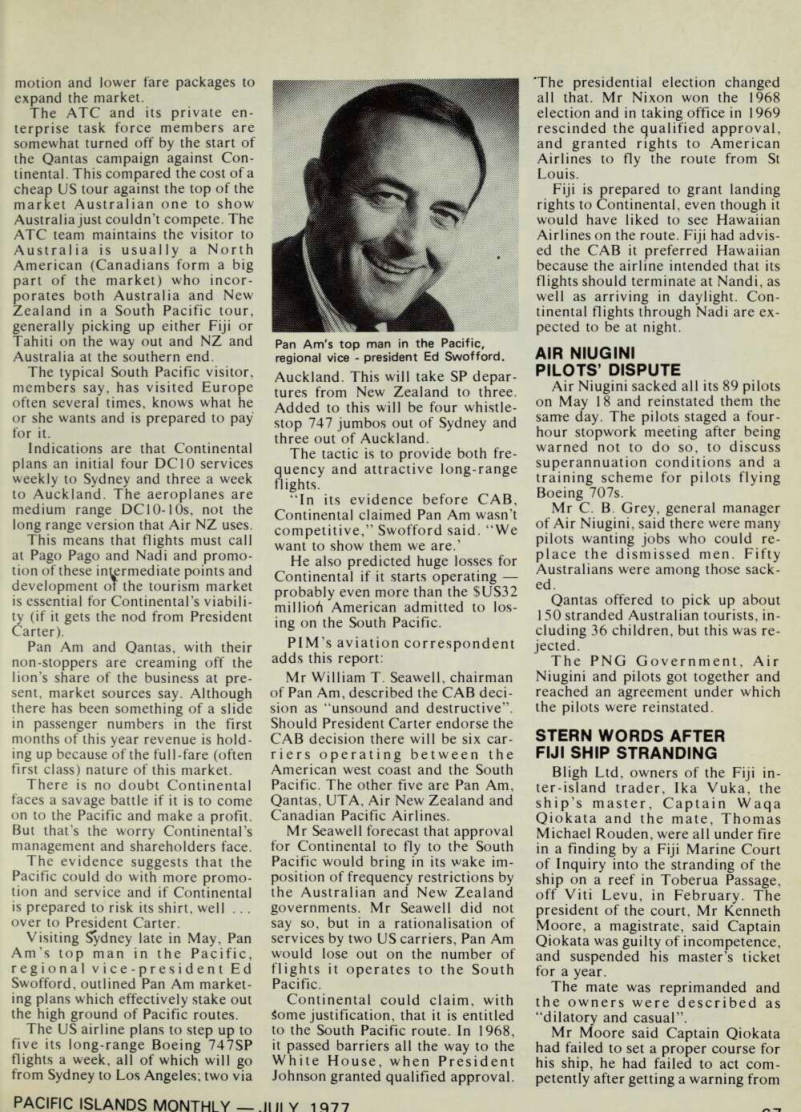
Pan Am's top man in the Pacific, regional vice - president Ed Swofford.
the mate just before the grounding, and failed to see that navigational equipment normally carried by the ship was on board.
The captain and the mate had been appointed to the Ika Vuka at short notice for one voyage. Captain Qiokata’s taking charge had been most causal; there was no proper handing over. There were no log en tries.
He had left Suva with nothing but a compass, a list of lighthouses, and 13 years’ experience. He had been “lethargic and dilatory” after he was told at 4 am that the ship was off course and that an expected light had not been sighted. He had not taken the action that would have been expected.
Mr Rouden had been concerned about the ship’s safety and had felt that the course had been “erroneous and dangerous”. After a check he had twice altered course, but had failed to advise the captain.
While it might be difficult for a mate to tell a captain he was wrong, he had a duty to ensure the safety of passengers and crew, Mr Moore said. The mate deserved a rep rimand for failing to make a more forceful impression on the captain that a dangerous course was being followed.
The Ika Vuka, a motor-sailer, op erated between Suva and Savusavu.
She was holed after she hit the reef and later sank. However, a salvage team refloated her and she was tow ed to Suva for repairs.
Png Organises
Container Service
A new stevedoring consortium has been formed in Papua New Guinea to handle .the three con tainer ships which will be phased into the Australia-PNG service, starting in July.
The consortium will operate in Port Moresby, Lae, Rabaul and Madang, handling cargo for the in tegrated service to be operated by the New Guinea Australia Line,
PNG Shipping Corporation and
Conpac (Australia West Pacific Line). It will be responsible for both the ship container exchange, and terminal freight station operations.
Steamships Trading Co Ltd will manage the stevedoring in Port Moresby and Madang, and Burns Philp at Lae and Rabaul.