Intrepid was the word for ‘Eka’
pp. 52-53 · Read in the full issue
author of ‘At home in Fiji’
By Jane Gregor
Funny thing, chance, isn’t it?
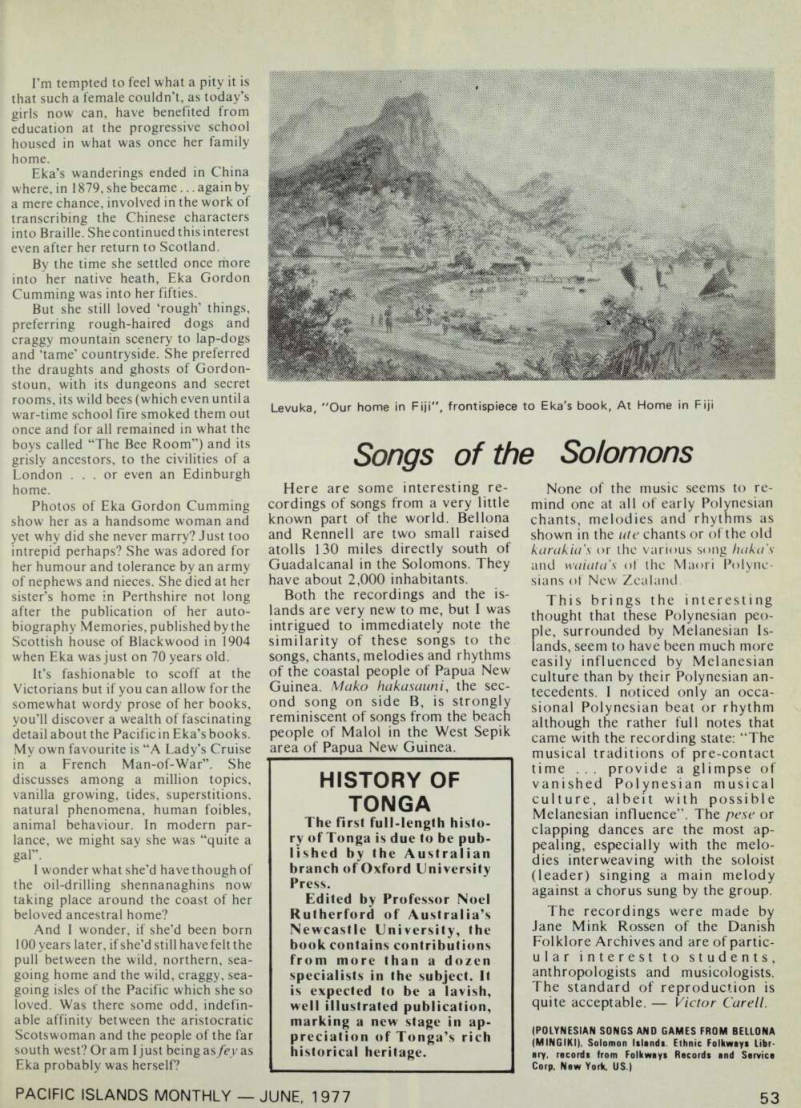
During my stay in Fiji naturally I read C. F. Gordon Cumming’s classic At Home in Fiji. But I didn’t really think about the author. Since I’ve returned home to Scotland I’ve just stumbled across the fact that she was, in fact, an intrepid aristocrat ... a pioneer, indeed, who still rates sizeable entries in the literary reference books.
Furthermore, her ancestral home ‘way up in the far north of Scotland, is now none other than that famous school where royalty educatesitssons . . . name of Gordonstoun. This school, famous for its emphasis on self discipline, adventurousness and service to others, was founded just before World War Two by Dr Kurt Hahn, an Austrian refugee from the Nazi regime.
I wonder what chance wind blew him to that remote corner, to the ancient stronghold of the Gordon family? Strange, isn’t it, that a man of such high principles and ascetic ideals should have landed in a place from where, almost 100 years earlier, a young woman of very similar nature, set out to travel to remotest Fiji?
Indeed, when asked where she’d most like to journey, Eka Gordon Gumming had said, jokingly . . . “Oh, somewhere no-one knows, like ... like Fiji.” For in those Victorian days Fiji sounded as remote to most people as outer space does to us today.
To a well-brought-up lady surrounded by a large (16 brothersand sisters) and loving family on a quiet estate in northern Scotland even London was a strange place, a very long way away. But Constance Frederica, whose forebears linked her with the early rulers of Scotland was a great pet of her father, the clan chieftain, and a tomboy on a par with her wild, energetic brothers. With them she tramped the heather, climbed trees, swam, rowed, shot and fished.
Sir William, her father, made sure she was well-read and as she grew, developed a particular facility for painting and for writing.
By the time Eka was a teenager
some of her elder brothers and sisters had dispersed around the globe, going into the Indian Army, coconut planting in Ceylon or lion hunting in South Africa. So she grew up accustomed to hearing travellers’tales.
But not until she was 31 did she start her own travels which later led to a series of travel books and a positive spate of articles in magazines such as Blackwood’s and the Atlantic Monthly.
By this time Eka was very much alone in the world. Her mother, father and three of her favourite brothers had died in tragic and dramatic circum stances. Although contemporary portraits show her as a good-looking woman with a pleasant, gentle expression, she had not married. And so, when a married sister asked her to go with her to join a soldier husband in India, Eka set off with a high heart in November 1868.
From then on there was no stopping her. Although Gordonstoun remained very dear to her, Eka noted in her first travel book, “Avoid returning to our British Isles in February or any other bleak wintry month!” And was soon
off again, this time for two years with old friends, in Ceylon.
Shortly after her return (and the publication of another travel book illustrated by the author, of course).
Sir Arthur Hamilton Gordon (a distant relative), was appointed Fiji’s first governor; who more natural to be asked to accompany Lady Gordon, as companion and governess to the young Gordons, than Eka Gordon Gumming. “Needless to say,” wrote our heroine, “I accepted with delight”.
And so, once more through the Red Sea, of which she wrote, character istically, “I have never once exper ienced the great heat which many find so trying and have always found a dress of navy serge and pilot-cloth jacket the most comfortable clothing.” This from a woman, who growing up in the Scottish Highlands, wore muslin dresses in May and notes how the climate has changed since she was young.
Singapore, Sydney, Fiji, New Zealand. As the years passed, Eka circled the globe often spending years in a new place. America, Japan and finally China were added to her list.
And all the time she wrote letters, she sketched, she painted. Her magazine articles covered such topics as “Wolves and Were-Wolves”, “On Cuttle-Fish as a Dainty Dish”, “Professions for Dogs” and “Alligator Farming”.
Many of her views were symptomatic of her age; that alcohol was a poison was, I suppose, a predictable opinion.
That she should support the “simplicity, cleanliness and the exceeding cheapness” of cremation, such as she had witnessed in Japan, in the face of the British howls of indignation in the 1880 s against such a practice, is less so. But it does show the
open-minded approach of our
Victorian traveller.
Indeed, if you can get through the somewhat long-winded prose of her style of writing, there’s a wealth of information in Miss Gordon Cumming’s books and clear evidence of a disciplined, inquiring and original mind.
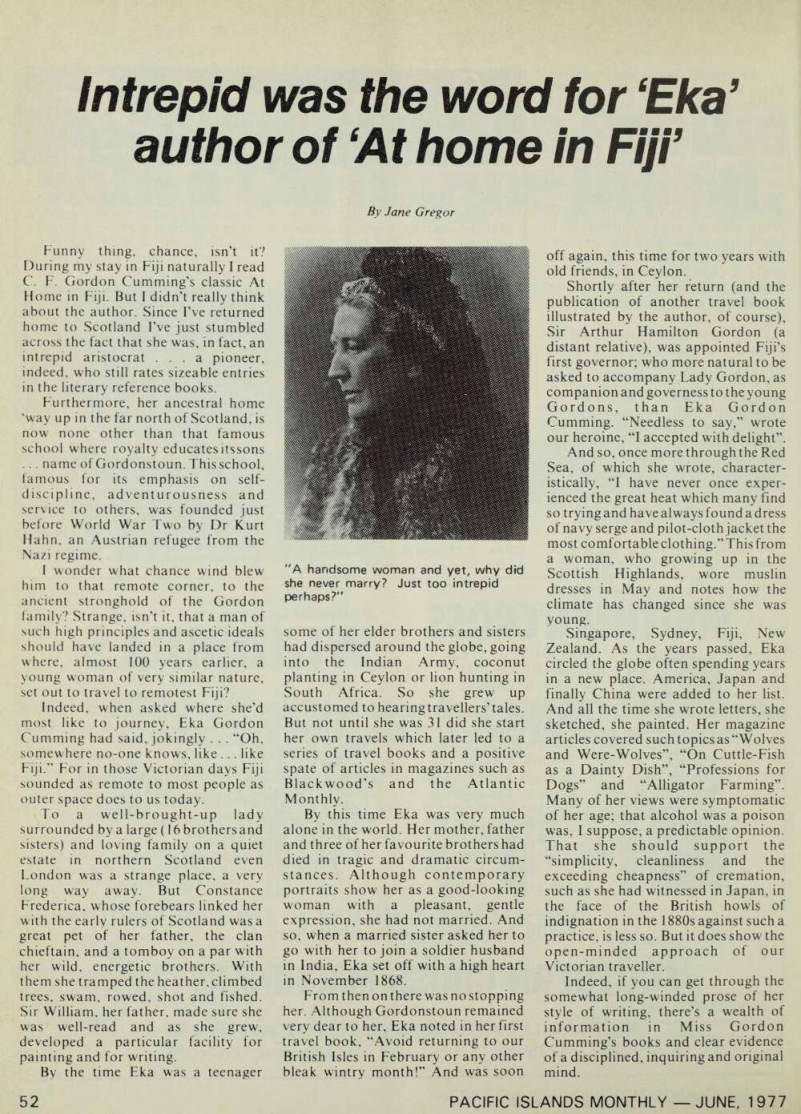
"A handsome woman and yet, why did she never marry? Just too intrepid perhaps?"
I’m tempted to feel what a pity it is that such a female couldn’t, as today’s girls now can, have benefited from education at the progressive school housed in what was once her family home.
Eka’s wanderings ended in China where, in 1879, she became ... again by a mere chance, involved in the work of transcribing the Chinese characters into Braille. Shecontinued this interest even after her return to Scotland.
By the time she settled once more into her native heath, Eka Gordon Cumming was into her fifties.
But she still loved ‘rough’ things,
preferring rough-haired dogs and
craggy mountain scenery to lap-dogs and ‘tame’ countryside. She preferred the draughts and ghosts of Gordon stoun, with its dungeons and secret rooms, its wild bees (which even until a war-time school fire smoked them out once and for all remained in what the boys called “The Bee Room”) and its grisly ancestors, to the civilities of a London ... or even an Edinburgh home.
Photos of Eka Gordon Cumming show her as a handsome woman and yet why did she never marry? Just too intrepid perhaps? She was adored for her humour and tolerance by an army of nephews and nieces. She died at her sister’s home in Perthshire not long after the publication of her auto biography Memories, published by the Scottish house of Blackwood in 1904 when Eka was just on 70 years old.
It’s fashionable to scoff at the Victorians but if you can allow for the somewhat wordy prose of her books, you’ll discover a wealth of fascinating detail about the Pacific in Eka’s books.
My own favourite is “A Lady’s Cruise in a French Man-of-War”. She discusses among a million topics, vanilla growing, tides, superstitions, natural phenomena, human foibles, animal behaviour. In modern par lance, we might say she was “quite a gal”.
I wonder what she’d have though of the oil-drilling shennanaghins now taking place around the coast of her beloved ancestral home?
And I wonder, if she’d been born 100 years later, if she’d still have felt the pull between the wild, northern, sea going home and the wild, craggy, sea going isles of the Pacific which she so loved. Was there some odd, indefin able affinity between the aristocratic Scotswoman and the people of the far south west? Oram I just being as fey as Eka probably was herself?