A ‘sympathetic’
pp. 49-51 · Read in the full issue
look at Karkar Island and its cargo cult
Books by anthropologists are fre quenty unreadable to other than fellow-members of that fraternity.
This is a book by an anthropologist, but it is not couched for the most part in the formidable jargon of the profession.
It is a scholarly work, certainly, but clearly written and sympathetic, a study of the people of Karkar Island, their social and intellectual system and the history of their con tact with the European.
There is, naturally enough, material which will appeal mainly to anthropologists, but the bulk of the book will repay the reader with an intelligent interest in the affairs of Papua New Guinea.
Those who have been fortunate enough to visit the beautiful island of Karkar in the Madang Province will recollect the tranquility of the place and the attractive nature of the people.
While other parts of PNG, have, over the years, provided sensational stories and lurid headlines for Australian newspaper readers, one cannot recollect any mention of Karkar Island and it is probably excusable to imagine that the people have been happy with their lot and content to go along with the tremen dous social, political and economic changes of the post-war years. A stu dy of Dr McSwain’s book will quickly correct this view.
The Karkar people, like the rest of the population of the central Madang Province, were exposed to the impact of Western culture from 1885. Three distinct agents of contact, planters, missions and ad ministrations, each made their own impression upon the people. The Lutherans began their work on Karkar in 1890 and the Catholics in 1930.
There were eight successive ad ministrations the German New Guinea Company, the Imperial Ger man Administration, the Australian military government of the Great
War, the Australian mandate administration, ANGAU, the Japanese briefly, the post-war provisional administration and the civil administration that led to the present state of independence. Planters were there from the earliest times.
The pace of development on Karkar, and indeed the rest of Papua New Guinea in the years before the Pacific war, was leisurely. the emphasis in the Mandated Territory being on economic development (in which the people played little part, except for the vital provision of their labour) and in Papua on the protection of the people, through the paternal policies of Sir Hubert Murray.
The picture changed dramatically with the introduction of the new policies of the post-war Australian administration and the increasing emphasis on education, native economic development, local government and political progress.
When one considers the complex historical influences that have work-
Books
ed on the Karkar people over so short a span of time, it hardly seems surprising that the doctrines of the Madang coast Messiah, Yali. made an immediate impact on them, and cargo cult outbreaks occurred on the peaceful island of Karkar.
Dr McSwain’s treatment of the whole cargo cult issue and its effect on the Karkar Islanders is to me the most fascinating part of her book It is no news to past and present Euro pean residents of Papua New Guinea that Australians in general know nothing of and care little about the country, but there would be few who would not recognise the term cargo cult’ for its bids fair to become a part of our language.
Hitherto, most anthropologists and administrators have argued that cargo beliefs must inevitably give way before economic, social and political progress. Professor Peter Lawrence, author of the most widely-known work on cargo cull.
Road Belong Cargo, who con tributes a most illuminating preface
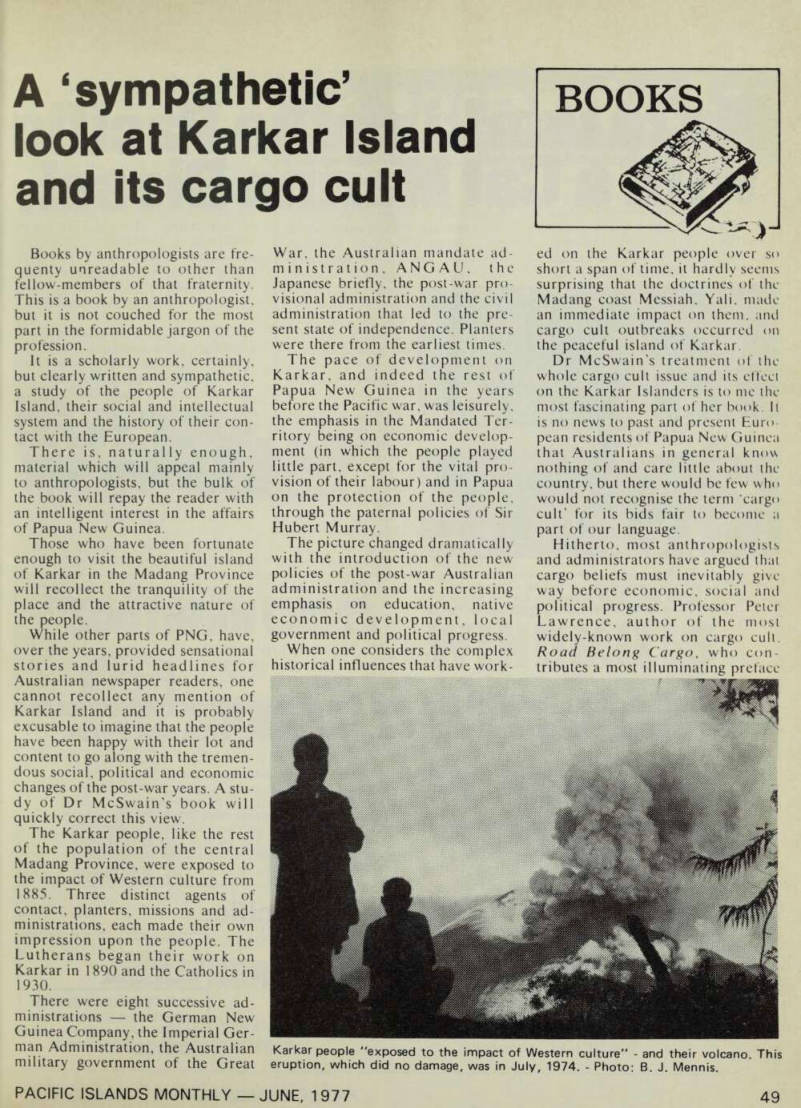
Karkar people "exposed to the impact of Western culture"-and their volcano. This eruption, which did no damage, was in July, 1974. Photo: B. J. Mennis.
to the present book and Professor Peter Worsley, author of the equally authoritative The Trumpets Shall Sound, are of this belief.
But in Karkar, as Lawrence states, Dr McSwain has ‘shown convinc ingly that the cargo belief can coex ist with a fair measure of economic and sociopolitical development: tra ditional and modern institutions op erate side-by-side, sometimes in harmony, sometimes in conflict’.
Her work, Lawrence believes, has made a signal contribution to the study of the cargo cult phenomenon.
It certainly makes convincing read ing.
I was interested to note that Dr McSwain departed from orthodox anthropological practice by employ ing that once-despised lingua fran ca, Pidgin English, to gather her in formation in the field instead of learning the local language. How times change. The official language of parliament in Papua New Guinea is English, but in reality it is Pidgin and Police Motu which allows the commerce of daily life to proceed.
Pidgin is becoming positively re spectable.
A book, then, that is warmly re commended The orice is high but it
is well produced with the normal features of a significant study notes, bibliography, index, maps, tables, figures but. unfortunately, no
maps. James Sinclair
(THE PAST AND FUTURE PEOPLE: Tradition and changa on a Now Guinea island. By Romola McSwain. Puklishad by Oxford University Prats.