for old-time gold-seekers
pp. 63-67 · Read in the full issue

PNG as one of the last havens for old-time gold-seekers
Books
Although Hank Nelson’s Black, White & Gold claims to be the histo ry of goldmining in Papua New Guinea it, in fact, concentrates almost entirely on the early history of the industry in the old territory of Papua, devoting less than 20 pages to PNG’s most prolific Morobe field.
There are, no doubt, several reasons for this but it is a pity that the author didn’t carry the job on until the outbreak of the Pacific War instead of making 1930 the cut-off point. Mining in the old sense never got going again in the post-war
period.
But apart from this shortfall at the New Guinea end, this is the most comprehensive survey yet of early goldmining and goldminers and the effect they had on the indigenous people who were caught up in the in dustry. The author has done a good job of research and has put together a mass of material that otherwise re mains buried in archives and institu tions all over Australia and PNG.
Individuals have written about individual PNG goldfields but Nelson’s wider angle puts PNG into context with that 19th century phenomenon the great gold rushes that began in California in 1848 and girdled the world in the following 80 years.
PNG was one of the last havens for old-time prospectors but the earliest of them had gone there from the Palmer goldfield inland from Cooktown, Queensland, and were frequently graduates of even earlier strikes. Such stalwarts in PNG min ing as Matt Crowe and Shark-eye Park were veterans of Coolgardie- Kalgoorlie, West Australia, and the Yukon.
The first goldfield in Papua was on Sudest, the largest of the Louisiade Islands, perhaps because of its geographical position. As the name implies it is in the extreme SE of what had become a British Pro tectorate in 1884. Virtually all the early navigators had been that way although few of these had landed and the islanders had been in con tact with foreigners from early in the
Australian colonial period. Royal Navy surveyors, traders, whalers, pearlers and, at a later stage, labour recruiters for the Queensland canefields, all made their presence felt and relationships with the Louisiade Islanders varied from ac ceptance through armed neutrality to open hostility.
In 1888, Captain David Whyte, master of a pearler, reported finding gold-bearing reef on Pana Tinani, the island at the SE end of the Calvados Chain. At his home port of Cooktown, local businessmen financed an expedition consisting of Whyte and nine prospectors and they set off in May that year, found nothing except hungry quartz on Pana Tinani but crossed to Sudest
and by August had recovered 142 ounces of alluvial gold.
The news electrified Cooktown and by the end of 1888 about 400 miners were in Sudest or were pre paring to go there. In view of past
history, relationships between the
1,000 indigenous inhabitants of Sudest and the miners were reasona ble. The Sudest were anxious for European goods and prepared to work as carriers in order to get them. A number even worked on miners’ claims although some of the miners found the idea abhorrent, even unethical, having been nur tured on the tough Australian idea that a man worked his own claim or perhaps “two men’s ground’’ with a mate. A team of natives at the sluice boxes while the miner merely super vised proceedings, was contrary to previous mining lore.
It was an attitude that soon disap peared in PNG and so far as the Sudest labourers were concerned they soon woke up to the fact that they would be far better off working claims of their own. This did not please the white miners either but the only real trouble occurred when an old miner was killed by a disap-
pointed supplier of sweet-potatoes who thought he’d been swindled.
Sudest gave up its richest gold within two years and made no one wealthy. By 1890 only 40 white miners were left there and soon even these were gone, leaving what gold remained to the local people who continued to scratch over the field right up to the beginning of the Pacific War.
Even at the end of 1888, it was clear that Sudest was not going to support the number of Australian miners who were heading that way from Cooktown. Fearing that they would disperse in unsupervised fashion all over the Islands, Dr MacGregor, then Lieut-Governor of the territory, put the government schooner at the disposal of a prospecting party which scoured most of the larger islands and found prospects on Misima, NNW of Sudest.
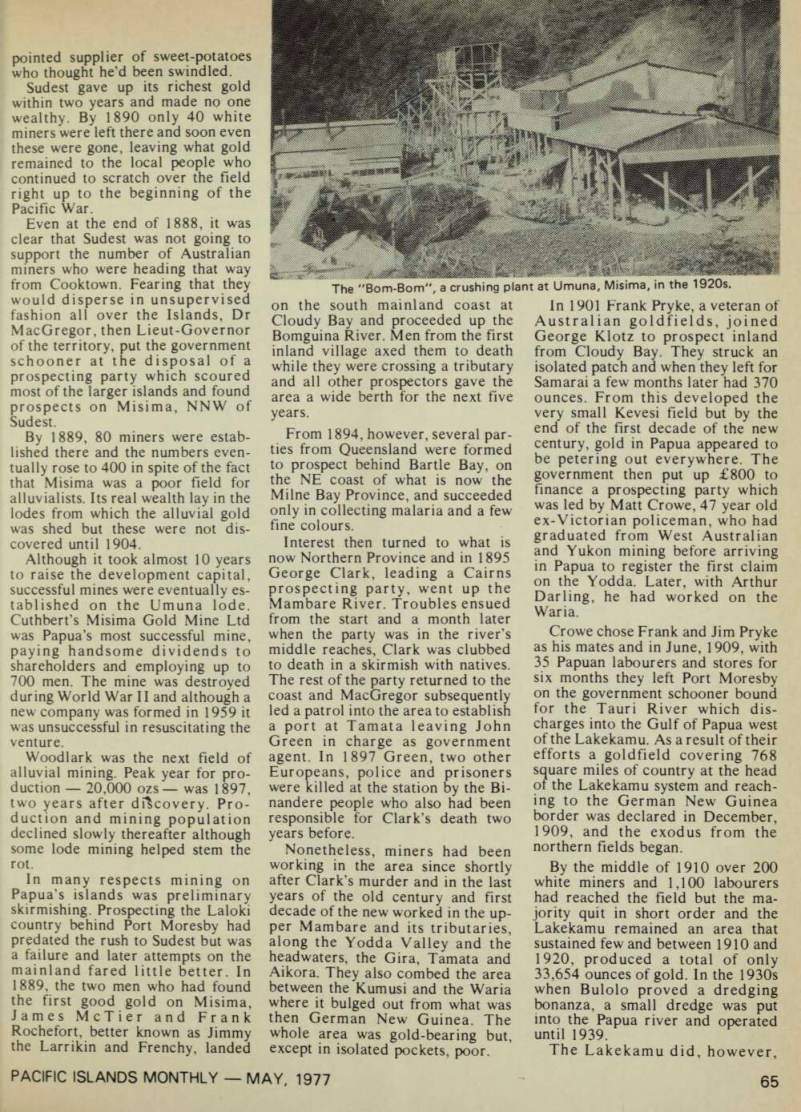
By 1889, 80 miners were estab lished there and the numbers even tually rose to 400 in spite of the fact that Misima was a poor field for alluvialists. Its real wealth lay in the lodes from which the alluvial gold was shed but these were not dis covered until 1904.
Although it took almost 10 years to raise the development capital, successful mines were eventually es tablished on the Umuna lode.
Cuthbert’s Misima Gold Mine Ltd was Papua’s most successful mine, paying handsome dividends to shareholders and employing up to 700 men. The mine was destroyed during World War II and although a new company was formed in 1959 it was unsuccessful in resuscitating the venture.
Woodlark was the next field of alluvial mining. Peak year for pro duction 20,000 ozs— was 1897, two years after discovery. Pro duction and mining population declined slowly thereafter although some lode mining helped stem the rot.
In many respects mining on Papua’s islands was preliminary skirmishing. Prospecting the Laloki country behind Port Moresby had predated the rush to Sudest but was a failure and later attempts on the mainland fared little better. In 1889, the two men who had found the first good gold on Misima, James McTier and Frank Rochefort, better known as Jimmy the Larrikin and Frenchy, landed
on the south mainland coast at Cloudy Bay and proceeded up the Bomguina River. Men from the first inland village axed them to death while they were crossing a tributary and all other prospectors gave the area a wide berth for the next five years.
From 1894, however, several par ties from Queensland were formed to prospect behind Bartle Bay, on the NE coast of what is now the Milne Bay Province, and succeeded only in collecting malaria and a few fine colours.
Interest then turned to what is now Northern Province and in 1895 George Clark, leading a Cairns prospecting party, went up the Mambare River. Troubles ensued from the start and a month later when the party was in the river’s middle reaches, Clark was clubbed to death in a skirmish with natives.
The rest of the party returned to the coast and MacGregor subsequently led a patrol into the area to establish a port at Tamata leaving John Green in charge as government agent. In 1897 Green, two other Europeans, police and prisoners were killed at the station by the Bi nandere people who also had been responsible for Clark’s death two years before.
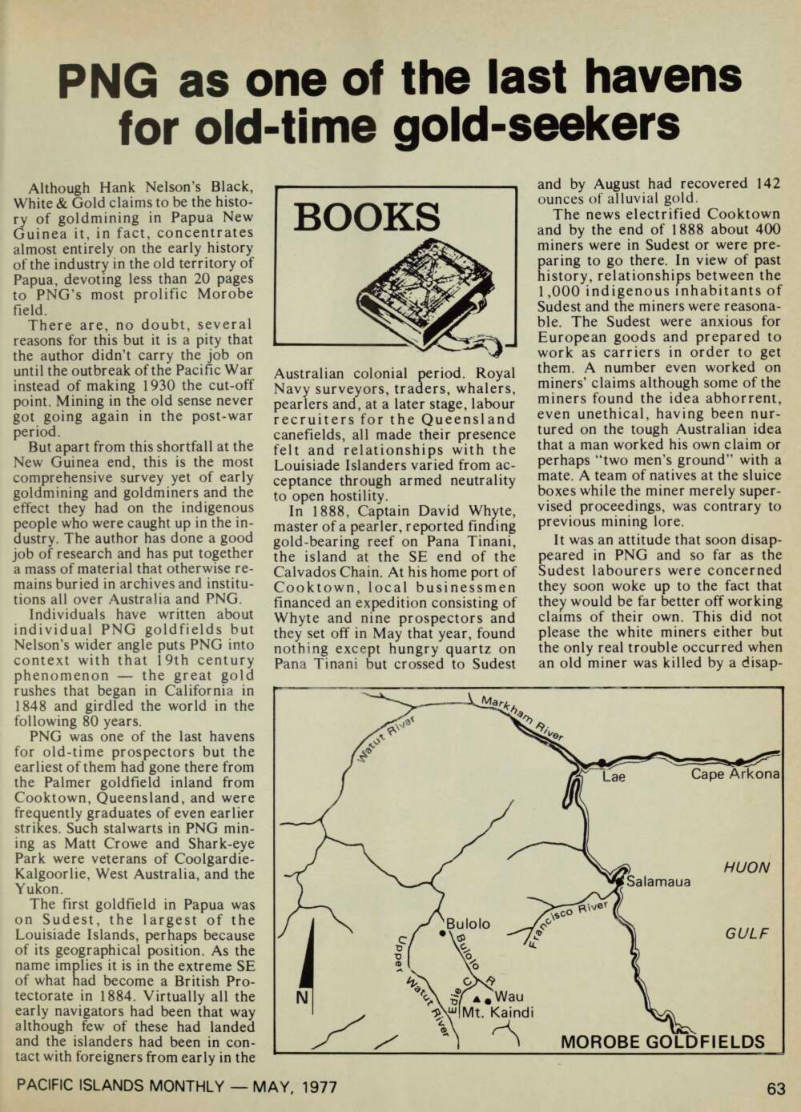
Nonetheless, miners had been working in the area since shortly after Clark’s murder and in the last years of the old century and first decade of the new worked in the up per Mambare and its tributaries, along the Yodda Valley and the headwaters, the Gira, Tamata and Aikora. They also combed the area between the Kumusi and the Waria where it bulged out from what was then German New Guinea. The whole area was gold-bearing but, except in isolated pockets, poor.
In 1901 Frank Pryke, a veteran of Australian goldfields, joined George Klotz to prospect inland from Cloudy Bay. They struck an isolated patch and when they left for Samarai a few months later had 370 ounces. From this developed the very small Kevesi field but by the end of the first decade of the new century, gold in Papua appeared to be petering out everywhere. The government then put up £BOO to finance a prospecting party which was led by Matt Crowe, 47 year old ex-Victorian policeman, who had graduated from West Australian and Yukon mining before arriving in Papua to register the first claim on the Yodda. Later, with Arthur Darling, he had worked on the Waria.
Crowe chose Frank and Jim Pryke as his mates and in June, 1909, with 35 Papuan labourers and stores for six months they left Port Moresby on the government schooner bound for the Tauri River which dis charges into the Gulf of Papua west of the Lakekamu. As a result of their efforts a goldfield covering 768 square miles of country at the head of the Lakekamu system and reach ing to the German New Guinea border was declared in December, 1909, and the exodus from the northern fields began.
By the middle of 1910 over 200 white miners and 1,100 labourers had reached the field but the ma jority quit in short order and the Lakekamu remained an area that sustained few and between 1910 and 1920, produced a total of only 33,654 ounces of gold. In the 1930 s when Bulolo proved a dredging bonanza, a small dredge was put into the Papua river and operated until 1939.
The Lakekamu did, however,
The "Bom-Bom", a crushing plant at Umuna, Misima, in the 1920s.
maintain the men who were to even tually open up the rich Morobe field on the other side of the mountains and which had tantalised ex perienced miners from the time they first entered Yodda, Gira and Lakekamu fields. They were pre vented from putting their idea to the test, firstly, by the impossibility of maintaining supply lines in country virtually untouched by Europeans and peopled by hostile natives and, secondly, by tne fact that the Ger man administration was determined to keep mineral rights out of foreign hands although right up to the end of their period in NG they had done little in the way of gold search and nothing in the way of exploitation.
According to Nelson, Frank Pryke, at one time, considered becoming a naturalised German in order to explore the Watut- Markham country but, generally, a state of stalemate prevailed while men washed a bare living from the creeks and rivers that fed the Lakekamu.
Among those who did more than theorise about the gold beyond the German border was Arthur Darling who, in late 1909, prospected the Markham and Watut until forced to retreat through lack of food, malaria and a spear wound. He died as a result of these experiences in 1911.
In 1912 a party consisting of Matt Crowe, William (Shark-eye) Park, James Preston and Edward Auer bach prospected the Markham but their only discovery was to confirm the fierceness of the local natives.
There have been suggestions that Preston returned to the area in 1914 and that Darling or Preston actually washed good gold at what was later Koranga Creek but this had never been confirmed.
Although an Australian ex peditionary force took over German New Guinea in 1914, a Mandate from the League of Nations did not come into force until 1921 and two more years went by before a mining ordinance came into effect and Australian diggers could legally op erate.
It was found that two men had jumped the gun and had been wash ing gold at Koranga Creek which ran into the Upper Bulolo before it plunges into a gorge. They were Shark-eye Park, who had got his first sniff of the country 10 years before and John Nettleton, an ex-
member of the expeditionary force who had returned to set up a trade store on the Huon Gulf. He left the store in someone else’s care and joined Park in 1922. In 1923, they emerged to register their claims and bring out the gold they had accumu lated from a year’s work. It was more than could have been expected from several lifetimes on Yodda or Lakekamu.
In spite of this, no rush developed, partly because the ranks of Papua’s prospectors had been thinned in the war years, partly because of the remoteness and difficulty of the country at the head of the Bulolo.
Some old stalwarts of the Papuan fields who had been battling from one miserable creek to another for 20 years, including Frank Pryke, Les Joubert, Joe Sloane and George Arnold, were fairly early arrivals at the new find but even at the end of 1925 the number of men working above Bulolo Gorge could be counted on two hands. It was not un til the discovery of even better gold in the upper reaches of Edie Creek, which joined the Bulolo below the Koranga, that the situation changed.
A rush of sorts began although in comparison with the rushes of California, Australia and the Klon dike, each of which involved scores of thousands of individuals, what occurred in Morobe in the 1920 s was a dawdle not a rush.
At the end of 1926 there were 200-odd miners on the field and in 1932, after air transport had super seded the six days’ agony of the Salamaua-Edie track, and the first dredges were working, miners still numbered less than 500.
Morobe gold was of poor quality and on average brought less than £3 per ounce in the early years but a team could wash out up to 80 ounces a day on Koranga and a claim on the Edie could produce as much in a day as the best Lakekamu claims could in a year.
By the outbreak of World War 11, gold from Morobe was worth over £3 million a year big money in those days. It helped to keep the Territory financially afloat and at no cost to the Australian taxpayer.
It is interesting to speculate on what the old Territory of New Guinea would have been like if the Morobe deposits had not been dis covered until after World War II in stead of after World War I; or what would have happened if the Ger mans, who had been in their Ter ritory since 1 883, has produced prospectors and miners on the same scale as Australia instead of concen trating almost entirely on planters and traders.
In comparison with the detail in which he describes the history of the several Papua fields, Nelson’s chapter on Morobe is brief and fairly superficial, possibly because the big developments in air transportation and large-scale dredging after 1927 are fairly well documented and are, in any event, in a different dimension.
Black, White & Gold is, nonethe less, an excellent account of a phase of PNG history that covered half a century and is never likely to be re peated. The fact that the author has put equal emphasis on the reactions of the indigenous people who were touched by this alien industry pro vides perspective that most other PNG mining accounts lack.
The book is illustrated with some old photographs and line drawings.
There are production and other ta bles and 15 maps which are simple and are adequate for those blessed with good sight. All those who are not are recommended to equip themselves with a good magnifying glass to ease the reading of some of
the place names.
Judy Tudor
(BLACK, WHITE & GOLD. By H. N. Nelson.
Published by Australian National University Press, PO Box 4, Canberra, ACT $8.95 (paper), $16.95 (cloth).)
The last three permanent residents at Edie Creek, from left, George (Scotty Suther land) and Stella and Ned Partridge, pictured in the 1960s. -Photo: M. R. Hayes