New Zealand looks to booming
pp. 59-61 · Read in the full issue
future in Pacific trade
By Allan Parker,
Public Relations and Economic Services Division, New Zealand Manufacturers’ Federation
Economic and social trends indicate that within the next 20 years before the close of this century the Pacific basin will have become the world’s largest trading region. Its potential importance was underlined recently by the release of a detailed report by one of Europe’s most influential banks. West Germany’s Deutsche Bank.
The bank considered the Pacific basin as the region with the greatest growth potential and pointed out that: • already, half the world’s na tional product is created in Pacific basin countries, • these same countries order one third of all world imports; • nearly 40% of the world’s population lives in this region.
The Deutsche Bank report also noted that in the past the countries with the strongest economies (Japan and the United States primarily) had benefited the most. But it expected that all countries in the region could expect to benefit to a much greater degree in the future, particularly
with an increasingly sophisticated
transport system for shipment of foods across the vast Pacific ocean distances involved.
New Zealand, one of the smaller
countries on the rim of the basin, can expect to be included among these as trading has always been the life-blood of the nation.
New Zealand on a per capita basis is in the top league of international traders.
The following comparison on a per capita basis illustrates this; New Zealand SUS2,OOO, Japan
$U51,046, Usa Susi,Ooo, Uk
$U51,750.
New Zealand’s prominence in the region has grown rapidly, spurred by rapid industrial development and a dramatic surge in manufac tured exports to complement its tra ditional agricultural exports.
Over the past decade there has been a significant redirection of NZ’s international trade.
In 1965 58% of all our trade was with Europe this had dropped to 32% by 1975.
In 1965 34% of all trade was with Pacific basin countries this rose to 51% by 1975 with expectation that this rise will continue.
So there has been a virtually com plete switch in markets in the last *lO years.
The importance of New Zealand in the Pacific basin is highlighted by the fact that the Pacific Basin Econ omic Council meeting will be held in Christchurch in May. The theme, appropriately enough, will be in vestment in the Pacific, with emphasis on energy and food.
New Zealand’s interest in the area can be gauged, too, by the number of new trade agreements coming into force between New Zealand and other countries in the Pacific.
There is, of course, the 10-year old New Zealand-Australia Free Trade Agreement (NAFTA) be tween these two Pacific neighbours.
But more recently there have been two new arrangements made with Pacific countries.
The first is SINTESD the
Agreement for Industrial, Tech nological and Scientific Co-op eration which aims to promote co-operation between businessmen in New Zealand and Singapore in making the best and most efficient use of the technological and other resources each possesses.
The agreement has three main provisions: • a framework for the estab lishment in Singapore and New Zea land of joint commercial ventures based on the resources and tech nological expertise of the two coun tries; • a formal basis for joint com mercial enterprises and develop ment projects in third countries of the South-East Asian region; • a formal basis for scientific co operation, confirming and building on the relationship which already exists between New Zealand’s Department of Scientific and Indus trial Research (DSIR) and the Singapore Institute of Standards and Industrial Research (SISIR).
A comparison of two-way trade between the two countries shows the growing importance of the two countries to each other’s economies.
Last year, two-way trade reached SNZI3O million, a 400% growth in just five years. But New Zealand still accounts for only 1% of Singapore’s total trade and Singapore only 1.5% of New Zea land’s trade.
The advantages of agreements such as SINTESD between countries in the region can best be illustrated by pointing out that Singapore is anxious to build up its industrial base and can, in return, offer New Zealand a new market-place and a geographical stepping stone to other markets.
In addition, closer ties between the two countries will be of benefit to New Zealand as the former joins the proposed Association of South-
East Asian Nations (ASEAN) com mon market.
More recently, New Zealand has introduced a Pacific Islands Indus trial Development Scheme which is aimed at providing financial as sistance and incentives for New
Zealand companies developing ap
proved manufacturing operations in
Fiji, Tonga, Western Samoa, the Cook Islands and Niue, with the ob jective of fostering economic development and employment op portunities. (See elsewhere in this issue of PIM.) As has happened with companies in Australia and New Zealand op erating under the NAFTA, so too will SINTESD and PUDS create a greater interdependence of Pacific basin economies.
A measure of this interdepen dence and, in particular. New Zealand’s reliance on the Pacific basin is the fact that in the year ended June 1976, manufactured goods worth $NZ418,177,217 were sent to 22 countries in the Pacific and South-East Asian areas. And that excluded the West Coast of North and South America.
This represented some 55% of New Zealand’s total exports to the same countries of $763,294,794 in the same year.
The biggest market was Australia, which took $217.3 million worth of New Zealand manufactured goods.
And the growing influence of Japan in the region is underlined by the fact that it took $122.25 million worth of New Zealand manufac tures. So over three-quarters of New Zealand’s manufactured goods ex ported into the Pacific were taken by two countries.
At the other end of the scale. New Zealand’s smallest buyer in the area was Fletcher Christian’s haven, Pit cairn Island, which took SNZII,OOO worth of goods from New Zealand
industry.
While New Zealand’s farming produce meat, wool, butter, cheese, etc. will continue to dominate the country’s economy at least until 1980, the sign “Made in New Zealand” will be appearing on more and more shop-shelves in such varied places as Manila, Kuala Lumpur, Tokyo, Sydney and Suva.
New Zealand has long relied on its agriculture to pay for its imports.
The Deutsche Bank report mention ed earlier described this country as “the green island of the South
Pacific”. But it has been this reliance on farm products that has caused the national economy so many problems in the past and not least the current recession as commodity prices around the world have soared and dived.
The country is now realising the need for a more solid base to the economy to even out the fluctua tions in food prices. In the past decade, rapid industrialisation has greatly expanded the country’s ability to counter these violent dips.
This industrial expansion was in itially aimed at import substitution making products in New Zealand that were previously bought from overseas countries and thus saving valuable foreign currency. But more recently, the emphasis has switched to the export of manufactured goods as an earner rather than simply a saver of foreign exchange. The re sults have been remarkable.
In 1965, total exports of manufac tured goods amounted to only SNZ34 million (FOB). By the end of November 1975 this had risen to $383 million an increase of over 1,000 per cent in just 10 years.
In 1976, these exports were worth $612 million, a staggering $229 million (60%) increase over the previous year. Last year’s earnings from manufactured exports were worth 22.4% of New Zealand’s total export earnings of $2,723 million.
A major side-effect of these ex ports is an improvement in quality.
Consumers throughout the Pacific region are becoming more sophisti cated and demanding goods of a correspondingly higher quality.
New Zealand is now in the midst of a massive export drive and it is widely recognised that the country’s manufacturers have the greatest ability to spearhead this growth. In deed, a rapid growth in exports is now one of New Zealand’s top priorities and this has been re cognised by government itself. Last year, the National government’s Minister of Trade and Industry, Mr Lance Adams-Schneider, com menting on the passing of the $5OO million mark for manufactured ex ports in a single year, issued the country’s manufacturers with a special challenge to double that figure in five years in other words, export goods worth $1 billion by 1980.
New Zealand industry is con fident it can reach this landmark and it is hopeful that its exports will equal those of the country’s agricultural products by 1985.
Australia has long been the focal point in the drive for more manufac tured exports. It will now prove a logical stepping stone for companies who cut their export teeth in that competitive market to move further into the Pacific basin.
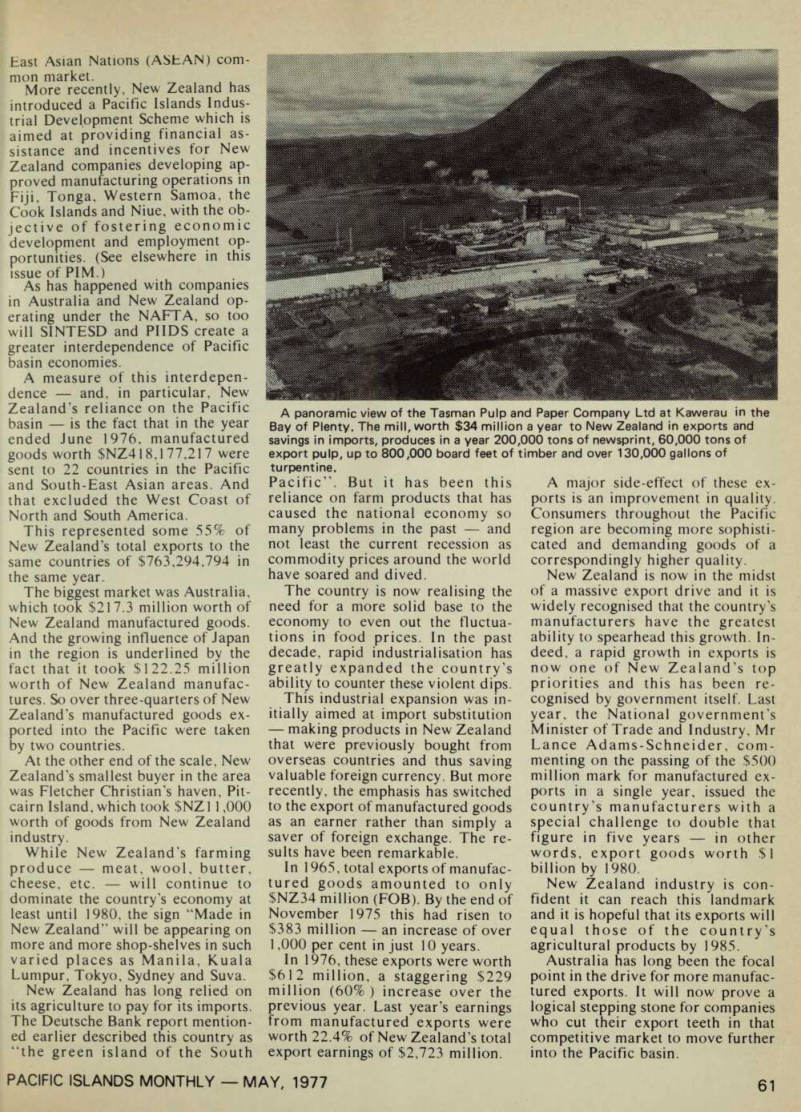
A panoramic view of the Tasman Pulp and Paper Company Ltd at Kawerau in the Bay of Plenty. The mill, worth $34 million a year to New Zealand in exports and savings in imports, produces in a year 200,000 tons of newsprint, 60,000 tons of export pulp, up to 800,000 board feet of timber and over 130,000 gallons of turpentine.