First steps in NZ’s big move to take industry
pp. 55-57 · Read in the full issue

take industry to the Islands
The New Zealand Government’s Pacific Islands Industrial Develop ment Scheme is gingerly taking its first steps, with three or four ven tures tentatively expected to be es tablished in its first year.
The scheme, announced by the government in November, 1976. aims at encouraging New Zealand based companies to set up approved manufacturing operations in Fiji, Tonga, Western Samoa, the Cook Islands and Niue. It offers com panies a range of financial induce ments, including interest-free loans (which convert to grants if the ven tures are still operating five years after they are set up), assistance with up to 50% of the cost of labour training programmes, feasibility stu dies, and the transfer of key per sonnel and equipment from New Zealand.
If the venture ceases operating, or moves from the Island nation in which it was established within five years of the assistance being pro vided. or fails to meet other condi tions set at the time the loan was ap proved. the loan will become re payable and will bear interest from the time of closure or movement un til repayment.
Applications for assistance under the scheme are assessed in accor dance with a number of criteria, in cluding the following: • The value of the venture to the Island economy, taking into account the use of local resources, employ ment creation, the value of the labour skills acquired, the extent of local equity and management par ticipation. and other factors. • The extent to which the ven ture needs assistance and incentives to be provided by New Zealand.
The amount of incentive to be pro vided will depend on the extent to which the venture is disadvantaged by features of the commercial en vironment. such as infrastructural shortcomings. • The desirability of attracting a venture to a particular Island location it may be necessary to provide greater incentives to attract ventures to some Islands than to others.
• The need to maintain rational industrial development within the Islands. • The provision of special access to the New Zealand market will be regarded as a form of assistance, and the provision of incentives may be adjusted accordingly.
• The need to prevent undue dis ruption to production and employ ment in New Zealand. • The extent to which en vironmental aspects of ventures are satisfactory.
The Pacific Islands Industrial Development Scheme stems from
the work of a special committee set up by the Minister for Trade and In dustry, Mr Adams-Schneider. The committee comprised rep resentatives of the New Zealand Manufacturers’ Federation, the Federation of Labour, and govern ment departments. It met a number of times before several of its mem bers joined a party of New Zealand parliamentarians on a 25-day good will and fact-finding mission to the Islands.
The framework of the proposed scheme was placed before Island governments for their consideration during the parliamentary visit, and, following the return of the mission to New Zealand in September, 1976, the committee met to complete its thinking and to prepare a report for the NZ Government.
“Make haste slowly” seems to be the wise motto of the New Zealand officials in charge of the scheme.
One of their statements says; “The New Zealand Government hopes that an increasing flow of new ven tures will follow the substantial number of initial inquiries, but the pace at which the scheme will develop is difficult to predict. It will depend in large part on the willing ness of New Zealand manufacturers to take advantage of the scheme, but the rate at which the industrial in frastructure can be built up across the region will also be an important factor.”
Despite present uncertainties, the potential long-term advantages of the scheme, especially its possible effect in bringing down the level of Islander immigration into New Zea land, guarantee that the New Zea land Government will not lightly abandon it.
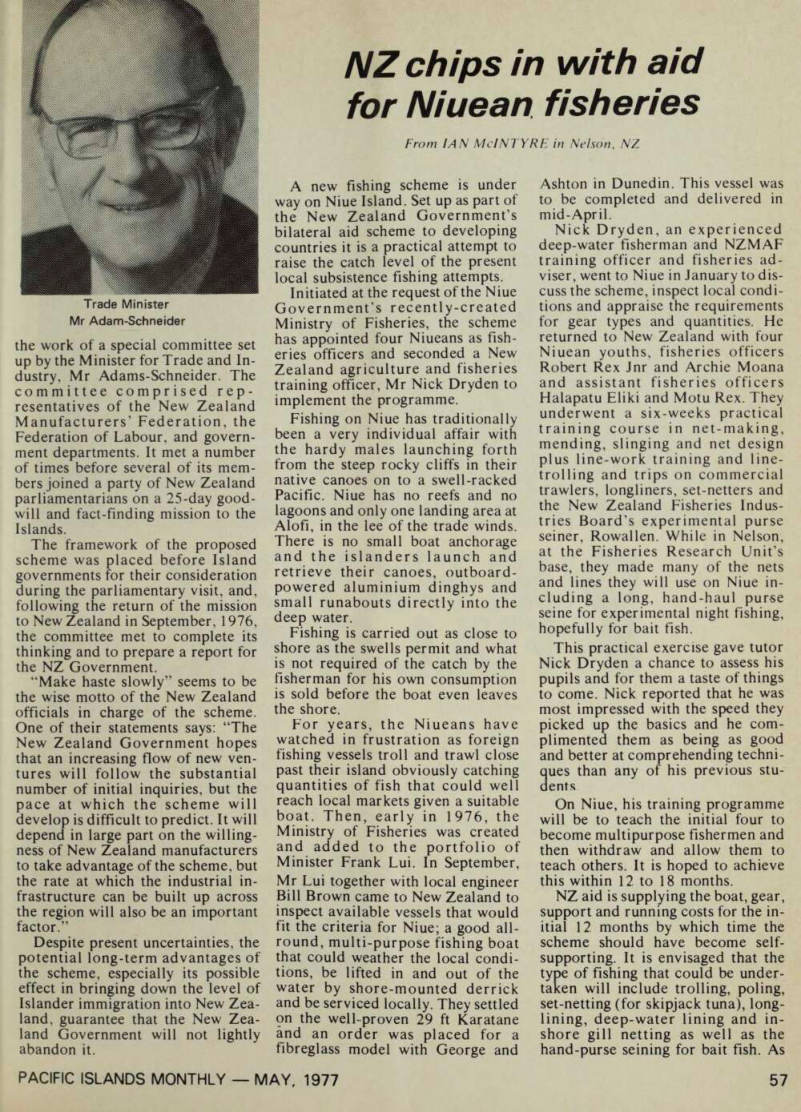
Trade Minister Mr Adam-Schneider