News
pp. 21-23 · Read in the full issue

The
In A
Nutshell
Anthropologist In Cooks
Mr Christian Clerk, an anthropologist from University College, London, arrived at Rarotonga in late March after spending the previous nine months in Mangaia Island studying a branch of
anthropology.
He investigated the Mangaians’
knowledge and classification of the island’s birds, animals and fish, and how they collect, cook and eat them. Mr Clerk left for New Zealand and the United Kingdom a few days after his arrival in Rarotonga.
Too Many Men?
The Cook Islands had a population of 18,112, made up of 9,287 males and 8,825 females at the time of the census on December 1, 1976. The 1971 census gave a population of 21,323, mainly because of activities generated by con struction of the airport. The 1966 census gave a population of 19,247. The population of the various islands was; Rarotonga, 9,812; Aitutaki, 2,414.
Mangaia. 1,530. Atiu, 1,312; Mauke, 710; Mitiaro. 305; Palmerston, 53; Pukapuka, 786; Nassau, 113; Manihiki, 263; Rakahanga, 283; Penrhyn, 531.
Didn’t anyone count Tom Neale on Suwarrow?
Png Envoy For Vatican
Papua New Guinea’s Minister for Foreign Affairs, Sir Maori Kiki, announced in March that his country has entered formal diplomatic relations with the Holy See.
A joint communique released
simultaneously in the Vatican City and Port Moresby said. “Papua New Guinea and the Holy See, in the desire to promote and develop mutual friendly relations, have decided by common consent to establish diplomatic relations
between them, at the level of embassy on the part of Papua New Guinea and Apostolic Nunciature on the part of the
Holy See.”
Sir Maori described the move as a significant step towards recognition of what the Roman Catholic Church and Christian denominations had contributed towards development, particularly in the educational and social fields, in Papua New Guinea.
Libel Alleged
Mr Charles Stinson, the Fiji Finance Minister, has filed a writ in the New Zea land Supreme Court seeking $1 million damages for alleged libel. Named as de fendants are the Listener, a weekly magazine, the NZ Broadcasting Cor poration, which owns the Listener, Wilson and Horton Ltd, the printers, and Vernon Wright, journalist, writer of the article in which Mr Stinson claimed he was libelled.
Mr Stinson alleges, in a statement issued in Suva, that the Listener, in an article on March 5, under a heading, “Fiji for sale”, made several incorrect and damaging assertions concerning his (Mr Stinson’s) involvement in Fiji’s
tourist development.
Tongan Seaman Lost
Semisi Paeahelotu Latu, 23, Tongan member of the crew of the Tauloto, was reported to have drowned at Whampoa Port, China, in March. At the time he was acting as second mate. The Tauloto, on charter of a shipping line in China, has been there since September, 1976.
Semisi became a cadet officer with Pacific Navigation Co Ltd in March, 1973, and first served in the Hifofua. He joined the Tauloto in September, 1973, and became third mate in November, 1974. He was one of nine children of Tevita and ’Ana Latu, of Mataika, Vavau.
Exile S Wish
Canon Charles Fox, at the age of 98, wants to become a citizen of the Solomon Islands, not without good reason. He spent 70 years in the Solomons as an Anglican missionary, and retired to New Zealand four years ago. He wrote from hospital in NZ to ask to become a Solomon Islander. “I want to be what I was for over 70 years because that is home to me, and the peo ple there are my people which is not true of any other place or people.” Rather sadly he wrote, that on medical advice he might not be allowed to make the “journey home to the Solomons”. His chances of having his wish granted must be rated highly for the Chief Minister, Mr Kenilorea, commented on the matter in the Legislative Assembly, “Would any of us refuse such a wish?” Dr Fox, a well known author and linguist, wrote four books and compiled dictionaries of three
local languages.
Girls In Blue!
Papua New Guinea will start training its first policewomen this year. Twelve trainees in the first intake will undergo the same training as policemen. There have been pressures in PNG for some time for the establishment of a small corps of policewomen, but some men in the force have not favoured the idea. “If any men don’t like it, then their only op tion is to leave the force” the Com missioner, Mr Pious Kerepia, said in Port Moresby. The training course for women will begin in June. Uniforms are still being designed.
Png Wages Rise
Minimum wages for rural primary industry workers and urban workers in Papua New Guinea rose by 3.31% from March 1. Workers getting the urban minimum wage of K. 27.18 or higher in specified centres received another 90t a week, while rural primary industry workers received another 471. The minimum wage for other rural workers was unchanged at K 11.38. It was reported in February that PNG in 1976 had one of the lowest inflation rates in the world only 4.95% .
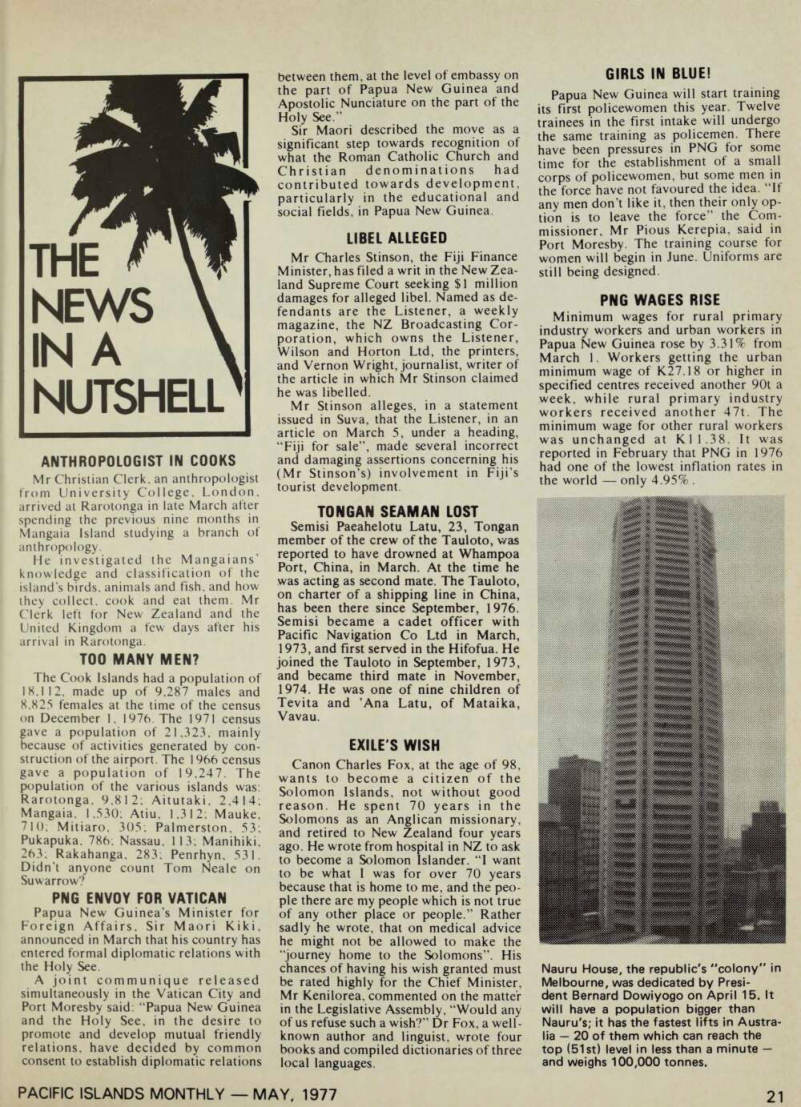
Nauru House, the republic's "colony" in Melbourne, was dedicated by Presi dent Bernard Dowiyogo on April 15. It will have a population bigger than Nauru's; it has the fastest lifts in Austra lia 20 of them which can reach the top (51st) level in less than a minute and weighs 100,000 tonnes.
Relics For Futuna
The relics of St Peter Chanel, the first canonised Roman Catholic martyr of the Pacific, left Paris on March 22 to be ex posed in various Pacific countries before reaching their final resting place in Wallis and Futuna, where this Marist missionary was slain on April 28, 1841.
The saint’s relics were returned from France at the request of the Bishop of Wallis and Futuna, Bishop Fuahea. Ex tensive ceremonies were planned in the territory, with a shrine to be built on Futuna for the saint who went to the is lands in 1836. The casket of relics was flown first to Sydney by UTA airlines to be exposed at the St Peter Chanel Church, Futuna Street. Woolwich, near the Marist Mission Centre for the Pacific. The relics were then to go to Wallis via stopovers in Auckland, Suva.
Vila and Noumea.
River Runs Wild
A river running wild in March brought down a hydro-electric tower, forcing Madang one of Papua New Guinea’s major towns on to emergency power.
The river Naru changed course by more than 100 metres to bring down the tower and damage three others from the Ramu hydro-electric scheme, one of PNG’s biggest and newest.
The Ramu scheme’s transmission line of 340 steel towers crosses what geologists describe as some of the youngest and most unstable terrain in the world.
There were indications that the unexpected diversion of the river will have a widespread effect on all engineering design work in the area, including work on roads and bridges.
Ship Explosion Inquiry
The master of a PNG government ship, Rouna Falls, which exploded with the loss of four lives was criminally culpable, a coroner found at an inquiry in late March. The finding also said that a government maritime official was
"partially culpable” and a gas supply
company “partially responsible”.
The ship was carrying a girls’ netball team and supporters on an excursion last September when an explosion occurred
north of Madang. killing four people.
The coroner, Mr Alan McLay, found that a low-pressure gas cylinder in the ship’s hold had leaked and that the ship’s mam engine had ignited the escaped gas in the engineroom and hold. He said the cylinder had been stored in the hold
contrary to regulations governing
dangerous cargo, there was evidence it had not been secured and there had been no protective guard around the valve and outlet.
He said the ship’s master. Captain Sebby Nebo. was responsible for the storage and was therefore criminally
culpable. The controller of marine services for the region. Captain Norman Brown, was partially culpable because of his overall control and his shipping survey responsibilities. The company which supplied the gas, Guinea Gas, should not supply cylinders without protective guards, the coroner said, and was therefore partially responsible for
what happened.
Sock And Roc Soccer
Soccer players from New Caledonia did not endear themselves to opposing players, the referee and spectators when they met New Zealand in an interna tional match. Trouble had simmered almost from the start of the game, and erupted when the referee sent a New Caledonian, Pierre Wacopo, from the field for kicking one of the home play ers.
Wacopo went a few metres, then stop ped. The referee waved him to leave the field. Some of Wacopo’s team mates ask ed the referee to reconsider his decision, but the referee ordered resumption of
play. New Caledonian players jostled
him, one pushed him and another tried to grab him around the neck.
The referee then signalled the end of the game, and left the field with a police man as an escort. But that was not enough for the New Caledonians. One of them threatened a photographer with a chair, while others gesticulated angrily.
About the same time, in Fiji, a Taiwan soccer team, in a warm-up game against Fiji before tackling Australia in a World Cup elimination series, nearly caused an international incident. The players went on to the field wearing shirts bearing the initials ROC (Republic of China). The Secretary for Foreign Affairs, Mr Jioji Kotobalavu, warned Taiwan they were breaking an agreement under which they were admitted to Fiji.
The team’s action could harm Fiji’s friendly relations with the People’s Re public of China, which did not recognise the Taiwan Government. Taiwan im mediately agreed not to wear the ROC shirts when they met Australia.
Png's Test'' Victory
Papua New Guinea was far too strong for Fiji when the two countries met for the first time in a cricket “test” at Port
Moresby in March, winning by eight
wickets. The visitors were as good as the home side in bowling, superior in field ing, but their batting let them down.
Apart from a sound first innings by opener, Cecil Browne, the Fiji batting was very erratic.
Veteran Inoke Tabualevu, also a Rug by international, smote the ball hard in the second innings, while another veteran. Curly Valentine, the captain, bowled steadily. Both Tabualevu and Valentine played for Fiji as long ago as 1960, when they were in the team which toured the New South Wales country dis tricts.
Peni Dakai bowled well for Fiji, and had good support from Valentine and Suka.
Papua New Guinea gave Fiji an object lesson in disciplined batting. Opener Don Fox. and Ilinome Tarua both top ped the half-century. They waited for the right ball to hit, and hit it hard. But their best player, who was later named “man of the match” was swing bowler Vavine Pala. who took 4/36 in the first innings and 1/8 in the second.
Fiji batted first. They made 138 in the first innings and 163 in the second.
Papua New Guinea, after making 253 in the first innings, had no trouble in hit ting off the 49 runs required for a win.
Four Lost In Canoe
A search for two women and two children, missing off the south coast of New Britain in March was called off after five days when the seas became too rough and dangerous. With two men, they were travelling from Gasmata, West New Britain, to Penlolo village, in a canoe which broke up on a reef. The two men, William Namilo, 15, and Jack Nalu, 30, managed to get ashore after spending five hours in the water. They were injured in crossing the reef and were treated for cuts.
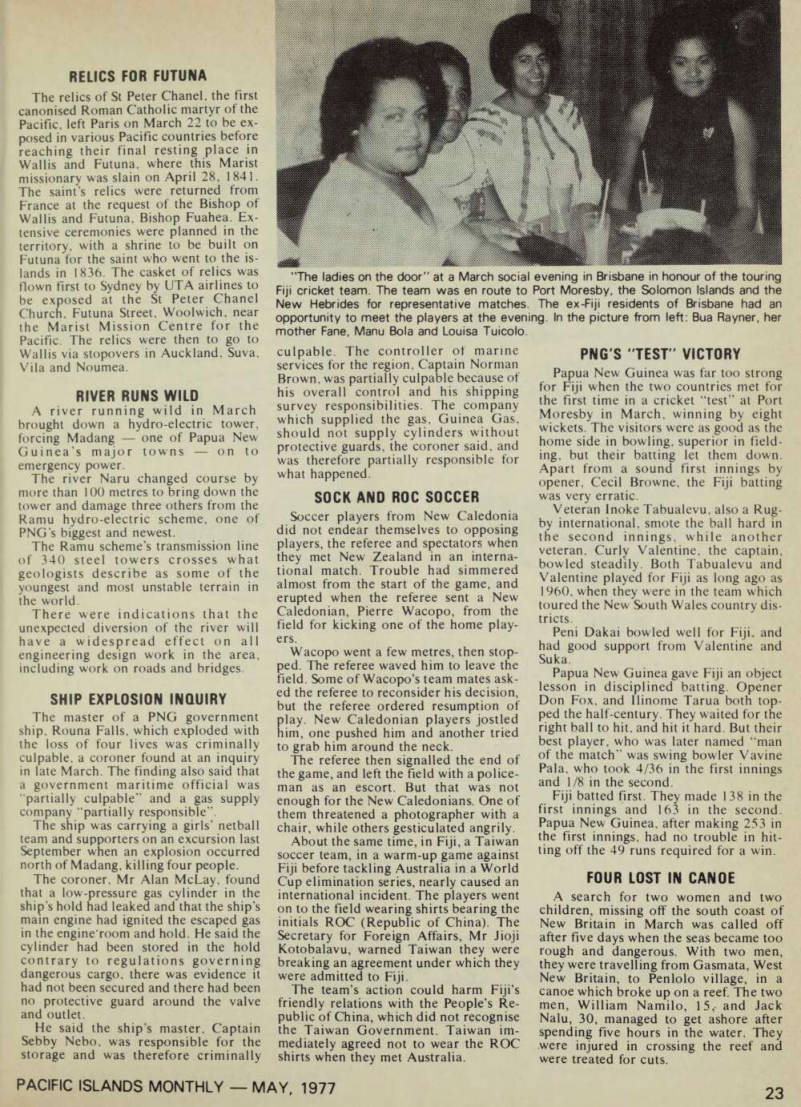
“The ladies on the door” at a March social evening in Brisbane in honour of the touring Fiji cricket team. The team was en route to Port Moresby, the Solomon Islands and the New Hebrides for representative matches. The ex-Fiji residents of Brisbane had an opportunity to meet the players at the evening. In the picture from left: Bua Rayner, her mother Fane, Manu Bola and Louisa Tuicolo.