Pngs First General Election
p. 19 · Read in the full issue
The Party System On Trial In
From GUS SMALES in Port Moresby
“Party Politics” amounted to little more than a couple of dirty words in the Papua New Guinea of not so many years ago.
Australia didn’t like the idea of politics in PNG, and the few Papua New Guinean voices of the time pleaded “keep us clean”. Even politics as an art or a trade was considered vaguely suspect, but as for parties they were far beyond the pale.
Much of this was a symptom of pure ignorance, and is typified in the extraordinary lengths to which some of the pioneer politicians went to
explain their position.
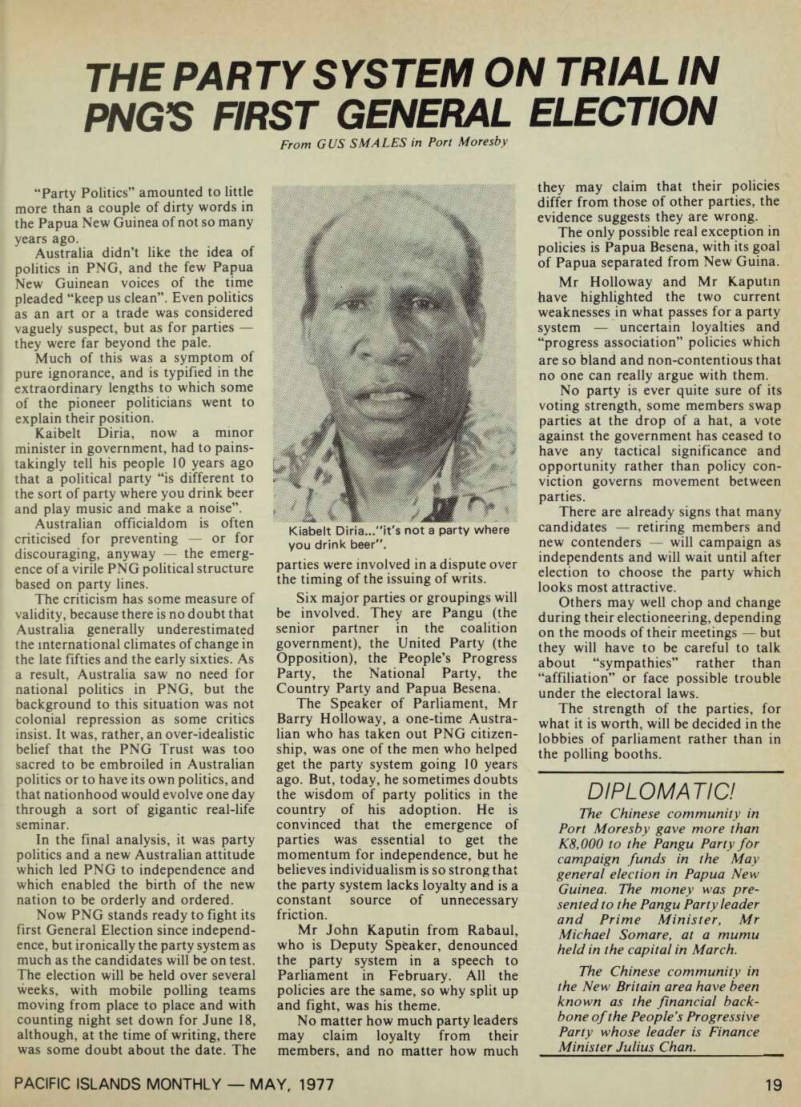
Kaibelt Diria, now a minor minister in government, had to pains takingly tell his people 10 years ago that a political party “is different to the sort of party where you drink beer and play music and make a noise”.
Australian officialdom is often criticised for preventing or for discouraging, anyway the emerg ence of a virile PNG political structure based on party lines.
The criticism has some measure of validity, because there is no doubt that Australia generally underestimated the international climates of change in the late fifties and the early sixties. As a result, Australia saw no need for national politics in PNG, but the background to this situation was not colonial repression as some critics insist. It was, rather, an over-idealistic belief that the PNG Trust was too sacred to be embroiled in Australian politics or to have its own politics, and that nationhood would evolve one day through a sort of gigantic real-life seminar.
In the final analysis, it was party politics and a new Australian attitude which led PNG to independence and which enabled the birth of the new nation to be orderly and ordered.
Now PNG stands ready to fight its first General Election since independ ence, but ironically the party system as much as the candidates will be on test.
The election will be held over several weeks, with mobile polling teams moving from place to place and with counting night set down for June 18, although, at the time of writing, there was some doubt about the date. The
parties were involved in a dispute over the timing of the issuing of writs.
Six major parties or groupings will be involved. They are Pangu (the senior partner in the coalition government), the United Party (the Opposition), the People’s Progress Party, the National Party, the Country Party and Papua Besena.
The Speaker of Parliament, Mr Barry Holloway, a one-time Austra lian who has taken out PNG citizen ship, was one of the men who helped get the party system going 10 years ago. But, today, he sometimes doubts the wisdom of party politics in the country of his adoption. He is convinced that the emergence of parties was essential to get the momentum for independence, but he believes individualism is so strong that the party system lacks loyalty and is a constant source of unnecessary friction.
Mr John Kaputin from Rabaul, who is Deputy Speaker, denounced the party system in a speech to Parliament in February. All the policies are the same, so why split up and fight, was his theme.
No matter how much party leaders may claim loyalty from their members, and no matter how much
they may claim that their policies differ from those of other parties, the evidence suggests they are wrong.
The only possible real exception in policies is Papua Besena, with its goal of Papua separated from New Guina.
Mr Holloway and Mr Kaputm have highlighted the two current weaknesses in what passes for a party system uncertain loyalties and “progress association” policies which are so bland and non-contentious that no one can really argue with them.
No party is ever quite sure of its voting strength, some members swap parties at the drop of a hat, a vote against the government has ceased to have any tactical significance and opportunity rather than policy con viction governs movement between
parties.
There are already signs that many candidates retiring members and new contenders will campaign as independents and will wait until after election to choose the party which looks most attractive.
Others may well chop and change
during their electioneering, depending
on the moods of their meetings but they will have to be careful to talk about “sympathies” rather than “affiliation” or face possible trouble under the electoral laws.
The strength of the parties, for what it is worth, will be decided in the lobbies of parliament rather than in the polling booths.
Kiabelt Diria..."it's not a party where you drink beer".