A sailor flies a 'goose'
pp. 65-68 · Read in the full issue
along the 'Last Frontier’
From SUSAN K. GRAEF on Majuro
The islands and atolls of the Pacific are full of expatriate men and women who see themselves as part of the last frontier. Majuro, the district centre of the Marshall Islands, is no exception the men (mostly) and women here describe their privations and the deficiencies of the Marshalls with as much pride as they describe the im provements they have brought or hope to bring to the islands.
One frontiersman in the Marshalls is John Slattebo, who pilots the Grumman Goose, an amphibious craft he brought to the Marshalls almost 18 months ago. John Pilot, as he is known to many Marshallese, is blond and blue-eyed and looks like the California surfer he used to be and the sailor he still is. He arrived in the Marshalls in September, 1973, as skipper of the 56ft ketch, Renegade, and stayed ‘‘because Majuro was the first tropical, frontierish place that I’d seen that was under the US”.
Slattebo left the Renegade and looked around for business possibilities in the Marshalls. He found a sponsor in Kirt Pinho, a native Hawaiian of Portuguese ancestry, who still runs a construction company on Majuro, and the two men decided to attempt the resurrection of an idea that had already failed twice before an island air taxi service.
Slattebo had the necessary licences, having learned to fly during the late 19605. Pinho had the necessary business and political ties.
After three months in the Trust Territory and Guam, where he check ed on the availability of fuel, supplies and government interest, Slattebo returned to California, found more in vestors in the project, formed Tradi tion Air Transport and began looking for a plane.
From the beginning, the men wanted an amphibious craft that could handle the few airstrips and many lagoons of the Marshalls.
Manufacturers are no longer building amphibious planes, and any plane found would need extensive overhaul to make it suitable for use. Fortunate ly, Slattebo found a plane where some of the preliminary “tearing down” had been done already, a Grumman
Goose which had lost its nose on a water landing in Canada. The plane had been recovered and taken to California where Slattebo spotted it, liked the condition of the parts and bought it.
The rebuilding took seven months and was supervised by a mechanic, Harold (Mitch) Mitchell, who follow ed the plane and continues to service it. He has done a good job the plane has been unable to fly on only three days since June, 1975, when the service began.
There are only three islands in the Marshalls where the seaplane cannot land. Since June, 1975, the seaplane has flown about 50 medical evacuations from outer islands, flying as far as Ujelang (the northernmost Marshalls atoll, about 700 miles from Majuro). About one-third of all flights are medical evacuations, another third are government business charters and the rest are private.
An example of a private charter, according to Slattebo, was one by the Government of Nauru, which needed a dozen frigate birds (Nauru’s national bird) for display at a gather ing of Pacific leaders. The plane, carrying a Nauruan minister, flew to Moloelap and Aur atolls to pick up the pre-packaged birds each in a woven coconut basket with a hole for
its head. Slattebo described the episode as “a little scary you couldn’t even walk down the aisle with all those birds on the seats”.
But the medical evacuations are the most important contribution made by the seaplane service.
One of the more dramatic episodes involved the evacuation from Ujelang of a patient with a ruptured appendix.
The seaplane could not carry suf ficient fuel to make the trip, so it was necessary for the US Army to send a military plane with fuel to Enewetak from the Kwajalein Missile Range.
The seaplane flew from Majuro to Kwajalein, refuelled, flew to Ujelang, (which has no landing strip), picked up the patient and flew to Enewetak where the army plane took the patient (because it could make better time than the seaplane back to Kwajalein).
The seaplane refuelled and then flew to Kwajalein and back to Majuro.
Tradition Air Service’s plans for the future are expansionist. Slattebo wants to add a land plane for servicing the Marshalls atolls with landing strips, particularly Enewetak, which is being rebuilt by the United States Government and which is the site for extensive scrap metal reclamation projects.
A land plane could also be used for servicing Kusaie, the new Trust Territory district in the Caroline Islands.
When asked if the continuing development in the Marshalls yacht and tennis clubs, new hotels, television was destroying the fron tier quality which had first attracted him, Slattebo replied that, ‘‘Things still have quite a way to go yet. I thought 1 would really be able to make a difference here. Now I’m not so sure, but I’ll probably stay for a little while.” The words of a 25-year man, at least.
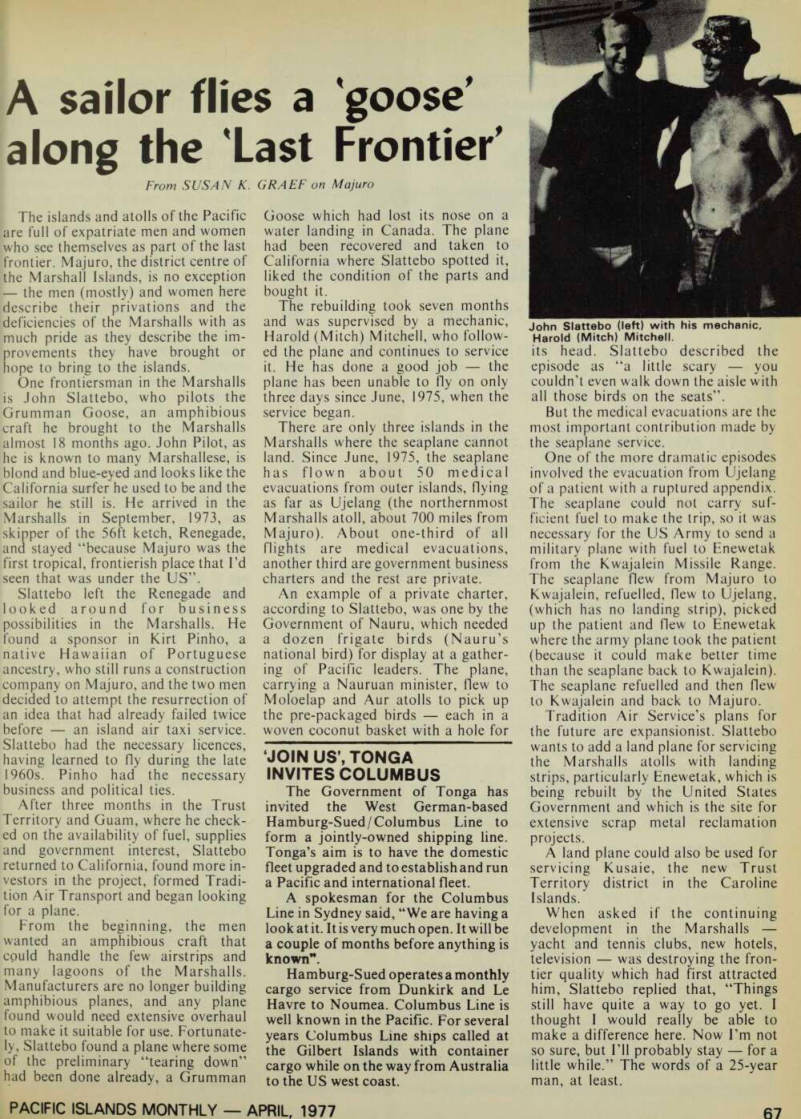
John Slattebo (left) with his mechanic, Harold (Mitch) Mitchell.
Airstrips For
Southern Cooks
The Cook Islands Government is ready to begin construction of airstrips on the southern islands of Atiu, Mauke and Mitiaro and in that order. Atiu will be first because much of the heavy equipment for the job is already on the island.
Plans for the construction of airstrips on the southern Cooks have been in the pipeline for many years and it was decided to start work on them as soon as practicable after the opening of Rarotonga’s Interna tional Airport in December, 1973.
Mangaia, the southernmost of the islands, is also keen to have an airstrip and seven possible sites have been surveyed. However, Mangaia is not included in the cur rent programme because further discussions are still to be held be tween the islanders and the Govern ment.
Cook Islands Airways owns one aircraft, a nine-seater Britten Nor man Islander, Rarotonga-based and capable of operating from short strips. The three airstrips are ex pected to be completed by July.
New Ship
Hits Png Reef
The Niugini Trader, the 373tonnes cargo vessel, delivered a short time ago from the Fiji makers, Carpenters Industrial, to owner Anton Lee of Port Moresby, escaped disaster by a hair’s breadth in mid- February.
She struck a reef near Samarai but the only damage was a jammed rudder.
She was pulled off the reef and taken in tow by PNG coastal vessel Ame Rupa, and berthed safely at Port Moresby.
Nz Gift For
New Hebrides
A 23-metre steel beach landing craft, the Roena, is now the property of the New Hebrides Government.
The Roena is a gift under the NZ Government aid programme for the Pacific Islands, and was built in Auckland. She can carry more than 85 tonnes of cargo, but as she dis places a little more than half a metre of water at the bow can land in shallow water.
The Roena has accommodation for a crew of four and has four dou ble-berth cabins for passengers; is powered by two 110 hp diesel engines and has twin rudders.
Bigger Planes, Less
Money For Airport
Nadi airport will finish 1977 in the red to the tune of about $1.5 million unless the South Pacific Air Transport Council hikes landing fees and introduces navigation and passenger service fees. Bigger aircraft such as Boeing 747 s and DC 10s, plus the withdrawal of a number of airlines, have led to fewer landings.
But the loss could be corrected fora little more than 50% of the economy fare for one passenger a flight from Honolulu to Nadi, according to the Fiji Director of Civil Aviation, Mr M.
Varley. SPATC at a recent meeting suggested a rise of 15% in landing fees.
At present the landing fee for a Boeing 747 is $1,806. A 15% increase on that works out at $271 —just over 50% of the economy fare between Honolulu and Nadi.
The withdrawal of a number of Qantas flights could lead to a loss of about $620,000 at Nadi in 1977 $370,000 in landing fees and about $250,000 in the sale of items in the duty free shop at the airport. From April, six of the Qantas 12 weekly Boeing trans-pacific flights through Nadi will end.
A passenger trend today is for quicker services on the Australia-US route. To meet this PAA operates direct Australia-US services. Qantas, from April 1, will partly meet this competition with direct Sydney- Honolulu services. But Qantas is offering some compensation from April 1 with two Boeing 747 weekend flights from Sydney to Nadi, where they terminate.
Upgrading Cooks’
Inter-Island Shipping
The Cook Islands Government and Silk and Boyd have signed an agreement under which Silk and Boyd will upgrade inter-island shipping within the next two months. Silk and Boyd, before June, will have a second ship in operation in return for a government subsidy and other assis tance to ensure the service is economically viable.
The Silk and Boyd services will be based on a two-ship operation to all islands on a minimum, but regular, six weeks schedule. There will be a greater frequency of services during the citrus and pineapple seasons.
The Minister for Shipping, Mr G.
F. Ellis, announcing details of the agreement, which is for three years.
said regular and adequate shipping was vital to the economic and social development of the Cook Islands.
Improved services were necessary to minimise the isolation and scattered nature of the islands, and to provide greater incentive for agricultural production.
A day or two later, Mr Don Silk, of Silk and Boyd flew to Europe, via NZ, to inspect a number of ships, and select one to supplement the Manuvai. He expected to return to the Cook Islands with the selected ship before the end of May, in time to cope with the flush of the citrus season.
Truk Airport
Demonstration
A peaceful crowd estimated at 150- 200 people distributed leaflets at Truk airport in February demanding settlement of a dispute over the land on
which the airport is located.
Residents of the village of Iras, Moen Island, are demanding that they be justly compensated for land which they claim to own but which is being
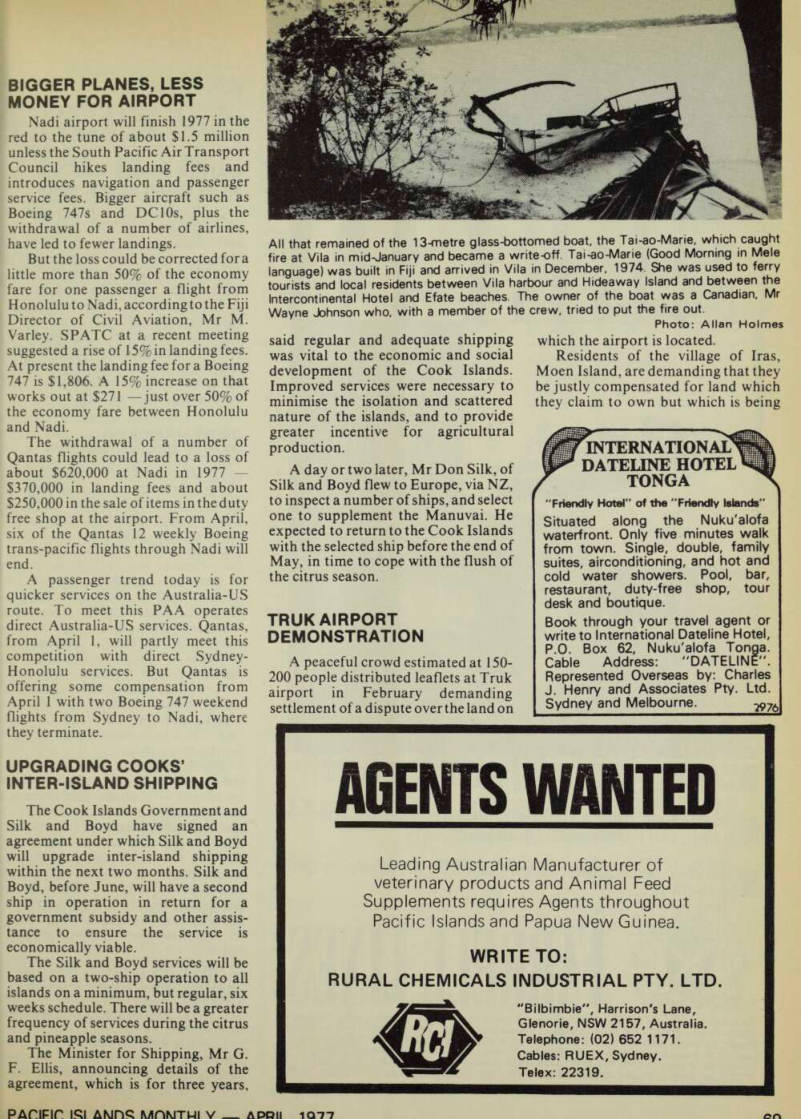
All that remained of the 13-metre glass-bottomed boat, the Tai-ao-Marie, which caught fire at Vila in mid-anuary and became a write-off. Tai-ao-Marie (Good Morning in Mele language) was built in Fiji and arrived in Vila in December, 1974. She was used to ferry tourists and local residents between Vila harbour and Hideaway Island and between the Intercontinental Hotel and Efate beaches. The owner of the boat was a Canadian, Mr Wayne Johnson who, with a member of the crew, tried to put the fire out.
Photo: Allan Holmes
used for the airport.
Also at issue is the proposed construction of a new $US7 million airport on the same land and adjacent areas.
Daiwa Line's
New Container Ship
The Daiwa Line will introduce a 15.000 tonner roll-on/roll-off cat and container carrier to the New Hebrides and New Caledonia in May. The vessel can carry 512 cars on deck and 169 in the hold, as well as 432 containers, including refrige rated cargo. Total capacity is 22.000 cubic metres. The vessel will initially include only the above twc territories on its monthly sailings but other neighbouring ports could eventually be served this way.
Containers For
Papua New Guinea
The Papua New Guinea Shipping Corporation Pty Ltd will become directly involved in the containei shipping services between the majoi ports on the Australian east coast and Papua New Guinea. Last year New Guinea Australia Line, which is part of the China Navigation group, and Conpac, owned b> Australia West Pacific Line and Burns Philp, under a joint ar rangement agreed to charter twc container ships and share an Australia-PNG service.
Now there will be three containei ships, with PNG Shipping Corp and NGAL running two and Conpac one. They will share the containers on the three ships.
The first ship to go into service the Papua Chief, was to be launched on March 31 in Japan. It is expected in Australian waters about July 1 and will go into service that month The second ship will be the Coral Chief, due for launching on May 5, It is expected in Australia about the end of July, ready to go into service in August. The third ship has not yet been named. It is expected to arrive in Australia about the end of Sep tember.
The ships are 320 teu (tonne equivalent unit) geared, cellular container ships, which means they carry 300 containers 20 ft x 8 ft x 8 ft.
Initially NGAL will keep a con ventional cargo ship on the service, chiefly for outlying ports which may not be able to handle containers.