New sights, new sounds
pp. 63-64 · Read in the full issue
Pacific Transport
New sights, new sounds in Norfolk Island skies
There are new sights and new sounds in the skies over Norfolk Island these days. Gone are the bulky outline and roaring propellers of the Qantas DC4’s which have served the island for more than 20 years. In their place Norfolk Islanders are gradually getting used to the slimmer lines and the steady whine of the turbo-prop engines of an East-West Airlines Fokker 500.
The change came late in February, as East-West flew its inaugural flight and Qantas flew its last.
It was in line with the recommenda tion in the report of the Royal Commission into Norfolk Island affairs that Qantas should be permitted to withdraw from the service, and that a “single domestic operator” should take it over.
Subsequent hearings held by the Department of Transport resulted in the service being awarded to East-West over rival bids by Trans-Australia Airlines, Ansett Airlines of Australia, and Norfolk Island Airlines.
Background to the success of East- West is clearly outlined in the airline’s submissions to a Royal Commission hearing in August, 1975.
“The Sydney-Norfolk Island route and East-West are ideally suited to each other,” the airline said con fidently.
If that sounds a little coy, there is nothing coy about the hard-headed case put by East-West to substantiate its claim.
It included the following argu ments: • “The Norfolk air route is a vital and necessary link but is quite small in comparison to the total aviation, passenger business. That is the sort of route in which East-West specialises.” • “Twelve East-West routes are larger than Norfolk and four are similar. One East-West route is longer (Sydney-Alice Springs, 2,046 km) than Norfolk (1,676 km) and two are about one-half to one-third shorter (Maroochy and Hobart charter route)
with the remainder within the 200 to 700 km range.” • “The Norfolk route would make up over 10% of East-West’s gross revenue and would therefore warrant prime attention. It would certainly become a ‘blue ribbon’ route in East- West’s hands rather than being one of many fairly minor destinations in a larger airline’s inventory.”
This last point must have been something of a clincher in the success of East-West over its rivals, especially the much larger TAA and Ansett.
The same theme of “small is beautiful” is apparent in East-West’s discussion of the type of aircraft most appropriate to the Norfolk Island service.
DC9, Boeing 727 and Boeing 737 aircraft are rejected on grounds including noise pollution and runway improvement costs, and East-West comes down heavily in favour of atwostage development with two smaller
aircraft: first, introduction of the Fokker F27-500F turbo-prop, with specially-fitted long-range fuel tanks, to be followed by the Fokker F 23-4000 or 6000 pure jet, when airport upgrading has been carried out on Norfolk.
One of the strong points in East- West’s argument for the use of smaller aircraft on the route is frequency of service important from a variety of social points of view, not the least of which is the general breakingdown of the sense of isolation of the Norfolk population. As one East-West spokes man bluntly put it: “Dumping in a 747 every fortnight is not the answer for Norfolk.”
Interviewed by PIM in Sydney in late January, Mr Bruce Teague, planning and development manager for East-West, said his company looked forward to “a happy, lifelong association with Norfolk”, Mr Teague said that on a visit to
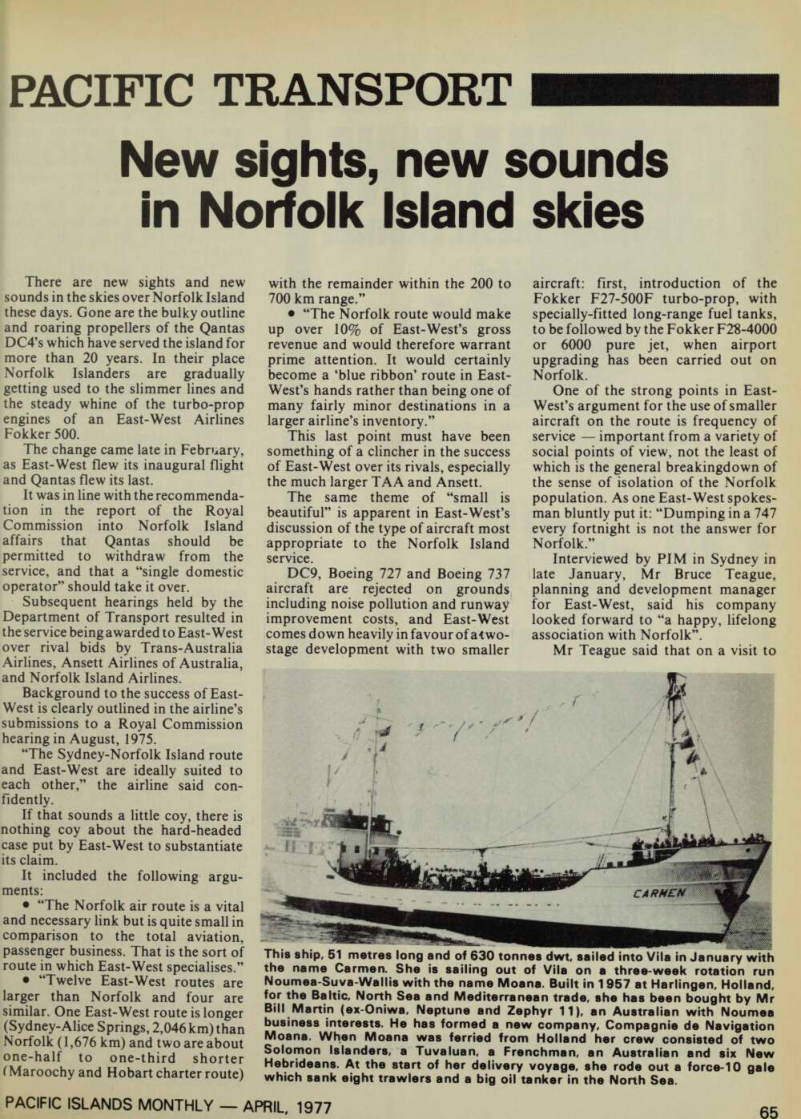
This ship, 51 metres long and of 630 tonnes dwt, sailed into Vila in January with the name Carmen. She is sailing out of Vila on a three-week rotation run Noumea-Suva-Wallis with the name Moana. Built in 1957 at Harlingen, Holland, for the Baltic, North Sea and Mediterranean trade, she has been bought by Mr Bill Martin (ex-Oniwa, Neptune and Zephyr 11), an Australian with Noumea business interests. He has formed a new company, Compagnie de Navigation Moana. When Moana was ferried from Holland her crew consisted of two Solomon Islanders, a Tuvaluan, a Frenchman, an Australian and six New Hebrideans. At the start of her delivery voyage, she rode out a force-10 gale which sank eight trawlers and a big oil tanker in the North Sea.
Norfolk late in December East-Wesl executives had received “a favourable reaction” from the administration, tourist board and everybody they’d come in contact with.
He said: “Our basic problem now is to learn to operate the route and get tc know the people who use it.”
In the longer term, East-Wesl would be working hard to encourage more people to use the route in off peak periods.
“There is a very bad ‘peaking’ situation now, particularly at school holiday times,” said Mr Teague. “In fact, the peaks and troughs are more acute on the Norfolk Island route than on any other in Australia that we know of. We’re sure this was one of the factors in the losses suffered by Qantas they worked very hard at school holiday times, but had very little to dc during winter.
“We’ve asked the tourist board tc co-operate in anything that might b< done in an effort to even-out th( situation.”
He said the long-term future of the service would not be definitely settlec until the two conditions laid down bj Australian Transport Minister Nixor had been met.
The first concerned the eventua performance characteristics of the so called de Havilland Dash 7, a new four engined propeller aircraft which hac been considered for the route and i: still undergoing development by it: American manufacturers.
The second relates to the Australia: Government’s own decision on the waj to meet the Royal Commission’: recommendation that the Norfoll Island airport should be upgraded tc accommodate jet aircraft.
For the time being, said Mr Teague East-West will proceed with its two stage plan: first using the F27-500F and then, when airport conditions an right, moving over to the F2£ (Fellowship) pure jet.
Mr Teague described the F27-500F as the “super-dooper” version of the Friendship series.
“It has improved engines, naviga tional gear, additional air-condi tioning, inflight music, new sea design, and so on..
“East-West is the only airline in Australasia with F 27-500 Fs fitted with the extra fuel tanks required for the Norfolk Island service.”
The airline had recently brought two of the aircraft at a cost of about SAS million.