The Banabans' Story-
pp. 30-33 · Read in the full issue


Told By An Insider
Bertram Jones, whose story on the Banabans is below, is a former Fleet Street journalist who resigned to work with the Banabans because he believed they had been badly treated. He met Tebuke almost by chance. The Banabans had sent a deputation to Whitehall to ask for independence for Ocean Island. Mr Jones, who had worked in Sydney for nine years (six of them as correspondent for the Daily Express, London), had collected a lot of material about the Ocean Island affair. He contacted Tebuke by telephone just as the delegation was about to leave London for Fiji and wrote a story for his newspaper. On a later visit to London, Tebuke invited him to come and work on Rabi Island. For several months he and his wife lived on Rabi, the only Europeans among 2,500 Banabans. Later they transferred to Suva, where Mr Jones dug into official records in the Western Pacific Archives.
It has been a long and at most times, a losing battle. But after more than 10 years of disheartening rebuffs along the corridors of power in London the Banabans have won world acceptance of their belief that they have had a rotten deal from Britain over the exploitation of their Ocean Island phosphate.
A British judge said so in a pro nouncement that took five days to read. And overnight, the Banabans, who had so often been cold shouldered when they tried to get people to listen, found themselves surrounded by instant friends. Until then it had been mostly a case of “No scandal, please. We’re British.”
But when the judge came out with such phrases as “Sense of outrage” and “Breach of higher trust” the Banabans were publicly applauded as heroic little South Sea island Davids. Newspapers that had shied away from a story that simply clamoured to be told gave it splash treatment. And when, a few weeks ago, the British Broadcasting Com mission showed a television docu mentary, that it had kept on ice for more than a year because it was sym pathetic to the Banabans and could not be released while the lawsuits were before the court, the floodgates of outraged public opinion burst open.
A torrent of letters, telegrams and telephone calls swept in to the BBC.
Viewers declared that they would never have believed that Britain could have behaved in such a way. A retired colonel wrote that he was ashamed of his country, and was there any way in which he, per sonally, could help to make amends?
Total strangers rang the bell of
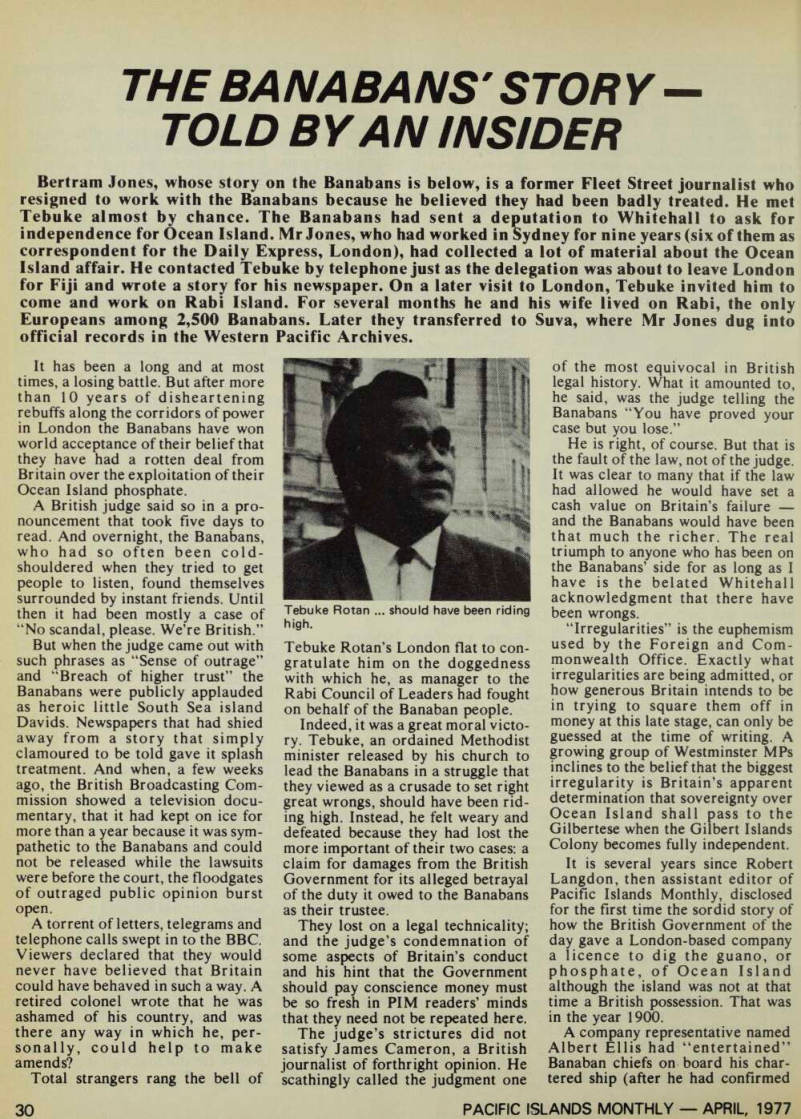
Tebuke Rotan’s London flat to con gratulate him on the doggedness with which he, as manager to the Rabi Council of Leaders had fought on behalf of the Banaban people.
Indeed, it was a great moral victo ry. Tebuke, an ordained Methodist minister released by his church to lead the Banabans in a struggle that they viewed as a crusade to set right great wrongs, should have been rid ing high. Instead, he felt weary and defeated because they had lost the more important of their two cases: a claim for damages from the British Government for its alleged betrayal of the duty it owed to the Banabans as their trustee.
They lost on a legal technicality; and the judge’s condemnation of some aspects of Britain’s conduct and his hint that the Government should pay conscience money must be so fresh in PIM readers’ minds that they need not be repeated here.
The judge’s strictures did not satisfy James Cameron, a British journalist of forthright opinion. He scathingly called the judgment one
of the most equivocal in British legal history. What it amounted to, he said, was the judge telling the Banabans “You have proved your case but you lose.’’
He is right, of course. But that is the fault of the law, not of the judge.
It was clear to many that if the law had allowed he would have set a cash value on Britain’s failure and the Banabans would have been that much the richer. The real triumph to anyone who has been on the Banabans’ side for as long as I have is the belated Whitehall acknowledgment that there have been wrongs.
“Irregularities’’ is the euphemism used by the Foreign and Com monwealth Office. Exactly what irregularities are being admitted, or how generous Britain intends to be in trying to square them off in money at this late stage, can only be guessed at the time of writing. A growing group of Westminster MPs inclines to the belief that the biggest irregularity is Britain’s apparent determination that sovereignty over Ocean Island shall pass to the Gilbertese when the Gilbert Islands Colony becomes fully independent.
It is several years since Robert Langdon, then assistant editor of Pacific Islands Monthly, disclosed for the first time the sordid story of how the British Government of the day gave a London-based company a licence to dig the guano, or phosphate, of Ocean Island although the island was not at that time a British possession. That was in the year 1900.
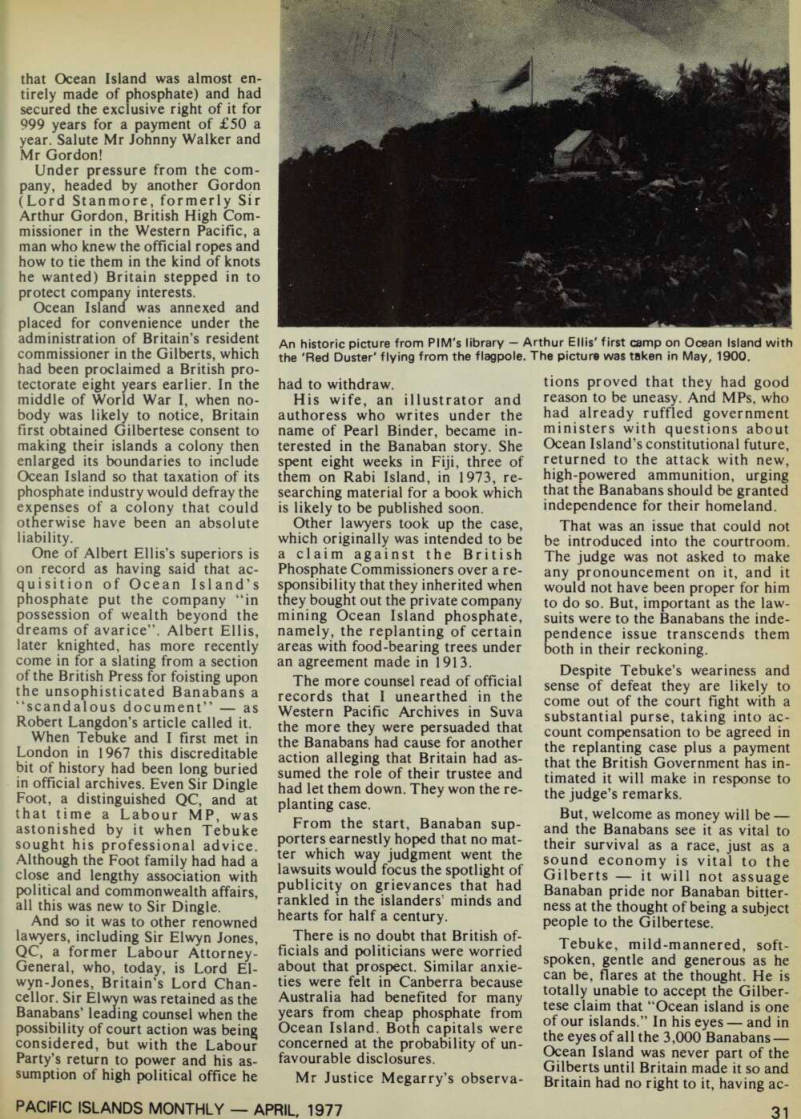
A company representative named Albert Ellis had “entertained”
Banaban chiefs on board his char tered ship (after he had confirmed
Tebuke Rotan ... should have been riding high.
that Ocean Island was almost en tirely made of phosphate) and had secured the exclusive right of it for 999 years for a payment of £5O a year. Salute Mr Johnny Walker and Mr Gordon!
Under pressure from the com pany, headed by another Gordon (Lord Stanmore, formerly Sir Arthur Gordon, British High Com missioner in the Western Pacific, a man who knew the official ropes and how to tie them in the kind of knots he wanted) Britain stepped in to protect company interests.
Ocean Island was annexed and placed for convenience under the administration of Britain’s resident commissioner in the Gilberts, which had been proclaimed a British pro tectorate eight years earlier. In the middle of World War I, when no body was likely to notice, Britain first obtained Gilbertese consent to making their islands a colony then enlarged its boundaries to include Ocean Island so that taxation of its phosphate industry would defray the expenses of a colony that could otherwise have been an absolute liability.
One of Albert Ellis’s superiors is on record as having said that ac quisition of Ocean Island’s phosphate put the company “in possession of wealth beyond the dreams of avarice’’. Albert Ellis, later knighted, has more recently come in for a slating from a section of the British Press for foisting upon the unsophisticated Banabans a “scandalous document’’ as Robert Langdon’s article called it.
When Tebuke and I first met in London in 1967 this discreditable bit of history had been long buried in official archives. Even Sir Dingle Foot, a distinguished QC, and at that time a Labour MP, was astonished by it when Tebuke sought his professional advice.
Although the Foot family had had a close and lengthy association with political and commonwealth affairs, all this was new to Sir Dingle.
And so it was to other renowned lawyers, including Sir Elwyn Jones, QC, a former Labour Attorney- General, who, today, is Lord El wyn-Jones, Britain’s Lord Chan cellor. Sir Elwyn was retained as the Banabans’ leading counsel when the possibility of court action was being considered, but with the Labour Party’s return to power and his as sumption of high political office he
had to withdraw.
His wife, an illustrator and authoress who writes under the name of Pearl Binder, became in terested in the Banaban story. She spent eight weeks in Fiji, three of them on Rabi Island, in 1973, re searching material for a book which is likely to be published soon.
Other lawyers took up the case, which originally was intended to be a claim against the British Phosphate Commissioners over a re sponsibility that they inherited when they bought out the private company mining Ocean Island phosphate, namely, the replanting of certain areas with food-bearing trees under an agreement made in 1913.
The more counsel read of official records that I unearthed in the Western Pacific Archives in Suva the more they were persuaded that the Banabans had cause for another action alleging that Britain had as sumed the role of their trustee and had let them down. They won the re planting case.
From the start, Banaban sup porters earnestly hoped that no mat ter which way judgment went the lawsuits would focus the spotlight of publicity on grievances that had rankled in the islanders’ minds and hearts for half a century.
There is no doubt that British of ficials and politicians were worried about that prospect. Similar anxie ties were felt in Canberra because Australia had benefited for many years from cheap phosphate from Ocean Island. Both capitals were concerned at the probability of un favourable disclosures.
Mr Justice Megarry’s observa
tions proved that they had good reason to be uneasy. And MPs, who had already ruffled government ministers with questions about Ocean Island’s constitutional future, returned to the attack with new, high-powered ammunition, urging that the Banabans should be granted independence for their homeland.
That was an issue that could not be introduced into the courtroom.
The judge was not asked to make any pronouncement on it, and it would not have been proper for him to do so. But, important as the law suits were to the Banabans the inde pendence issue transcends them both in their reckoning.
Despite Tebuke’s weariness and sense of defeat they are likely to come out of the court fight with a substantial purse, taking into ac count compensation to be agreed in the replanting case plus a payment that the British Government has in timated it will make in response to the judge’s remarks.
But, welcome as money will be and the Banabans see it as vital to their survival as a race, just as a sound economy is vital to the Gilberts it will not assuage Banaban pride nor Banaban bitter ness at the thought of being a subject people to the Gilbertese.
Tebuke, mild-mannered, soft spoken, gentle and generous as he can be, flares at the thought. He is totally unable to accept the Gilber tese claim that “Ocean island is one of our islands.’’ In his eyes and in the eyes of all the 3,000 Banabans Ocean Island was never part of the Gilberts until Britain made it so and Britain had no right to it, having ac
An historic picture from PIM's library Arthur Ellis' first camp on Ocean Island with the 'Red Duster' flying from the flagpole. The picture was taken in May, 1900.
quired it by Force Majeure from the Banabans.
Any Pacific Islander ought to see that, he argues; and for the Gilberts’
Chief Minister, Mr Naboua Ratieta, to pretend otherwise shows how far he has strayed from true island tra dition and custom under the in fluence of alien advisers.
Nothing will ever persuade Tebuke that the Gilberts are other than receivers of stolen property whose claim to rightful sovereignty is an expedient sham. It seems to many that history is on his side.
The mammoth lawsuits the longest and most expensive in Bri tish legal history could cost nearly a million pounds, according to London estimates. Just what costs will be awarded to or against the Banabans still has to be decided in court.
But ever since the Rabi Council first decided on court action, in the early 19705, they have regularly set aside part of their phosphate income to meet legal fees on a pay-as-you go basis.