Tropicalities
pp. 27-29 · Read in the full issue

The sad tale
of a boar
On one of the smaller islands in the South Pacific the men raise a small species of pig suitable for use at the local feasts and they keep them in walled pens at the rear of their houses.
The economy of this island is simple and meagre and the daily routine for the men consists in the main of catching fish and gathering bananas which are cooked as the staple vegetable.
At one time the senior adminis trator of the territory was interested in introducing a range of new cash crops, so he visited the island with several European officials. When he saw the size of the local pigs he decided that something should be done to raise the quality of the stock. The men were ordered to gather all the male pigs on the island into one pen and they were told to watch carefully what happened next as they would shown how to grow
much bigger pigs.
On receiving explicit instructions
from his superior one of the officials, who was interested in animal husbandry, produced a razor blade and proceeded to castrate all the assembled pigs. The local men were puzzled and obviously thought that there had to be some good reason behind this rather strange behaviour, but little more was said.
When he returned to his head quarters island the senior adminis trator took himself off to the agricultural school which happend to have a small stud of beautiful pedigree Berkshire pigs. The boars were magnificent creatures, as big as the Berkshire can be and that is mighty large. He chose the largest boar of all and made arrangements for it to be shipped out on the first vessel calling at the small island. He saw that the introduction of the boar would be the means of improving the porcine quality of the island.
Eventually the enormous boar arrived and was brought ashore in a reef boat. The local men, gathered at
the landing place, gazed at this gigantic boar in wonderment, and discussed among themselves the reasons why they had been sent such a creature. It was of such huge proportions that feeding it, or any more of its kind, would place a severe burden upon their fragile limited food resources.
And then they remembered the lesson they had received from the senior administrator some time before on how to deal with big problems. A razor blade was found and our Berk shire soon joined a mob of castrated pigs. These island people still raise and eat the breed of pigs they like best.
Study in
black and white
Avarua, on Rarotonga, is the main settlement of the Cook Islands. It is here that all the main trading companies have their largest stores and it is here that the islanders flock at Christmas time to purchase all the foodstuffs, decorations and presents that make for a cheery festive season.
On Rarotonga at various times there have been attempts to put dotted lines down the centre of the tar-sealed road that encircles the island. By the end of 1976 the lines had faded into
insignificance.
Before Christmas at Avarua the days are marked by chaos on the roads, with vehicles of all sorts and sizes trying to make their way through the mass of people who wander in all directions.
Perhaps there is a perversity about island planning. It would seem that Avarua at Christmas time would not
be the best place to embark upon a road line-marking exercise, but that is just what happened. The New Zealand Ministry of Transport made available to the Ministry of Supportive Services the tractor-mounted line-marking machine used at the international airport and the enterprise was under way.
The whole affair was something new to the operators. Two stood on the front of the machine and gazed at the nozzle as squirts of white paint issued forth while the driver gazed at the activities of his two companions and the tractor wandered erratically along the road.
The end result was a wavy line that meandered along and along which a man as sober as a judge would have found it difficult to walk. At times the men on the marking machine realised that all was not as it should have been, and so they back-tracked in the hopes of mending their mistakes instead they were multiplied.
Unfortunately the paint used was too thin and not particularly quick drying and motorists were not warned that the road was being marked. As a result, many vehcles passed over the dotted line, picked it up on their tyres and went on to lay down more sets of
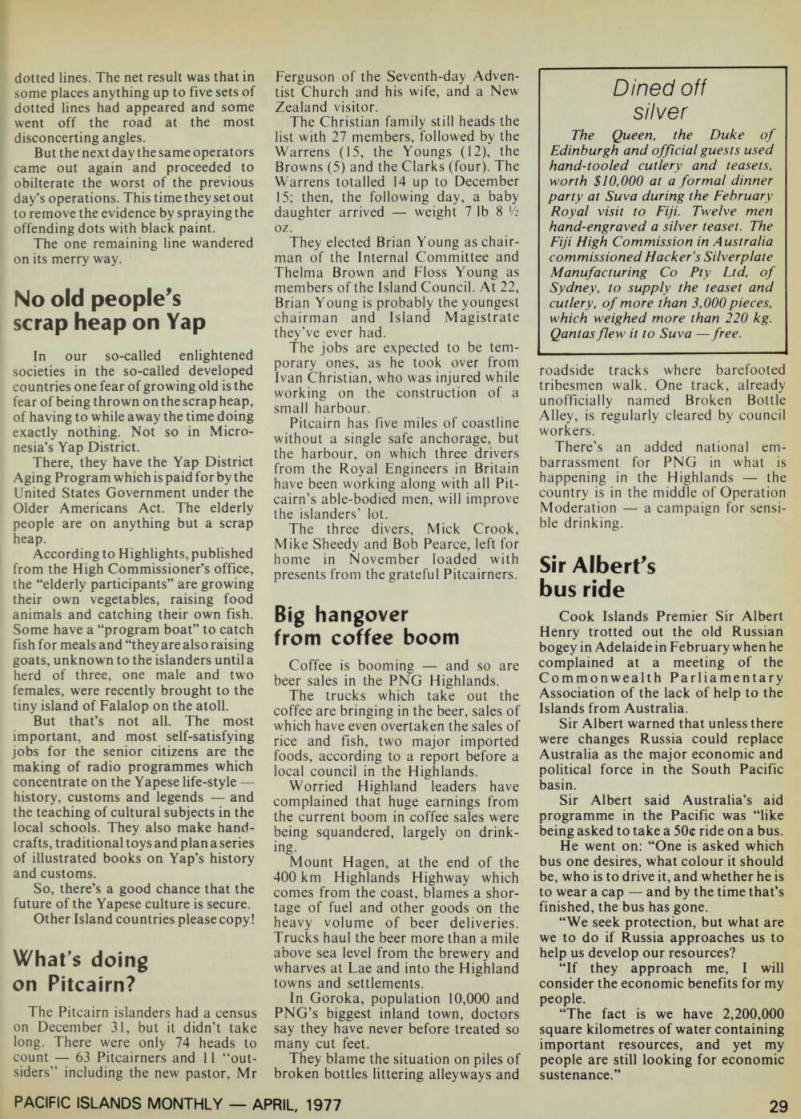
These Queen's Jubilee stamps must be among the most attractive the Cook Islands have ever released. Their colours are rich and the silver setting sets off the series to perfection.
dotted lines. The net result was that in some places anything up to five sets of dotted lines had appeared and some went off the road at the most disconcerting angles.
But the next day the same operators came out again and proceeded to obilterate the worst of the previous day’s operations. This time they set out to remove the evidence by spraying the offending dots with black paint.
The one remaining line wandered on its merry way.
No old people’s
scrap heap on Yap
In our so-called enlightened societies in the so-called developed countries one fear of growing old is the fear of being thrown on the scrap heap, of having to while away the time doing exactly nothing. Not so in Micro nesia’s Yap District.
There, they have the Yap District Aging Program which is paid for by the United States Government under the Older Americans Act. The elderly people are on anything but a scrap heap.
According to Highlights, published from the High Commissioner’s office, the “elderly participants” are growing their own vegetables, raising food animals and catching their own fish.
Some have a “program boat” to catch fish for meals and “they are also raising goats, unknown to the islanders until a herd of three, one male and two females, were recently brought to the tiny island of Falalop on the atoll.
But that’s not all. The most important, and most self-satisfying jobs for the senior citizens are the making of radio programmes which concentrate on the Yapese life-style history, customs and legends and the teaching of cultural subjects in the local schools. They also make hand crafts, traditional toys and plan a series of illustrated books on Yap’s history and customs.
So, there’s a good chance that the future of the Yapese culture is secure.
Other Island countries please copy!
What’s doing
on Pitcairn?
The Pitcairn islanders had a census on December 31, but it didn’t take long. There were only 74 heads to count —63 Pitcairners and 11 “out siders” including the new pastor, Mr
Ferguson of the Seventh-day Adven tist Church and his wife, and a New Zealand visitor.
The Christian family still heads the list with 27 members, followed by the Warrens (15, the Youngs (12), the Browns (5) and the Clarks (four). The Warrens totalled 14 up to December 15; then, the following day, a baby daughter arrived weight 7 lb 8 Vi oz.
They elected Brian Young as chair man of the Internal Committee and Thelma Brown and Floss Young as members of the Island Council. At 22, Brian Young is probably the youngest chairman and Island Magistrate they’ve ever had.
The jobs are expected to be tem porary ones, as he took over from Ivan Christian, who was injured while working on the construction of a small harbour.
Pitcairn has five miles of coastline without a single safe anchorage, but the harbour, on which three drivers from the Royal Engineers in Britain have been working along with all Pit cairn’s able-bodied men, will improve the islanders’ lot.
The three divers, Mick Crook, Mike Sheedy and Bob Pearce, left for home in November loaded with presents from the grateful Pitcairners.
Big hangover
from coffee boom
Coffee is booming and so are beer sales in the PNG Highlands.
The trucks which take out the coffee are bringing in the beer, sales of which have even overtaken the sales of rice and fish, two major imported foods, according to a report before a local council in the Highlands.
Worried Highland leaders have complained that huge earnings from the current boom in coffee sales were being squandered, largely on drink ing.
Mount Hagen, at the end of the 400 km Highlands Highway which comes from the coast, blames a shor tage of fuel and other goods on the heavy volume of beer deliveries.
Trucks haul the beer more than a mile above sea level from the brewery and wharves at Lae and into the Highland towns and settlements.
In Goroka, population 10,000 and PNG’s biggest inland town, doctors say they have never before treated so many cut feet.
They blame the situation on piles of broken bottles littering alleyways and
roadside tracks where barefooted tribesmen walk. One track, already unofficially named Broken Bottle Alley, is regularly cleared by council workers.
There’s an added national em barrassment for PNG in what is happening in the Highlands the country is in the middle of Operation Moderation a campaign for sensi ble drinking.
Sir Albert’s
bus ride
Cook Islands Premier Sir Albert Henry trotted out the old Russian bogey in Adelaide in February when he complained at a meeting of the Commonwealth Parliamentary Association of the lack of help to the Islands from Australia.
Sir Albert warned that unless there were changes Russia could replace Australia as the major economic and political force in the South Pacific basin.
Sir Albert said Australia’s aid programme in the Pacific was “like being asked to take a 50c ride on a bus.
He went on: “One is asked which bus one desires, what colour it should be, who is to drive it, and whether he is to wear a cap and by the time that’s finished, the bus has gone.
“We seek protection, but what are we to do if Russia approaches us to help us develop our resources?
“If they approach me, I will consider the economic benefits for my people.
“The fact is we have 2,200,000 square kilometres of water containing important resources, and yet my people are still looking for economic sustenance.”