Deaths
pp. 67-69 · Read in the full issue

of Islands People
Embarrassingly for the French, Pouvanaa’s son, Marcel, was elected to replace him in the French Cham ber of Deputies; and when Marcel died in 1961, his successor, John Teariki, seized every opportunity to proclaim that Pouvanaa had been the victim of a political frame-up.
Although Tahiti’s radical politi cians maintained constant pressure on the French Government for Pouvanaa’s release, the govern ment’s only concession to them in nine years was to allow Pouvanaa to move to a Protestant nursing home after three years in prison. Finally, on November 11, 1968 the 50th anniversary of the end of the war in which he had fought for France Pouvanaa was pardoned by decree of President de Gaulle.
Several thousand people turned out to welcome him when he return ed to Tahiti slightly paralysed from a stroke suffered the previous January. Six months later, President Pompidou, on coming to power, am nestied him along with other French citizens convicted of political crimes.
The amnesty meant that Pouvanaa’s record was ‘wiped clean’ and his civil rights were restored to him. He was thus able to run again for public office, and this he did in September, 1971, when he was elected to the French Senate for a nine-year term.
It was a symbolic victory for those Tahitians who had long felt that they could and should govern them selves. But Pouvanaa, then 76, was too old and broken in health to become again the magnetic per sonality of the autonomist move ment that he had once been. Indeed, his last years, like those of Archbishop Maze, were something of an anti-climax to a long career devoted to a single cause.
Archbishop Maze
Archbishop Maze, a Breton, was the fifth Vicar Apostolic of Tahiti.
He was born at Finistere, France, on April 4, 1885, and was ordained a priest of the Sacred Heart (Picpus) order when he was 25.
On arriving in Tahiti in Decem ber, 1910, he was immediately posted to the Cook Islands where he spent six years on Mauke and two on Atiu.
He was on Atiu in 1917 when the famous German sea raider, Count Felix von Luckner, arrived there in a small boat following the wreck of his ship, Seeadler, at Mopelia Atoll, Society Islands. Von Luckner had hopes of capturing another ship in which to continue raids on Allied shipping. He told Maze and the Atiu people that he and his companions were shipwrecked Dutch seamen.
Trustingly, they believed it, and provided the Germans with food and water.
In 1918, Maze was transferred to
the Tuamotu Archipelago where he spent two years working in conjunc tion with Father Amedee Nouailles (later Bishop of Tahiti) from head quarters on Hikueru Atoll.
Thereafter, he was placed in sole charge of the eastern atolls of the group remote, rarely-visited islands such as Reao, Pukarua, Nukutavake, Vahitahi, Tatakoto, Hao and Amanu.
Father Paul, as he was affec tionately known, had no fixed place of residence, but moved from atoll to atoll in trading schooners, Tuamotuan pahi, or in his own small cutter, the St Pierre. He learned the Tuamotuan dialects intimately and worked indefatigably to improve the spiritual, social and medical well being of his widely-scattered parishioners.
By the mid-thirties, Father Paul was already a semi-legendary figure.
He was of considerable assistance to the scientific expeditions from the Bishop Museum that visited the Tuamotus in 1929 and 1934, and virtually indispensable to the French administrators of the group.
The American novelists Nordhoff and Hall no doubt had him in mind when they created the character of Father Paul in their novel The Hur ricane (1936), which is set in the Tuamotus. The fictional priest is there described as ‘one of those transparently good old men, so often found in the service of the Roman Catholic Church, whose obscure and devoted lives the world never hears of, but who mean much to the little flocks they serve’.
After the death of Bishop Nouailles in 1937, Father Paul suc ceeded him, being consecrated in April, 1939. World War II pre vented the new bishop from making the traditional tour of his vicariate until 1946.
Meanwhile, the rapidly-growing number of children in Tahiti had caused him to devote much thought to the future of education in the ter ritory. One of the consequences was the arrival in Tahiti of the Sisters of Our Lady of the Angels, a Canadian teaching order, who opened a col lege at Faaa in 1951 and a school at Taravao shortly afterwards. Other schools were opened in other parts of the island during the next few years.
The growth of suburbs around Papeete led Maze to create several new parishes in which chapels were
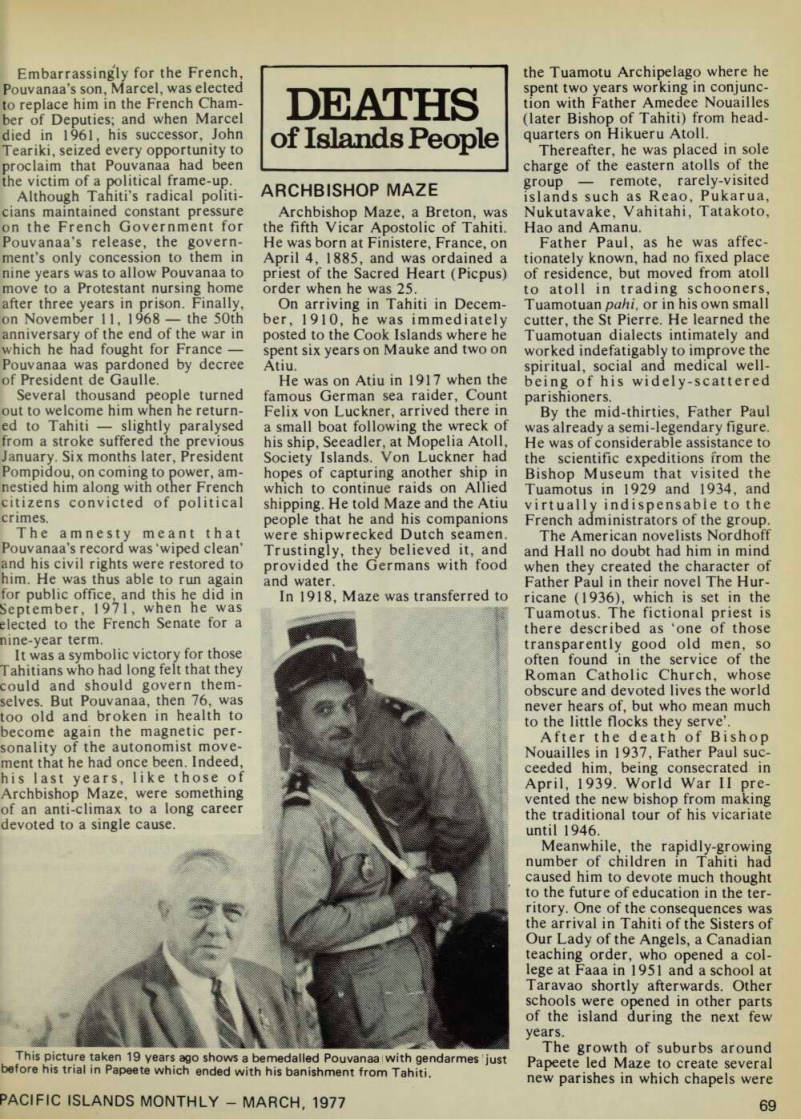
This picture taken 19 years ago shows a bemedalled Pouvanaa with gendarmes just before his trial in Papeete which ended with his banishment from Tahiti.
built and Catholicism has since prospered. But increasing urbanisa tion also created a serious child delinquency problem. So Maze brought in the Sisters of the Good Shepherd of Angers to grapple with it.
Bishop Maze was elevated to archbishop in 1966 when Pope Paul VI established a regular hierarchy of the Catholic Church in the Pacific and upgraded the status of Maze’s vicariate. However, two years later, at the age of 83, Maze handed over most of his duties to Michel Cop penrath, the first Islands-born priest to become a bishop. Maze resigned as archbishop in 1973.
Maze was a man of great charity, energy, endurance and apostolic zeal; a diplomat; and a firm believer in ecumenism. In 1970, in conjunc tion with Hubert Coppenrath, he published the fifth (extensively revised) edition of the Grammaire et Dictionnaire de le Langue Tahi tienne, originally prepared by Bishop Tepano Jaussen, the first Vicar Apostolic of Tahiti, more than a century earlier.
During his retirement, Archbishop Maze lived at Taravao where he worked on his memoirs despite increasing blindness caused by cataracts.
Father D. Moore The Rev Father Denis Moore, OBE, a former missionary in the Solomon Islands, died recently in New Zealand. He went to the group in 1931 and worked at Visale on Guadalcanal.
Father Moore returned to NZ at the start of World War 11. He was reposted to the Solomons in 1947. Heservedina number of areas, and was awarded the OBE for his outstanding work for education.
Chief Selwyn Taga Batagorovanua Chief Selwyn Taga Batagorovanua, one of the highest ranking custom chiefs on North Pentecost, New Hebrides, died in December, aged 85.
Mr Buzz Miller Mr Buzz Miller, American jour nalist and publisher who had lived in Tahiti since 1963, died of a brain haemorrhage while out fishing with a friend in January. In 1964 Mr Miller launched the magazine O’TAHITI, the first English language magazine to appear in Tahiti. In 1976 he extended op erations to the Cook Islands with the first edition of his Rarotonga Magazine.