Colourful Veterans
p. 66 · Read in the full issue
Tahiti Loses Two Of Its Most
By Robert Langdon
Pouvanaa a Oopa and Archbishop Paul Maze, SS.CC, two almost legendary figures of French Polynesia, have died in Tahiti. Both in their time exercised an enormous influence over the lives of the ter ritory’s population.
Pouvanaa, 81, a charismatic political leader and ardent na tionalist, almost succeeded some 20 years ago in persuading his country men to establish an independent Tahitian republic. In the days when French Polynesia’s Territorial As sembly had more powers than it has now, Pouvanaa was virtual prime minister of his country. He later served nine years of a 15-year term of exile and imprisonment in France for allegedly attempting to burn down Papeete, was pardoned by President de Gaulle and amnestied by President Pompidou. He ended his career as senator for French Polynesia in the French Parliament, with three years of his term still to run when he died on January 10.
Archbishop Maze, a missionary in the Pacific for nearly 70 years, died on December 21 in his 92nd year, eight days after a fall in which he broke his hip. He was renowned before World War II for his mis sionary work among the isolated Polynesians of the eastern Tuamotus; and for nearly 30 years after being made Bishop of Tahiti in 1939, he was the leading spirit in the affairs of the Roman Catholic Church in French Polynesia. Like Pouvanaa, he was a fluent and per suasive orator in the Tahitian language.
Pouvanaa, who was once de scribed as a ‘Tahitian David fighting the Goliath of French rule’, rose to prominence from shadowy origins.
He was born on Huahine on May 10, 1895, but little is known with cer tainty about his antecedents.
The first edition (1962) of the biographical dictionary Tahitiens states that one of his grandfathers was a Danish seaman, while the sec ond edition (1975) adds that his father is said to have been a French born printer, journalist and lawyer, who died in Tahiti in 1 933.
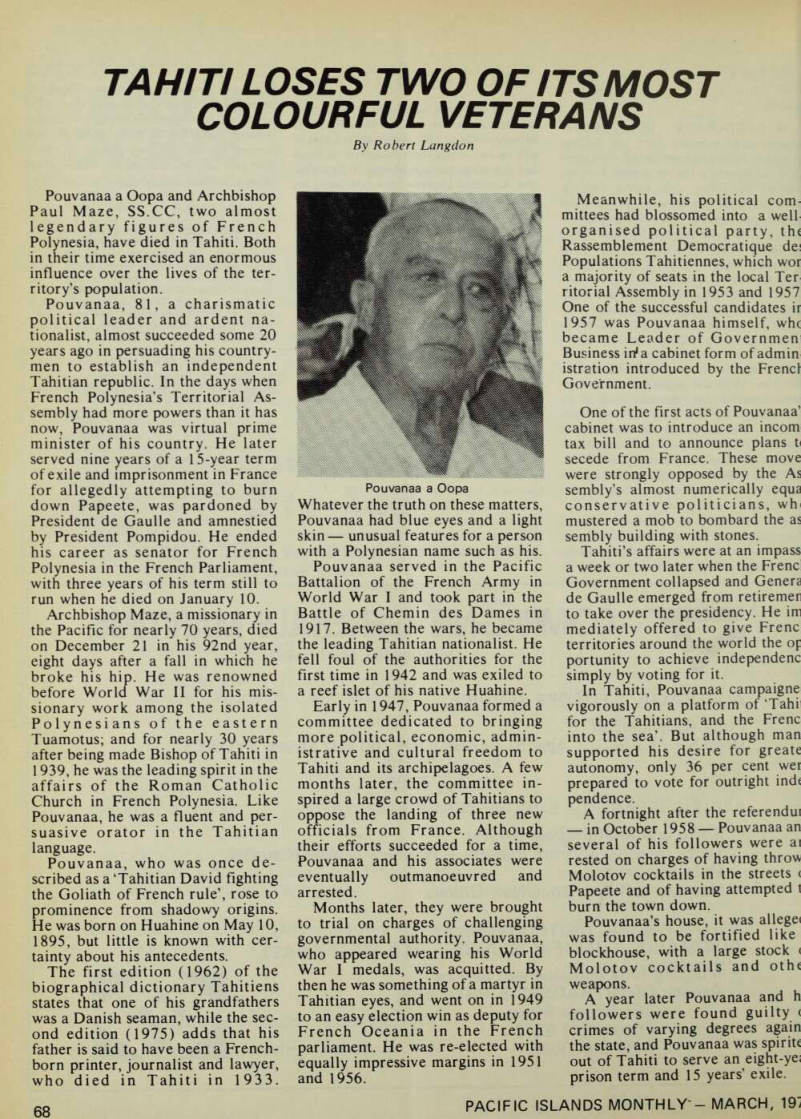
Whatever the truth on these matters, Pouvanaa had blue eyes and a light skin— unusual features for a person with a Polynesian name such as his.
Pouvanaa served in the Pacific Battalion of the French Army in World War I and took part in the Battle of Chemin des Dames in 1917. Between the wars, he became the leading Tahitian nationalist. He fell foul of the authorities for the first time in 1942 and was exiled to a reef islet of his native Huahine.
Early in 1947, Pouvanaa formed a committee dedicated to bringing more political, economic, admin istrative and cultural freedom to Tahiti and its archipelagoes. A few months later, the committee in spired a large crowd of Tahitians to oppose the landing of three new officials from France. Although their efforts succeeded for a time, Pouvanaa and his associates were eventually outmanoeuvred and arrested.
Months later, they were brought to trial on charges of challenging governmental authority. Pouvanaa, who appeared wearing his World War I medals, was acquitted. By then he was something of a martyr in Tahitian eyes, and went on in 1949 to an easy election win as deputy for French Oceania in the French parliament. He was re-elected with equally impressive margins in 1951 and 1956.
Meanwhile, his political com mittees had blossomed into a well organised political party, the Rassemblement Democratique de; Populations Tahitiennes, which wor a majority of seats in the local Ter ritorial Assembly in 1953 and 1957 One of the successful candidates ir 1957 was Pouvanaa himself, whe became Leader of Governmen Business in'a cabinet form of admin istration introduced by the Trend Government.
One of the first acts of Pouvanaa’ cabinet was to introduce an incom tax bill and to announce plans t< secede from France. These move were strongly opposed by the As sembly’s almost numerically equa conservative politicians, whi mustered a mob to bombard the as sembly building with stones.
Tahiti’s affairs were at an impass a week or two later when the Frenc Government collapsed and Genera de Gaulle emerged from retiremen to take over the presidency. He im mediately offered to give Frenc territories around the world the op portunity to achieve independenc simply by voting for it.
In Tahiti, Pouvanaa campaigne vigorously on a platform of ‘Tahf for the Tahitians, and the Frenc into the sea’. But although man supported his desire for greate autonomy, only 36 per cent wer prepared to vote for outright ind< pendence.
A fortnight after the referendui in October 1958 Pouvanaa an several of his followers were ai rested on charges of having throw Molotov cocktails in the streets ( Papeete and of having attempted t burn the town down.
Pouvanaa’s house, it was allege* was found to be fortified like blockhouse, with a large stock < Molotov cocktails and othc weapons.
A year later Pouvanaa and h followers were found guilty ( crimes of varying degrees again the state, and Pouvanaa was spirite out of Tahiti to serve an eight-yei prison term and 15 years’ exile.
Pouvanaa a Oopa