This Twin Otter
pp. 59-63 · Read in the full issue
Is Tonga’S Own
South Pacific Island Airways has upgraded its Pago Pago-Nukualofa service, replacing the seven-seater Cessna with a 20-seater De Havilland Twin Otter. King Taufa’ahau Tupou met the aircraft on its first arrival at Fua’amotu airport, and congratulated Mr George Wray, SPIA president, for acquiring a larger aircraft to serve Tonga.
Mr Wray, in reply, said the aircraft was to be considered Tonga’s own. In addition to the Pago Pago-Nukualofa service, it will operate Tonga’s inter nal service. An inscription on the Twin Otter reads, “In service to His Majesty, King of Tonga”.
When she left the wharf, Ravakai was carrying 27 persons, and an eye witness on board said, “the boat was fully laden with cargo both above and below deck. Movement aboard the boat was difficult because of the number of people aboard and the deck cargo which was stacked up to the full height of the canopy aft of the main cabin. A net was also suspended from the canopy and this contained more cargo. A space for people to walk from the back of the boat to the front was left on the starboard side buteventhenyou could not stand up straight there because of the net above. All passengers were perched on top of the deck cargo between it and the net.
Their baggage was alongside them”.
The Ravakai was not setting out on a short voyage in sheltered waters. This was a voyage of more than 700 miles, being made by a vessel which has achieved a maximum speed of eight knots. At about 11.45 pm the vessel began to list to port. The passengers scrambled to the starboard side of the vessel, which then rolled over onto her side. The crew and passengers were able to scramble to the port side of the vessel, which because of her in-built buoyancy was in no great danger of
sinking.
After considerable effort on the part of two men, the rubber life-raft was freed from below the deck cargo and the women and children were put into it. After the tarpaulin cover was cut away the vessel began slowly to right herself, with only the stern above water.
All the following day was spent clinging to the boat, or huddled in the life-raft, and although Rarotonga was in sight at one period it was not possible to move the ship under jury rig.
At 3.30 pm on the third day the distressed vessel and her complement
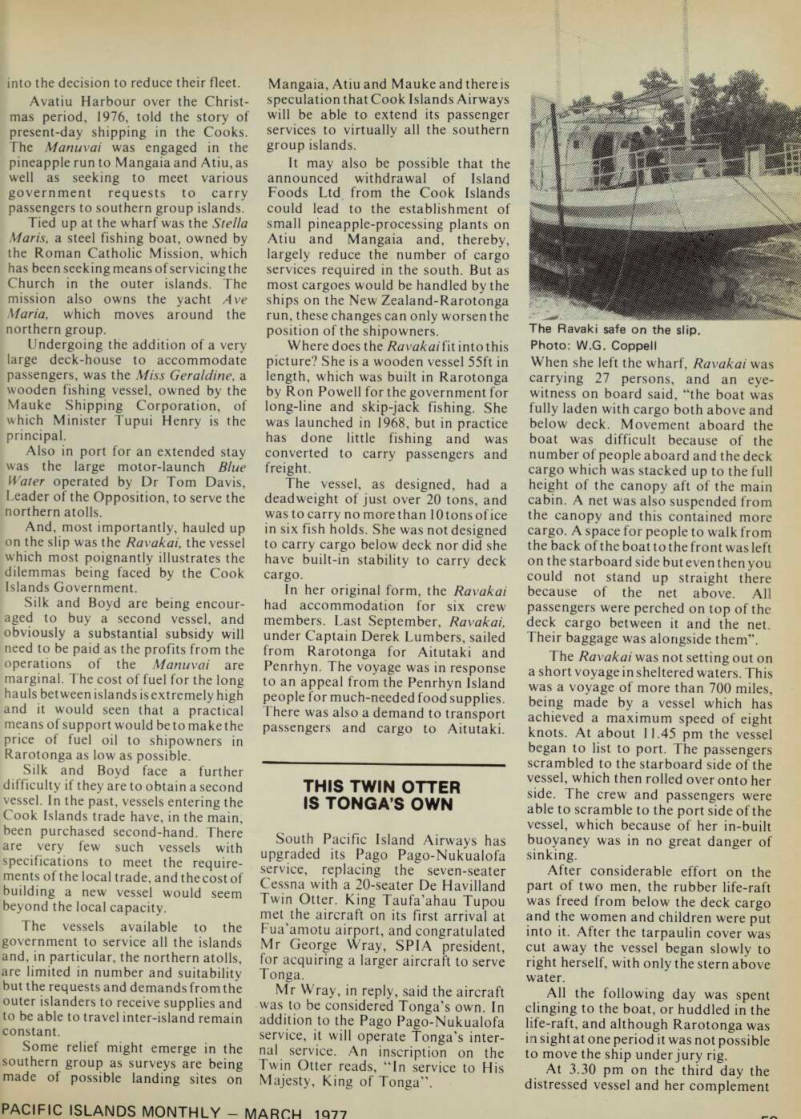
The Ravaki safe on the slip.
Photo: W.G. Coppell
were sighted by the Islander aircraft of Cook Islands Airways.
Flares, torches and a large rubber raft were dropped o the survivors and at 9 pm the Stella Maris was able to complete the rescue mission. One of the passengers, loane Dean, was lost in the mishap. It was most fortunate that the death-toll was not larger.
The Ravakai was towed back to Rarotonga and the government reimbursed the passengers for the losses they suffered in the disaster.
However, several questions must be raised. While it must be conceded that the government seems to be in a well nigh impossible position with regard to the provision of shipping to the more isolated islands, it must also be argued that the government itself must be the most vigilant of all those concerned with shipping, to ensure that the regulations and ordinances in force in the Cook Islands primarily concerned with the minimum standards of safety on local shipping are strictly enforced.
All vessels wishing to carry cargo and/or passengers within the Cook Islands arc required to be licensed, but the government, apparently, is exempt from these requirements.
The Premier of the Cook Islands, Sir Albert Henry, was obviously most distressed at the mishap and September 6 he said, “I wish to assure the public that a formal independent public enquiry will be held into this matter at which time all persons, who feel they have a contribution to make towards the ascertainment of all the relevant facts, will have an opportunity to provide their evidence. For government’s part the Ravakai casualty has worsened an already most difficult problem that of internal shipping. Let me assure the outer islands that I will be taking immediate steps today to get something done about their needs”.
On Rarotonga, the Ravakai incident remains a matter for much discussion and it seems unfortunate that, as late as the end of the year, the findings of the enquiry had not been made public, nor does it seem that there has been an inquest into the loss of loane Dean’s life.
The pressures upon the Cook Islands as a result of its difficulties about inter-island shipping are familiar ones in the Pacific countries, and it is to this area that the developed countries could well direct their attention when they are offering assistance to Island countries.
Air Niugini has
a drink problem
Air Niugini, PNG’s national airline, may stop serving alcohol to passengers on domestic flights.
There have been too many complaints from passengers about drunks causing trouble on flights, a management spokesman said in February.
The airline’s cabin crews had been instructed to refuse to serve passengers who appeared to have drunk too much, but the refusal itself often precipitated problems. On several occasions aircraft captains had intervened to stop trouble developing among passengers.
As a result, the airline was seriously considering a ban on alcoholic drinks.
The bar service on international flights would not be affected.
Air Niugini’s new Boeing 707 air craft flew its inaugural service from Port Moresby to Kagoshima, Japan, in January.
The aircraft, bought from Qantas for about K 5 million, seats up to 148 passengers in first and economy classes.
There were 55 VIP passengers from Papua New Guinea on the in augural flight. They included the Deputy Prime Minister and Minister for Defence, Foreign Affairs and Trade, Sir Maori Kiki, and Lady Kiki; the Minister for Transport, Works and Supply, Mr Bruce Jephcott; Leader of the Opposition, Sir Tei Abal; Chairman of the Public Services Commission, Mr Rabbie Namaliu; and three MPs, Messrs Harry Humphreys (Talasea), Suinavi Otio (Lufa), and Kui Baiyand (Mid dle Ramu).
The plane stayed overnight at Kagoshima and returned to Port Moresby the next day.
Nauru’S Conditions
For Forum Line
The Nauru Government will guarantee 20% of losses the South Pacific Forum shipping line expects to incur in its first year of operations.
Nauru will also provide two ships.
The Western Samoa Minister of Economic Affairs and acting Minister of Communications and Transport, Mr Asi Eikeni, made those statements after a recent visit to Nauru.
Mr Eikeni and the acting Attorney- General, Mr Neroni Slade, went to Nauru to discuss the shipping line
with the new Nauru Government. Mr Eikeni said the government had agreed to honour an agreement the previous government made to guarantee the line’s establishment costs and the provision of ships.
But Nauru would not sign the draft constitution for the shipping line, even with provision for a review in 12 months, unless there was agreement to amendments it proposed. Nauru wants all member countries of the forum to be shareholders in the ship ping line. It has proposed a share of $lO,OOO each.
Originally the plan was that all members of the Forum would give 510,000 to set up the line. Members providing ships would share profits and pay any costs, while the other members would be assured of better and more regular services.
Mr Eikeni said the Nauruan proposal did not present any problems for the Western Samoa Government.
It could very well turn out the best plan for the line. The only fear was that prolonged discussion of the Nauruan proposal would delay setting up the line within the next few weeks.
He said plans were unchanged for the United States to provide a ship for Samoa. New Zealand has also pledg ;d to supply a ship.
Over-Flying Planes
Are Worrying Fiji
With Qantas and Pan American World Airways over-flying Nadi Air sort on several of their flights between Australia and the US, the Fiji Sovernment is becoming worried.
Fewer landings mean heavy financial oss.
The Fiji Minister for Com nunications, Works and Tourism, Vlr Jonati Mavoa, expressed his fears )f losses at a recent meeting of the South Pacific Air Transport Council n Suva. Delegations from Britain, \ustralia, New Zealand and Fiji attended.
Mr Mavoa said over-flights would se a serious blow to airport revenues, md increasing landing charges was lot a solution as it would increase the lumber of over-flights. Alternative methods were needed to raise an atherwise constantly decreasing ■evenue. One method would be charge airlines, which did not actually land, 'ees for use of Nadi weather informa ;ion.
The question of airlines over-flying Nadi has been raised often in the past.
Now, with fewer airlines using Nadi and bigger aircraft making fewer
calls, Mr Mavoa’s warning is timely.
Mr Mavoa said the South Pacific region depended on Nadi airport as an important centre of international transport.
Six New Ships For
Micronesian Fleet
The US Trust Territory plans to add six new ships to its fleet. It recent ly sent a “letter of intent” to the Namura Shipbuilding Co Ltd, Osaka, Japan, for the construction of six new field trip vessels.
Mr William P. Flanagan, director of Transportation and Communica tion, and officials of his department, inspected the capabilities of five shipyards in Japan before deciding that Namura was the most suitable to build the ships.
The ships will be 56.38 metres long, with a beam of 10.05 metres. Each will carry 12 cabin passengers and up to 100 deck passengers. Mr Flanagan expects the new ships to be operating by the end of 1978.
French Shipping
Lines Merge
Two of the top French government owned shipping lines were to merge on March 1. The two lines, Com pagnie Generale Maritime (CGM).
Compagnie des Messageries Maritimes, now become the Com pagnie Generale Maritime (CGM).
With a fleet of 102 vessels, the CGM is the biggest French shipping line.
Previously, the two partners operated across the Atlantic and through Far East and Pacific ports. Together, they now operate throughout the world.
Emblem of the new CGM is a ship’s bow breaking through the waves, in red, white and blue. Among the com pany’s new vessels in Pacific ports are the Rostand and Rousseau.
Fiji Dockers
In The Money
The Fiji Waterside Workers and Seamen’s Union seems to be on the way to becoming a wealthy “capitalist” organisation. About two years ago it took up 26% interest in the newly-formed shipping company, Pacific Line Ltd, with Carpenters, also 26% and Sofrana 48%.
After initial early losses the line went into the black, and in the latest financial term has decided to pay a $30,000 interim dividend to the three shareholders. The dividend is at the rate of $ 1.50 for every dollar invested.
Mr Taniela Veitata, unofficial king of the Fiji waterfront and industrial adviser to the union, commented: “We are proud of what the company has achieved and look forward to be ing able to make further contributions to its trading results”.
Pacific Line runs a chartered ship, the Tui Cakau, 2,460 tonnes, on a cargo service between New Zealand and Fiji. It dropped a call at Apia some months ago.
Mr Harry Kiss, of Carpenters, who is managing director of Pacific Line, said the line was looking at major new cargo sources, including the shipment of sugar to New Zealand and other markets. Since its beginning, the line had brought about $550,000 in foreign earnings into Fiji, and had paid about $228,000 in local wages and taxes.
After Snags, Png
Gets New Trawlers
Papua New Guinea’s four new government-owned trawlers were due to go into operation in December after a four-month delay because of construction faults.
The 20-metre vessels cost the government K 186,000 each.
A spokesman for the Department of Transport, Mr John Reily, said the faults had been rectified at the ex pense of the manufacturers, Pan-Asia Shipbuilders of Singapore, after long negotiations.
Air Niugini stewardesses in Kagoshima after the inaugural flight to Japan. Note the new-style uniforms. Top to bottom the stewardesses are: P. Papilla, W. Teilflo, L. Caparas, H. Mesulam, W. Gutierrey.
Photo; Veronica Williams.