Sea tragedy underlines the
pp. 57-59 · Read in the full issue
Pacific Transport
Sea tragedy underlines the Cooks’ transport troubles
From W. G. Coppell
As the Cook Islands has an area of about 250 square kilometers of land surface on 15 islands scattered across more than 2,000,000 square kilometres of the Pacific, the provision of adequate inter-island shipping services has been an intractable problem extending over a lengthy period.
In days gone by, some of the southern group islands benefited from the calls of ships operating out of Auckland, which were engaged in the fruit trade. Much of the remaining work was done by the graceful wooden schooners owned by the trading companies, such as A. B. Donald’s Tiare Taporo or the Cook Islands Trading Company’s Tagua. There was also a period, particularly during the 1890 s, when a number of the islands owned and operated their own schooners Aitutaki had the Araura, Atiu had the Ngamaru Ariki, the Takitumu belonged to the Ngatangiia people of Rarotonga and the Penrhyn islanders had the doubtful pleasure of working the Te Tautua, a ship with a chequered career.
Since World War 11, the small motor-vessel has gradually replaced the wooden schooner and for a period D. C. (Dick) Brown, played a leading role in Cook Islands shipping with a long line of ships, a number of which became wrecks upon the reefs, sank at sea or became derelict. Among these were the Tahitienne, Inspire, Taveuni, Apanui and Mahurangi.
Towards the close of its time as the governing power in the Cooks, the New Zealand Government decided that there should be a rationalisation of shipping services; that well-found ships had to be provided; that there should be a reasonable but controlled element of competition among licence holders and that a subsidy should be available to the ship-owners who meet the specifications demanded of a licence-holder.
It was because of this move that three licences were issued to A. B.
On September 1 last year, the Ravakai, a Cook Islands government vessel almost foundered while on the way from Rarotonga to Aitutaki and Penrhyn. She turned on her side, one man was lost and she was rescued after her more than two dozen passengers had faced death for 40 hours . This mishap underlines the difficulties the Cooks faces over shipping.
Donald and Co, D. C. Brown, and Silk and Boyd Ltd. There was reality about the desire to see three vessels operating as the pineapple industry was expanding and there was a growing traffic in fruit between Mangaia and Rarotonga.
There was also a great amount of building materials making their way to outer islands for use in the construction of schools, hospitals, government administration buildings and harbour installations, and there were many people travelling as deck passengers, For a number ofreasonsthe pattern of licence-holding changed Dick Brown died, the Cook Islands Trading Corporation took over the Cook
Islands interests of A. B. Donald and Co, and, eventually, the only ship owners left maintaining a regular service were Silk and Boyd, who were to own three efficient motor-vessels, the Tagua, the Manuvai and the Manutea.
In retrospect, it was unfortunate that Silk and Boyd came under criticism as having a monopoly over the shipping services. The Tagua was wrecked on Mangaia and the Manutea was sold out of the country. The Manuvai is now the only substantial vessel operating in the Cooks.
But, the pattern of inter-island travel and trade has altered dramatic cally in recent years. The pineapple industry has not expanded to the extent earlier predicted, the flow ol building materials has declined very much and the number of inter-island passengers has also fallen away. A factor which contributed to the contraction of Silk and Boyd’s interests was the granting of a licence by the Cook Islands for Captain Hugh Williams to operate the Moana, formerly the Gilbert and Ellice Islands Government vessel Moana Roi.
Hughie Williams did not stay long but his stay and competition for a dwindling trade forced Silk and Boyd
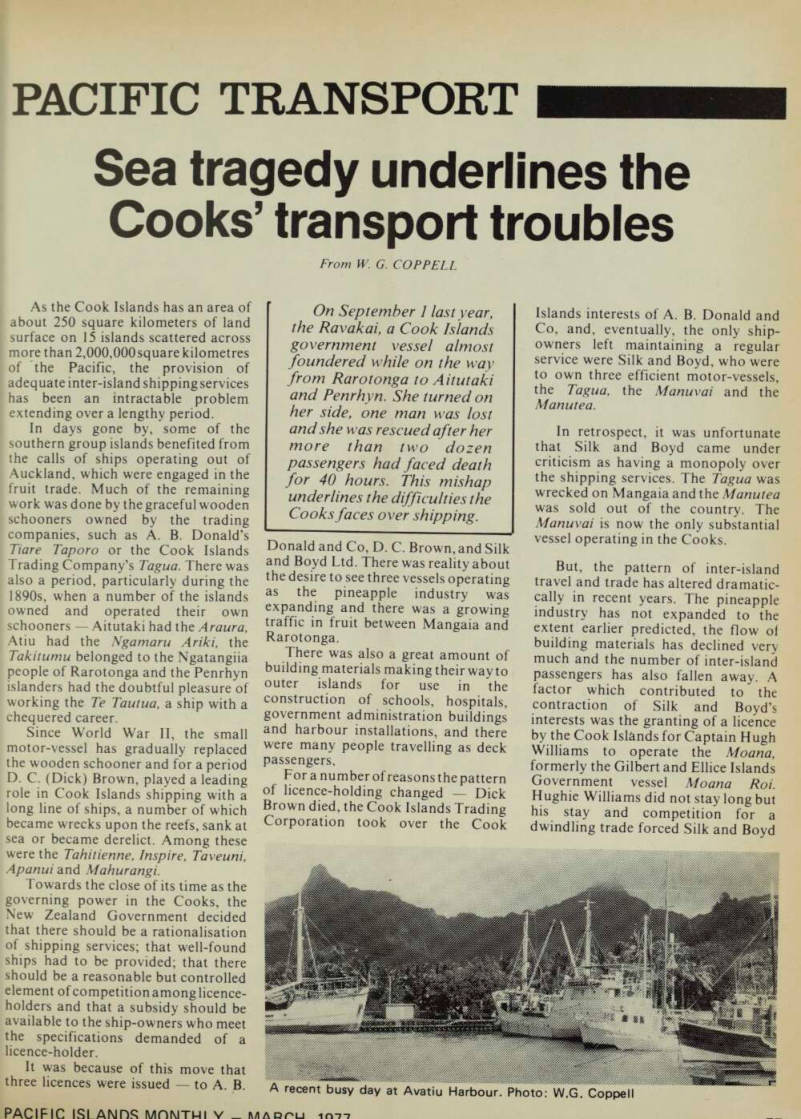
A recent busy day at Avatiu Harbour. Photo; W.G. Coppell
into the decision to reduce their fleet.
Avatiu Harbour over the Christ mas period, 1976, told the story of present-day shipping in the Cooks.
The Manuvai was engaged in the pineapple run to Mangaia and Atiu, as well as seeking to meet various government requests to carry passengers to southern group islands.
Tied up at the wharf was the Stella Maris, a steel fishing boat, owned by the Roman Catholic Mission, which has been seeking means of servicing the Church in the outer islands. The mission also owns the yacht Ave Maria, which moves around the northern group.
Undergoing the addition of a very large deck-house to accommodate passengers, was the Miss Geraldine, a wooden fishing vessel, owned by the
Mauke Shipping Corporation, of
which Minister Tupui Henry is the
principal.
Also in port for an extended stay was the large motor-launch Blue Water operated by Dr Tom Davis, Leader of the Opposition, to serve the northern atolls.
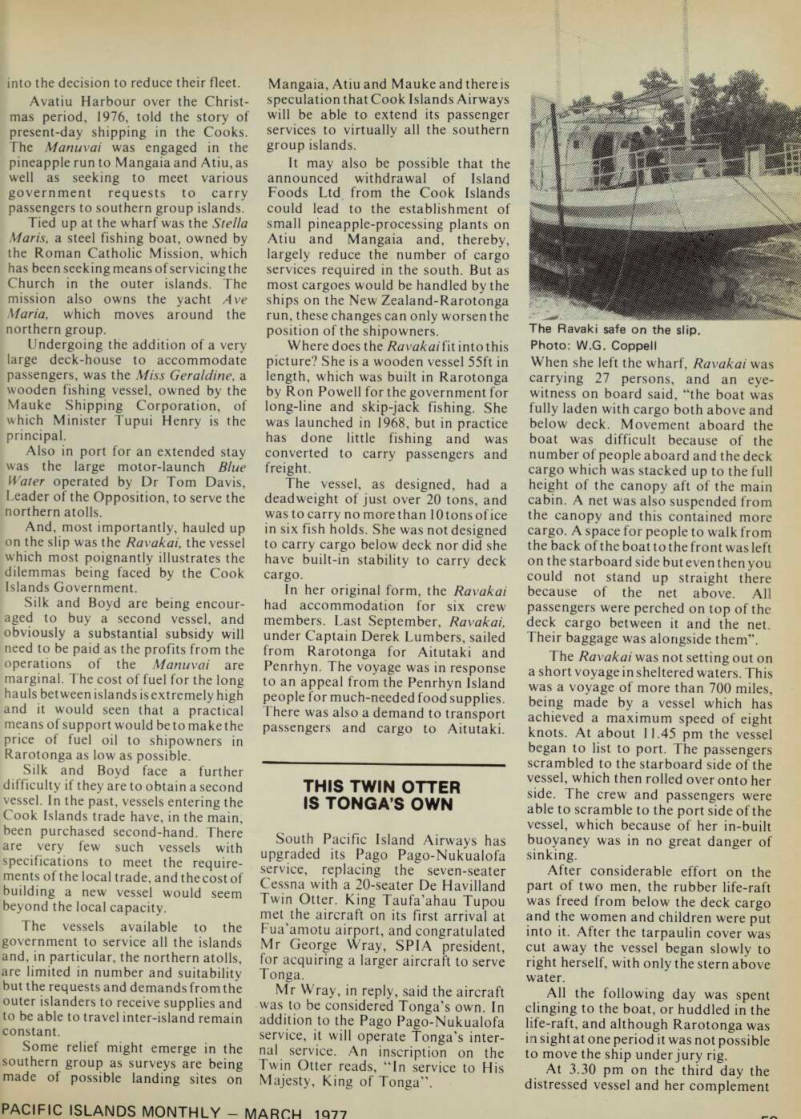
And, most importantly, hauled up on the slip was the Ravakai, the vessel which most poignantly illustrates the dilemmas being faced by the Cook Islands Government.
Silk and Boyd are being encour aged to buy a second vessel, and obviously a substantial subsidy will need to be paid as the profits from the operations of the Manuvai are marginal. The cost of fuel for the long hauls between islands is extremely high and it would seen that a practical means of support would betomakethe price of fuel oil to shipowners in Rarotonga as low as possible.
Silk and Boyd face a further difficulty if they are to obtain a second vessel. In the past, vessels entering the Cook Islands trade have, in the main, been purchased second-hand. There are very few such vessels with specifications to meet the require ments of the local trade, and the cost of building a new vessel would seem beyond the local capacity.
The vessels available to the government to service all the islands and, in particular, the northern atolls, are limited in number and suitability but the requests and demands from the outer islanders to receive supplies and to be able to travel inter-island remain constant.
Some relief might emerge in the southern group as surveys are being made of possible landing sites on
Mangaia, Atiuand Mauke and there is speculation that Cook Islands Airways will be able to extend its passenger services to virtually all the southern group islands.
It may also be possible that the announced withdrawal of Island Foods Ltd from the Cook Islands could lead to the establishment of small pineapple-processing plants on Atiu and Mangaia and, thereby, largely reduce the number of cargo services required in the south. But as most cargoes would be handled by the ships on the New Zealand-Rarotonga run, these changes can only worsen the position of the shipowners.
Where does the Ravakai fit into this picture? She is a wooden vessel 55ft in length, which was built in Rarotonga by Ron Powell for the government for
long-line and skip-jack fishing. She
was launched in 1968, but in practice has done little fishing and was converted to carry passengers and
freight.
The vessel, as designed, had a deadweight of just over 20 tons, and was to carry no more than lOtonsofice in six fish holds. She was not designed to carry cargo below deck nor did she have built-in stability to carry deck cargo.
In her original form, the Ravakai had accommodation for six crew members. Last September, Ravakai, under Captain Derek Lumbers, sailed from Rarotonga for Aitutaki and Penrhyn. The voyage was in response to an appeal from the Penrhyn Island people for much-needed food supplies.
There was also a demand to transport passengers and cargo to Aitutaki.