such a rich
pp. 45-46 · Read in the full issue
Islands’ bird life: such a rich heritage under threat
Books
Papua New Guinea and the Solomons have a rich and varied bird fauna. Everyone has heard about the birds of paradise, not found elsewhere except for two species in the West In dies, but there are also the magnificently crested goura, largest pigeon in the world, exquisitely plumaged kingfishers, beautiful parrots such as the kalanga, flower peckers, bower birds, hornbills, 'cassowaries, and a host of other species.
The co-authors of Birds of New Guinea and Tropical Australia list 852 local and visiting birds for Papua New Guinea, Irian Jaya and the Solomons. It is no wonder that 41 pages in E.T. Gilliard’s Birds of Paradise and Bower Birds (1969) are taken up by details of visits and ex peditions by ornithologists between 1818 and 1956, and that there have been just about as many publications on the birds as there are species.
Even so, much work remains to be done to fully uncover this great heritage of the Islands. In this superb book, Peckover and Filewood con tinue the work begun by Salvadori, Gould and Sharpe in the 19th century and continued by Mayr, Iredale, Rand and Gilliard, Schodde and Hitchcock, and others in recent times.
Advances in ornithology and photography have enabled the co authors to give us brilliant pictures of many of the birds in their natural habitat, and to provide a text, supplemented by maps of distribu tion, that helps the layman to a better appreciation of the unique place which the feathered inhabitants hold in the Islands. This is most important because it is the people at large, villagers and townsfolk no less than politicians, to whom this wonderful heritage is entrusted. It is they, just as much as the ornithologists, who need to have a proper understanding of the bird world around them if an ecological disaster is to be prevented.
The Australian Administration was too slow to act. It was not until 1968 that the Fauna Protection Ordinance
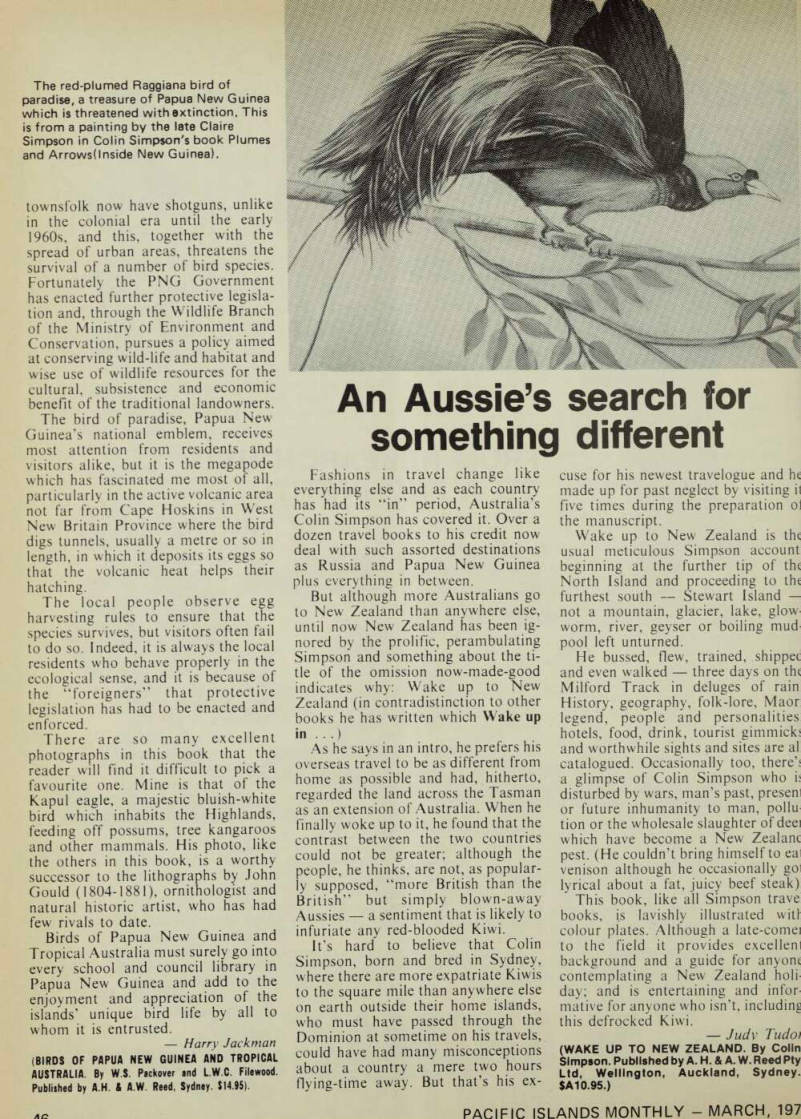
came into operation, protecting all birds of paradise, goura pigeons, Salvador's teal, osprey, New Guinea eagle, and certain egrets. By that time many species had already become scarce in some localities. No longer could one see large trees made fiery red by dozens of displaying Raggiana birds of paradise not far from what is now Kwikila sub-provincial headquarters, as I was fortunate to see them in 1948. No longer was the
goura pigeon a common bird along the banks of the Keram River as it had been in the 19505, and the Kokomo, the huge hornbill, who makes an amusing pet (mine flew around the Lawes Road area of Port Moresby until the police “arrested” it because of complaints from neighbours and it had to be sent to the sanctuary at Nondugl) had become scarce along the lower Vailala River, Very many villagers and some
townsfolk now have shotguns, unlike in the colonial era until the early 19605, and this, together with the spread of urban areas, threatens the survival of a number of bird species.
Fortunately the PNG Government has enacted further protective legisla tion and, through the Wildlife Branch of the Ministry of Environment and Conservation, pursues a policy aimed at conserving wild-life and habitat and wise use of wildlife resources for the cultural, subsistence and economic benefit of the traditional landowners.
The bird of paradise, Papua New Guinea’s national emblem, receives most attention from residents and visitors alike, but it is the megapode which has fascinated me most of all, particularly in the active volcanic area not far from Cape Hoskins in West New Britain Province where the bird digs tunnels, usually a metre or so in length, in which it deposits its eggs so that the volcanic heat helps their hatching.
The local people observe egg harvesting rules to ensure that the species survives, but visitors often fail to do so. Indeed, it is always the local residents who behave properly in the ecological sense, and it is because of the “foreigners” that protective legislation has had to be enacted and enforced.
There are so many excellent photographs in this book that the reader will find it difficult to pick a favourite one. Mine is that of the Kapul eagle, a majestic bluish-white bird which inhabits the Highlands, feeding off possums, tree kangaroos and other mammals. His photo, like the others in this book, is a worthy successor to the lithographs by John Gould (1804-1881), ornithologist and natural historic artist, who has had few rivals to date.
Birds of Papua New Guinea and Tropical Australia must surely go into every school and council library in Papua New Guinea and add to the enjoyment and appreciation of the islands’ unique bird life by all to whom it is entrusted.
Harry Jackman
(BIROS OF PAPUA NEW GUINEA AND TROPICAL AUSTRALIA. By W.S. Packover and LW.C. Filewood.
Published by A.H. & A.W. Reed, Sydney. $14.95).