Tropicalities
pp. 38-43 · Read in the full issue

When the Rising Sun did barrel rolls over a battered Rabaul
From V.J. SANDERS in Port Moresby
Not many people realise that Rabaul was one of the first targets south of the equator to be attacked and later occupied by the Japanese in early 1942, in their thrust towards New Guinea and the Solomons.
In fact, while the Japanese under General Yamashita were battling their way down the Malayan Penin sula, Rabaul had already fallen to the forces of Major General Horii on January 23, 1942. (The latter led the Japanese along the Kokoda Trail later in the year and was drowned in the Kumusi River during the subsequent retreat.) Earlier in the month, high-flying Japanese reconnaissance aircraft had been seen over Rabaul, presumably from the enemy bases in the Caroline Islands at Truk some 800 miles to the north, and bombing raids were carried out over Kavieng and Simpson Har bour.
Meanwhile, the only defence forces in Rabaul were a battalion of infan try, some gunners and less than a dozen RAAF Wirraways. The last named were basically trainer/army co-op planes never intended for offen sive action.
Against this small defence force, the Japanese sent a combined operational task force of assorted naval vessels and troop transports, supported by the slh Carrier Division, fresh from its triumph at Pearl Har bour. The aircraft carriers Shokaku and Zuikaku formed part of the group and supplied the navy Zero fighters.
The RAAF was operating from Lakunai adjacent to Matupi and also from Vunakanau on the escarpment, some 16 miles from Rabaul, inland from Vulcan.
Within a very short time, by January 21, only two Wirraways had survived the futile, but very brave attempt, to fight off the Japanese air
attacks, for the cumbersome 2-seater Wirraways with a top speed of only 220 mph were no match for the 340 mph Zero fighters.
The Zero pilots then put on taun ting aerobatic displays over Simpson Harbour performing barrel rolls and loops low across the water.
Two days later, silence fell over Rabaul, as the invasion force sub jugated the defenders and for many weeks the Allied HQ in Moresby and Brisbane were in ignorance of the details of the fall of the town. Sketchy accounts were received weeks later from the few who managed to escape by sea.
The two Wirraways were flown to Port Moresby via Lae and the only remaining Hudson had taken off, fill ed with wounded men, at 3 am from Vunakanau on January 22 and managed to reach Cooktown via Moresby, making a forced landing there because engine overheated.
Later, in March, the Americans sent Flying Fortresses up from Townsville to bomb shipping in Rabaul harbour, but the Forts were never much good at hitting targets from high altitudes.
One of the B 17s ran out of fuel on its way back from Rabaul after a run ning battle with Japanese Zeros, and crash-landed in the Agaiambo swamp a few miles east of Pongani in the Northern District, where it can still be seen to this day almost covered with swamp grass and reeds. The 11-man crew all survived after walking for four days to a nearby village.
During this time the Japanese were establishing their largest advanced base at Rabaul and sometimes over 100 ships including naval, cargo and coastal vessels were concentrated in Simpson Harbour.
In fact, in April, 1942, the Japanese mounted their main invasion force for
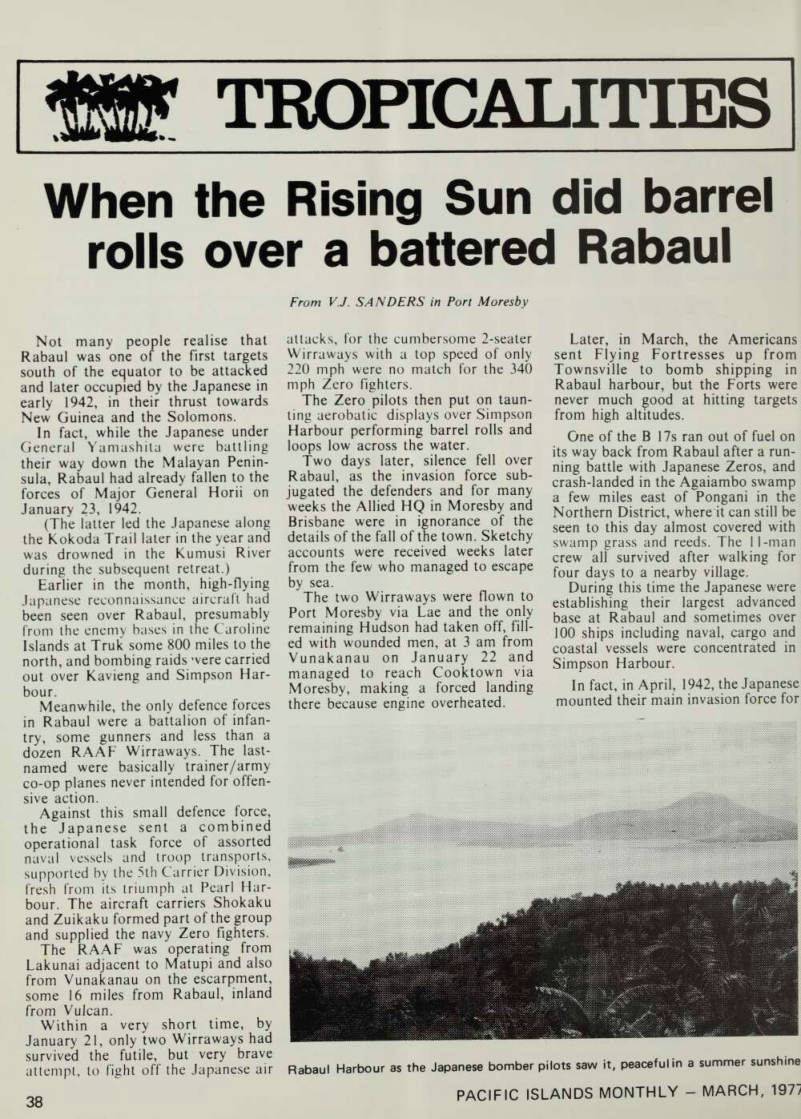
Rabaul Harbour as the Japanese bomber pilots saw it, peaceful in a summer sunshine
the occupation of Port Moresby from Rabaul, but it was thwarted by the Americans at the battle of the Coral Sea during the first week in May.
As the war proceeded and the Allies were able to develop new satellite airfields around Port Moresby such as Wards, Berry, Durands and Schwimmers, Australian and American warplanes started to counter attack the Japanese bases at Lae, Buna and Rabaul.
By August 3, the Allies had made it so hot for the Japanese fighter base at Lae, that the enemy withdrew most of their aircraft back to Rabaul.
At the same time the Americans landed at Guadalcanal in their first counter-offensive on August 7. As soon as the Japanese learned of the invasion of Guadalcanal they mounted one of their longest-ever fighter offensives from Rabaul down to the Solomons 560 miles away, or 1120 miles for the round trip. Famed fighter-ace Saburo Sakai, who had operated from Lae and destroyed quite a few Kittyhawks and Aerocobras over Moresby, was involved in this first long-distance action. He shot down three American planes over the Guadalcanal beachhead, before being severely wounded in the head. He only just managed to fly his battered Zero back to Rabaul via Green Island.
Some months later, on April 18, 1943, the Commander-in-Chief of the Imperial Japanese Navy, Admiral Yamamoto, who had planned the Pearl Harbour attack, decided to visit his South Pacific forces as he was becoming increasingly perturbed about the situation down in the Solomons. At the same time the
American cryptogram-service had cracked the Japanese navy code and knew of the arrangements.
Consequently, a squadron of USAAF Lightnings based at Guadalcanal was detailed to ambush Yamamoto. He took off from Lakanai with his chief-of-staff in two Betty bombers for Balale strip near the Shortlands Islands, but the Light nings roaring up from Guadalcanal intercepted him near Buin and both the Betty bombers were shot down; Yamamoto’s plane exploded in the jungle some 16 miles from Buin kill ing all aboard and his chief-of-staff was shot down into the sea off Moila Point, but lieved to tell the tale.
As the Allied air attacks mounted over Rabaul in increasing ferocity, the Japanese started to lose command of the air.
One of the characters involved in these fighter sweeps was Major Gregory Boyington of the United States Marine Corps of No 214 Squadron and a veteran of the Flying Tigers in China with quite a few vic tims under his belt; in fact he was up to about 25 kills at this stage.
On January 3, 1944, he was sitting on Torakina airstrip, which the Seabees had just carved out of the jungle alongside the ocean after the landing at Empress Augusta Bay in the previous November, eating a can of beans when a fighter sweep detail was announced for the Rabaul area.
Boyington did not realise at the time that this was to be his last flight in the big gull-wing Corsair fighter, for, in the ensuing action with Japanese Zeros, and after he had shot down his 27th kill, while attempting to shoot an enemy machine off the tail of one of
his fellow pilots, he in turn was shot down and parachuted into the St Georges channel only to be picked up by a Japanese submarine and taken to Rabaul. He was later flown to Japan as a ROW.
Ironically enough, the Japanese transport plane which flew Boyington out of Rabaul became tangled up in an Allied air-aid on the port and had to return to the airfield. On the second attempt, it teached Truk Island only to precede one of Admiral Halsey’s carriers strikes by a few minutes. The group of captured pilots was being es corted from the Betty bomber when a Helical came yammering down the strip spraying .50 calibre bullets and other hardware at everything in sight.
As Boyington comments in his book, ‘their recent piece of transpor tation disappeared in flame and smoke.’
Allied sweeps of large numbers of fighters and bombers eventually flattened Rabaul completely and the Japanese were cut off from all help and supplies, except for vital items brought in by submarine.
In Rabaul harbour you can still see one of the cargo submersibles which used to be towed by submarines.
Along the Kokopo road you can also see the tunnels which the Japanese built in which they used to conceal their landing barges from the
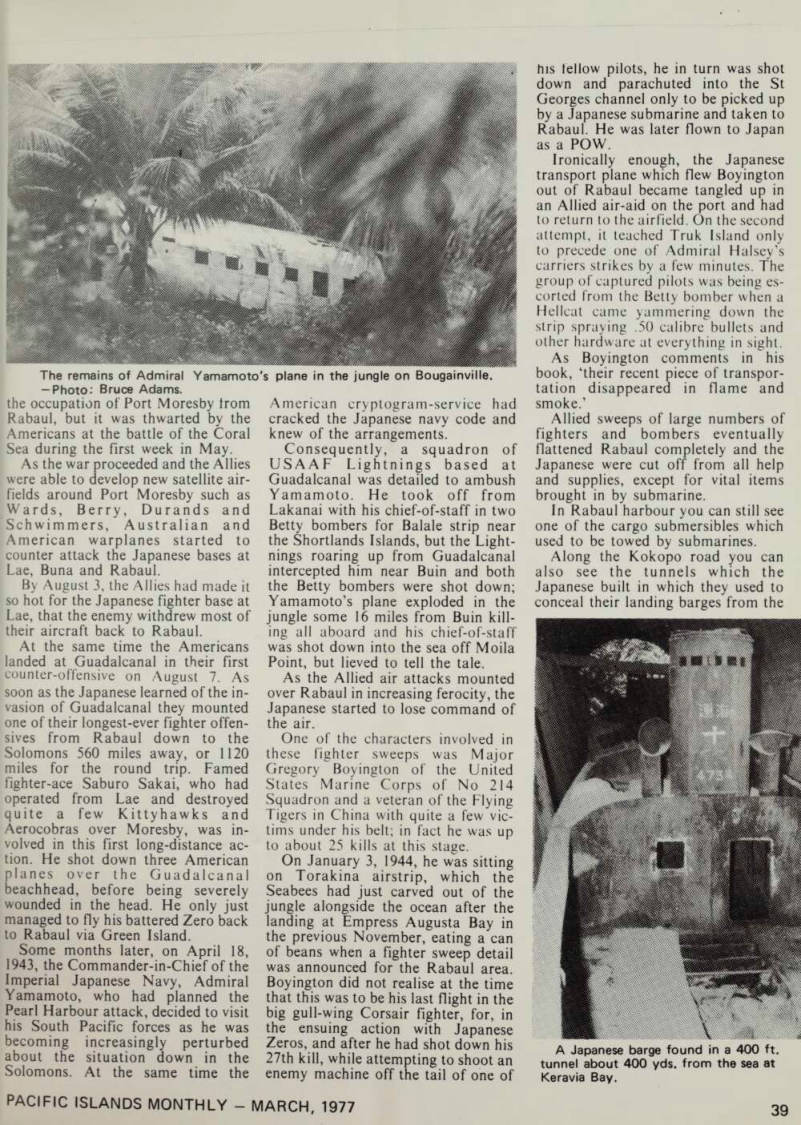
The remains of Admiral Yamamoto's plane in the jungle on Bougainville. -Photo: Bruce Adams.
A Japanese barge found in a 400 ft. tunnel about 400 yds. from the sea at Keravia Bay.
ferocity of the Allied air attacks, Some of the landing barges are still there to this day.
In the New Guinea Club, there are some excellent photographs pf the Allied air attacks on Rabaul with the shipping under actual bombardment and huge fires burning among the shore installations. Just nearby is the admiral’s bunker where the Japanese had their Navy HQ and signals section, one of the very few buildings to survive the bombings.
All these spots of interest are well worth a visit and when you have done so, take a trip up to Namunula Hill where the old German governors had their residences. The view across the harbour is magnificent, set among the lush, green foliage with the tropical background of palms reaching skywards.
It is difficult to imagine that only 35 years ago, Mitchell and Boston bombers, intermingled with Beauforts and various Allied fighters including Corsairs and Lightnings, were roaring back and forth across the harbour blasting shipping and warehouses with high explosives and raking the Japanese ack-ack gun positions with machine gun and cannon fire to such an extent that Rabaul ceased to exist
as a township and port.
When the Japanese signed their surrender in Rabaul on September 6, 1945 General Sturdee, the Australian commander, was amazed to learn that nearly 100,000 of the enemy had been cut off in East New Britain and were now his prisoners.
The port and airfield were in ruins and there were over 31 ships sunk in the harbour.
The Japanese had' honeycombed the hills around Rabaul with miles and miles of tunnels in which they kept stores, vehicles and workshops.
And what happened to the ravages of war? Ironically enough, most of the war-time wrecks were raised and cut up and shipped back to the Land of the Rising Sun by Japanese salvage teams which spent many months working in Rabaul harbour in the early 19605.
Only very few wartime wrecks now remain; out along the Kokopo road a partly-submerged pontoon crane may be seen near the water edge opposite the Japanese-built tunnels. Other vessels lie in deeper water near Rabaul and in the St Georges channel, victims of Allied bomber and torpedoes.
Meanwhile, over the post-war
years, Kabaul has been rebuilt and once again today it is one of the pret tiest spots in Papua New Guinea and with what a background of history!
In less than 100 years from the time when the first missionaries landed in the Duke of York islands, followed by the early German traders (not forget ting Queen Emma of Ralum fame) then the annexation of New Guinea by Imperial Germany, only to be lost to the Allies as a result of World War One, albeit under mandate to the old League of Nations, Rabaul had seen many changes, Then in 1937, the eruptions at Matupi and Vulcan caused great damage to the township, Five years later, invaders from a country thousands’ of miles to the north occupied Rabaul and the whole 0 f New Guinea, until their defeat in 1945, when Australia again resumed the mandate but this time under the auspices of the United Nations and now in 1977, Rabaul forms part of a successful transition from mandated territory to self-government, to in dependence.
Good old Rabaul for the beau ty of your harbour and the friendliness of your people, happy memories will always remain.