Out The Grafters
pp. 12-13 · Read in the full issue
...And Fiji Plans To Weed
From ROBERT KEITH-REID in Suva
Corruption has suddenly reared its head as an issue in Fiji a country whose people tend to think that they are relatively free of it.
This was underlined with the publication of two draft bills through which the ruling Alliance Government plans to zero on to those on the take and the people they take it from.
One bill proposes the appointment of “special investigators” with extra ordinary powers to delve into bank accounts and o(her intimate business affairs of not only corruption suspects, but their immediate relatives.
The other prescribes hefty
penalties for those who fall foul of the anti-corruption code.
Offences involving government matters would fetch a fine of up to $15,000, or seven years goal, or both.
And cases not directly involving the government would incur fines of up to $lO,OOO, gaol for up to five years, or a combination of both.
On top of the fines and gaol, courts would have power to really exact the state’s revenge by ordering the confiscation of wealth judged to have been amassed through corruption.
Modelled on Singapore and Hong Kong legislation, the bills are in part reaction to cases that have caused concern in Fiji in recent months, involving petty sums and minor matters compared with the giant swindles reported daily from the cities of Asia, America and Africa.
But they have been enough to make Fiji Islanders nervous, and in one case spelt personal diaster for a cabinet minister, Mr M. T. Khan.
The country began to get corrup tion conscious at the time of the Khan affair, a story which accounted for a good deal of local newspaper space through 1976. Earlier in the year, Mr.
Khan then Minister for Commerce and Industry, found himself in a fix over the matter of several hundred dollars of building materials cement, steel and suchlike he was alleged to have corruptly received from Mr Sennik, managing director of Suva steel rolling mill. Khan strenuously denied the charges from the start. He was acquitted after a trial but the verdict didn’t bring the
restoration of his cabinet position that he had resigned when accusations were made against him.
Coupled with his decision to abstain from voting on an important government land tenture bill, the affair prompted a move for his expulsion from the party.
A side feature of Mr Khan’s ordeal was the uproar emanating from the Fiji civil service when Attorney- General Sir John Falvey told Parliament that he was discovering far more corruption in government circles than he imagined ever existed.
There were shrieks of indignation from the Fiji Public Service Associa tion the civil service union at his implication that any of its members were anything less than honest.
And the Prime Minister, Ratu Sir Kamisese Mara, whose portfolio covers the service, thought it wise to mention that he couldn’t quite agree with Sir John. But Sir John, chewing hard on the cigar he invariably wears in his mouth, was unrepentant.
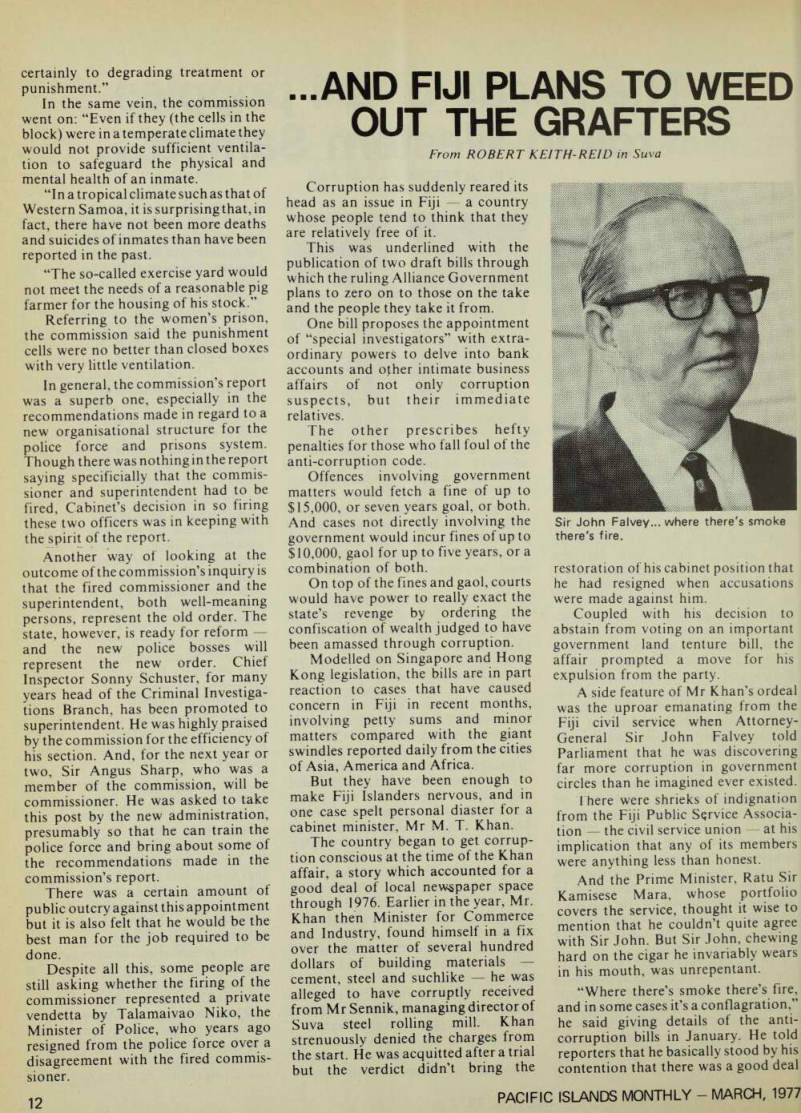
“Where there’s smoke there’s fire, and in some cases it’s a conflagration,” he said giving details of the anti corruption bills in January. He told reporters that he basically stood by his contention that there was a good deal
Sir John Falvey... where there's smoke there's fire.
of rotten material in Fiji’s public life.
His office was getting numerous complaints that could not be satisfactorily substantiated. The reason, he explained, was the existing corruption law, dating from between 1889 and 1916, was just not geared to coping with the sophisticated forms of fiddling being carried on in the last quarter of the 20th century.
The Prime Minister took a rather cautious line on the need for the bills.
“It is wise to have legislative provision, perhaps even more as a deterrent than as a corrective” he said.
Corruption was, after all, getting to reach “epidemic” proportions in developing countries and “unless we have a proper ordinance people will continue to indulge themselves in these peccadilloes”.
The PM said that under the bills everyone, including politicians, “will have to explain if their bank accounts suddenly take a bump”.
A sudden increase of private wealth, particularly if it happens to be out of proportion to an apparently honest citizen’s avowed annual income, will be an excuse for the special investigators to get cracking.
Such corruption as exists is certainly not as blatant as that experienced in some countries, where the waving palm of officialdom is the first and the last one (if you want to get an exit visa) encountered.
It’s fair to say that most Fiji residents never experience more than a hearsay whiff of it. On the other hand there has been of late a steady traffic in rumours, in which some well known names have featured, and which Fiji journalists know are the foundation for some sensational stories if only enough evidence could be gathered to fight off counter-action under the country’s tough libel laws.