The heads of tall poppies
pp. 11-12 · Read in the full issue
roll in Western Samoa...
From FELISE VA’A in Apia
These days, if you are a head of a government department in Western Samoa, you are living in fear a deadly weapon has been unleashed on public servants; the commission of inquiry. The aim of these commissions is to combat bribery and corruption and improve efficiency in government operations. Whether they are suc ceeding in their tasks remains to be seen but almost invariably the top men have lost their jobs.
Already, three commissions of inquiry have been held. In the first, Saena Hunter, Director of Lands, was fired. In the second, Willie Meredith, Director of Agriculture, did not lose his job but his minister, Muagututia Pinati, was pressured to resign. Other inquiries by the auditor and Public Accounts Committee resulted in the sacking of Vince Brebner, Controller of Customs, along with his top assistant, as well as the dismissal of Tuataga Te’o, secretary for Health and the accountant, Lamusitele Sio currently chairman of the Public Accounts Committee. Now in the latest commission of inquiry held late 1976, Lavea Lio, Commissioner of Police, and Pa’u Young, Superinten dent of Police, have both been sacked, effectively from January this year.
The Commission of Inquiry into the Department of Police and Prisons found much corruption, a high level of inefficiency, a drastic drop in morale, an extreme lack of training and motivation and the existence of brutality, and inhumane treatment of suspects and prisoners. In its report, the commission said: “It remains to be considered upon whom the respon sibility for this alarming state of affairs must rest. We have no hesitation in placing full responsibility for this state of affairs on the two top commissioned officers, namely the Commissioner and the Superintendent.”
In the commissioner’s case, one of the most serious findings against him was that, though he was aware of some allegations of bribery, he did not take any action. In the last analysis, the level of efficiency in the running of the department is reflected by the quality
of leadership.
The level of efficiency was so low and, therefore, the quality of the top leadership must be low. Therefore, the commissioner and the superintendent must be replaced, the commission reasoned.
There is general agreement here that the members of the commission were highly qualified for the task. The chairman was G. J. Donne, former Chief Justice of Western Samoa; Sir Angus Sharp, a former Commissioner of Police in New Zealand; H. H.
Bisset, another expert on police matters and Tamaseu Papa, a Samoan matai, who replaced Herbert Clarke, a local barrister and solicitor, who died in a motor vehicle accident last year.
The commission found there was widespread bribery in the force, particularly among traffic personnel.
This has arisen through payments of money to policemen by traffic violators who hoped, thereby, to escape prosecution. Bribes were also paid to obtain a warrant of fitness fora defective motor vehicle. In some instances, certain police officers had obtained loans they never intended to repay except that the lender would receive favourable consideration in police matters.
There was also evidence that the police had failed to pursue complaints and press charges in criminal matters, suggesting ulterior motives. Perhaps there had been family pressure.
Whatever the reason, the commission
found that bribery was facilitated because of inadequate remuneration for members of the police force as well as inept control on the part of superior officers.
“We have received much evidence of brutal and cruel action by members of the police in relation to alleged offenders,” the commission said. It then went on to give the details of some cases of brutality. In one case, for instance, “certain defenders who prior to their appearance in court had been in police custody, appeared in court with obvious injuries including puffed eyes; one had a swollen jaw, another a back blackened by bruises and all had blood on their clothes.”
“In another case,” the commission said, “persons arriving at the Police Headquarters to complain against assaults on them by policemen the previous day in their homes, were kept waiting from 9 am to 3.30 pm. They were then charged with obstructing the police the previous day and placed in custody.”
A further caseconcerned a motorist who double-parked his motor vehicle near the Apia Post Office for which offence he was wrongfully arrested by a policeman and ordered to drive to the Police Station. On arriving at the Police Station he was severely beaten by the policemen and placed in custody.”
The commission expressed sur prise that though the Police Regula tions provided for complaints by the police, there was no procedure laid down to deal with complaints against the police. There was much evidence that complaints against the police had been treated with complete indiffer ence by senior police administrators, and because of their example, by subordinate officers also.
The commission condemned the standard of the strict security block at the main prison at Tafaigata. It said, “We find it inconceivable that this block has been tolerated and condoned for so long. There is no feature in it which we commend. To incarcerate human beings in it is undoubtedly subjecting them if not to inhuman then
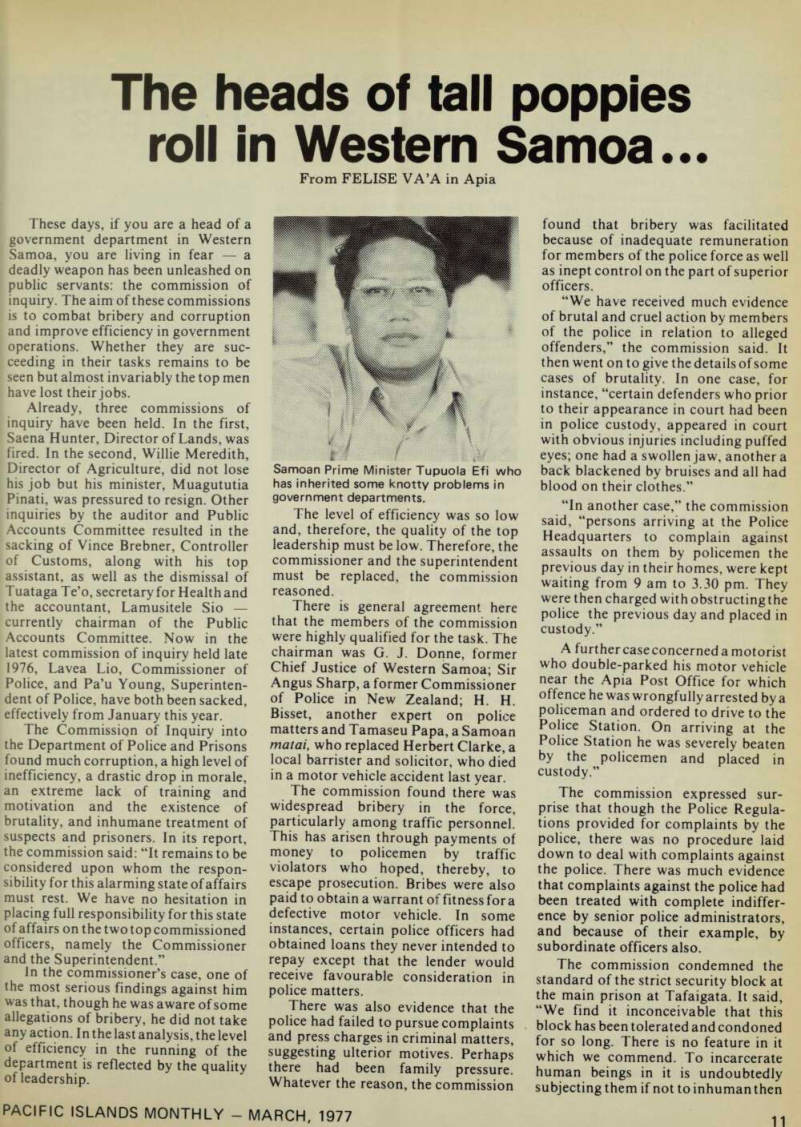
Samoan Prime Minister Tupuola Efi who has inherited some knotty problems in government departments.
certainly to degrading treatment or
punishment.”
In the same vein, the commission went on: “Even if they (the cells in the block) were inatemperateclimatethey would not provide sufficient ventila tion to safeguard the physical and mental health of an inmate.
“In a tropical climate such as that of Western Samoa, it is surprisingthat, in fact, there have not been more deaths and suicides of inmates than have been reported in the past.
“The so-called exercise yard would not meet the needs of a reasonable pig farmer for the housing of his stock.”
Referring to the women’s prison, the commission said the punishment cells were no better than closed boxes with very little ventilation.
In general, the commission’s report was a superb one, especially in the recommendations made in regard to a new organisational structure for the police force and prisons system.
Though there was nothing in the report saying specificially that the commis sioner and superintendent had to be fired, Cabinet’s decision in so firing these two officers was in keeping with the spirit of the report.
Another way of looking at the outcome of the commission’s inquiry is that the fired commissioner and the superintendent, both well-meaning persons, represent the old order. The state, however, is ready for reform and the new police bosses will represent the new order. Chief Inspector Sonny Schuster, for many years head of the Criminal Investiga tions Branch, has been promoted to superintendent. He was highly praised by the commission for the efficiency of his section. And, for the next year or two, Sir Angus Sharp, who was a member of the commission, will be commissioner. He was asked to take this post by the new administration, presumably so that he can train the police force and bring about some of the recommendations made in the commission’s report.
There was a certain amount of
public outcry against this appointment
but it is also felt that he would be the best man for the job required to be done.
Despite all this, some people are still asking whether the firing of the
commissioner represented a private
vendetta by Talamaivao Niko, the Minister of Police, who years ago resigned from the police force over a disagreement with the fired commis sioner.