For George Farwell,
pp. 45-46 · Read in the full issue
freedom had to be earned
Books
George Farwell spent the best part of his life in Australia working hard at what we Australians allegedly haven’t got culture and an appreciation of the arts. Just how hard is made abun dantly clear in his posthumously published autobiography, Rejoice in Freedom, in which George reveals himself as a many-sided fellow in deed, albeit lurking behind the facade of a mild-mannered, expatriate Englishman.
He was bdrn in the United Kingdom some time before World War I, of a family whose connections included a ne’er-de-well grandfather who had been at the Bendigo diggings, an English bishop, a lawyer who ad- L vised the British Cabinet, an uncle who wrote music and a great-great aunt who was lady-in-waiting to Queen Mary.
All good background for what he was to become in Australia radical, anti-establishment, bohemian, writer, wharf labourer, gold miner, actor, Australian Broadcasting Commission commentator/reader of poetry, seaman, public servant, outback traveller, magazine publisher and Pacific Island hopper.
Perennially, he was an advocate for the recognition of Australian artistic talent which, he believed, had to flee overseas or perish in the cultural desert created by the disinterest of successive conservative governments.
He did not see why the arts should not be subsidised, like farming or manufacturing a sort of artistic phosphate bounty, as it were.
Although many Australians look back on the era of Prime Minister R.
G. Menzies as some sort of Golden Age, to George Farwell and those of like mind it was a period of frustra tion, really relieved only when the Labor government came to power in 1972.
“It was a time of great ex citement,” he says, “new hopes, a belief that something could at last be made of this torpid, directionless country.” Prime Minister Whitlam certainly loosened the purse-strings
for the arts, as he loosened them for much else, and there was rejoicing amongst the cultural poor before his government was tossed out three years later.
Much of Rejoice in Freedom deals with Farwell’s struggle to survive by his writing and associated activities between the 1930’s and 1950’5, and to the analysis of life in those times from this viewpoint. As such it should have much appeal to those of like mind who tried to travel the same stony path.
Philistines will probably take greater pleasure in his excursions into the Australian outback and his other travels, most of which became sub jects for full-length books, his humorous asides and anecdotes; his continuing love affair with French Polynesia and his hilarious introduc tion to those isles of the blest as a member of a party of high class treasure seekers.
He was decanted straight from his minor public school into the Great Depression whereupon his lawyer un cle managed to find him a niche in Royal Dutch Shell with the ultimate prospect of transfer to the Netherlands Indies. When this idea
Putting a name to Hebridean trees
The New Hebrides, with a popula tion of under 100,000, has well over 100 distinct vernacular languages. To record all the vernacular names of the 150 different species of trees in the islands would clearly be an immense task.
While working for two years as a United Nations Volunteer in the islands, Miss Sheila Gowers has done ground-breaking work in this direc tion by collecting names from 35 of the most widely spoken languages covering 100 tree species.
The bulk of the book consists of detailed descriptions of 50 of the more common tree species. Each descrip tion includes notes on crown shape, bole, buttress, bark, slash, leaves, flowers, fruit, wood properties and
folded the same uncle whisked him to a clerk’s desk in the London Electric Supply Co, From an endless vista of life as a clerk in cold, wet London he finally decided to escape by cashing in his only inheritance and joining a syn dicate formed to search for treasure on the uninhabited atoll of Pinaki in the Tuamolu group of French Polynesia. The treasure, so the story went, had been looted from a church in Lima in 1859 and cached on lonely Pinaki until the fuss blew over. It was said to include 14 tons of gold ingots, gold, jewel-encrusted candlesticks and 38 diamond necklaces. The last per son to seek it was an Australian nam ed Howe who had got a chart and in formation from one of the original looters then on his death-bed. After he got himself to Pinaki in 1910 Howe lived there on fish and coconuts for 13 years while he frantically dug trenches all over the island. Finally the French authorities deported him to Australia where he spent the rest of his life try ing to raise the finance for another try.
“In bold outline,’’ says Farwell, “it was an improbable story. Boy’s Own Paper stuff. Or designed to separate
local uses. These are followed by a list of common and vernacular names and a full page illustration of the leaves, flowers and fruit. A further nine species are briefly described. All botanical terms used are fully describ ed in an illustrated glossary.
While the book’s primary intention is to reduce the confusion existing in the New Hebrides over the nomenclature of tree species, it should also be of interest to linguists, anthropologists and botanists work ing in the region and worldwide.
(SOME COMMON TREES OF THE NEW HEBRIDES AND THEIR VERNACULAR NAMES. By Sheila Gowers.
Published by the Forest Section of the Department of Agriculture, Vila, New Hebrides. Available from Maropa Bookshop. P.O. Box 210, Vila. Price 5A2.50, including postage.)
the guileless from their money.” But as he had decided to quit England anyway “somehow at all costs” this appeared a better method than most. And so it proved.
Three of the party went via Australia to pick up gear and an engineer; Farwell and two other via the Atlantic, the United States and the Pacific in what must have been the most luxurious prelude ever to such an expedition.
They joined Washington at Southampton and if, says George, the Great Gatsby was not on board, many of his beautiful people were. “The hubbub followed us down a long, soft lit passageway, past many gilt and white doors until the steward opened a double cabin. Twin beds with lilac sheets turned down, tiffany bedlamps, lacqured white wardrobes and dressing-tables and full-length mirrors that reflected what might have been an expense account suite at the Berkeley or Savoy . . . The US Line believed in style. A card on the dressing table advised that black tie or formal gown were required wear for dinner. Was there a Depression some place?”
They crossed the American conti nent in like style and in San Francisco joined Makura for Tahiti where there was a wait of several idyllic weeks while the rest of the party assembled and finally joined the chartered schooner Gisborne for the Tuamotus and fortune.
From the sea Pinaki was desolation personified and it soon was evident why the 13 years Howe had spent there were fruitless. The pass shown on the chart did not exist so they had to shoot the reef beach each morning while the schooner cruised up and down outside. The sand dunes “dense with harsh, dry vegetation, took us an hour to cross while spikey brown thorns and roots tore at our clothes”.
Afternoon temperatures reached 117 deg. in the shade and skin blistered in the heat.
Nothing tallied with the chart.
They couldn’t find a coral pinnacle which was supposed to be the domi nant landmark; or the pool where treasure chests were supposed to have been sunk. The older members of the expedition suffered heat exhaustion; George’s feet swelled up with coral poisoning; and the two gendarmes who had been sent as watchdogs by the French administration which ex pected a rake-off if anything were found, gave up and lay panting under a pandanus bush.
Someone at last suggested that maybe they were on the wrong island.
The schooner captain said that the island of Tepoto had once been called Tuanaki and given Polynesian confu sion of pronunciation between P’s and T’s, it was possible that a mistake had been made.
They found Tepoto, which had a pass; and a coral pillar, but on the west not east side of the island; and a pool of sorts which they tried to pump dry but could not because it was tidal.
They built a dam that wouldn’t hold water and decided that they had come temporarily to the end of the road.
The engineer went back to Australia to prefabricate a proper coffer dam and two other members of the party left for London to try to raise more money.
George stayed in Tahiti and to be young, white, free and male there in the 1930’s was to be closer to paradise than this refugee from a clerk’s desk in London had ever thought possible.
Because it was so idyllic he was to remember it for the rest of his life and in remembering this becomes an en trancing part of his book. But when, after a year, neither coffer dam nor more finance for treasure hunting materialised he decided to tear himself away. Instead of emulating the James Norman Halls, Charles Nordoffs or Robert Dear Frisbies, and becoming island fixtures as they did although one can wonder whether that would have made him ul timately any happier George cash ed in his return passage to London and sailed for Australia instead.
There be became a fringe-dweller as all who had to live by the arts did in the 1930’5, yet, he says, he felt an im mediate affinity for Australia as it then was, finding only amusement at the pretensions of local society matrons, with none of the bitterness for the so-called Australian way of life which he displays at the end of his book.
In the 1950’s during the reign of his despised Menzies, he had a brief flir tation with the Establishment by join ing the Australian News and Informa tion Bureau. This allowed him to travel widely, far from cities, and to Papua New Guinea, and as such perhaps should have satisfied him, but by the end of the decade restless George had quit and the early 1960’s find him taking a leading part in organising the Adelaide Festival, a bi yearly event that is the nearest Australian equivalent to a European cultural jamboree.
After the third festival in 1964 he resigned and apart from a stint as public relations officer at the Australian pavilion at Expo ’67 at Montreal the rest of his life was devoted pretty much to writing and travelling with his wife, Noni. Ob viously disenchanted with Australian affluence and concern for material possessions alone the “Toyota or Holden parked outside the door, dishwashers, overpriced TV, poker machines at the Leagues Club, government-run TAB in every sub urb” he sought something more elusive and what he believed was meaningful amongst the poor of Asia or Mexico.
One might wonder why he singled Australia out for what he took to be decadent materialism, when something similar afflicts the whole Western world. But that was his battlefield and there he fought to the bitter end.
There is something prophetic as well as angry in his last paragraph: “People like to assure me that mine has been a good life. Good? Well, not easy. Maybe it is better not to have had it easy. It seems now to have been nothing but a battler’s existence, always battling. For Christ’s sake, you can’t let the babbitts and buffoons and bludgers have it their way all the time. Instinct tells me I am likely to continue battling a long while yet.
Freedom has to be earned.”
The battle didn’t go on much longer for George Farwell. He died suddenly
on August 6, 1976.
Judy Tudor.
(Rejoice in Freedom, by Qeorje Ferwell. Nelion. $14.95.)
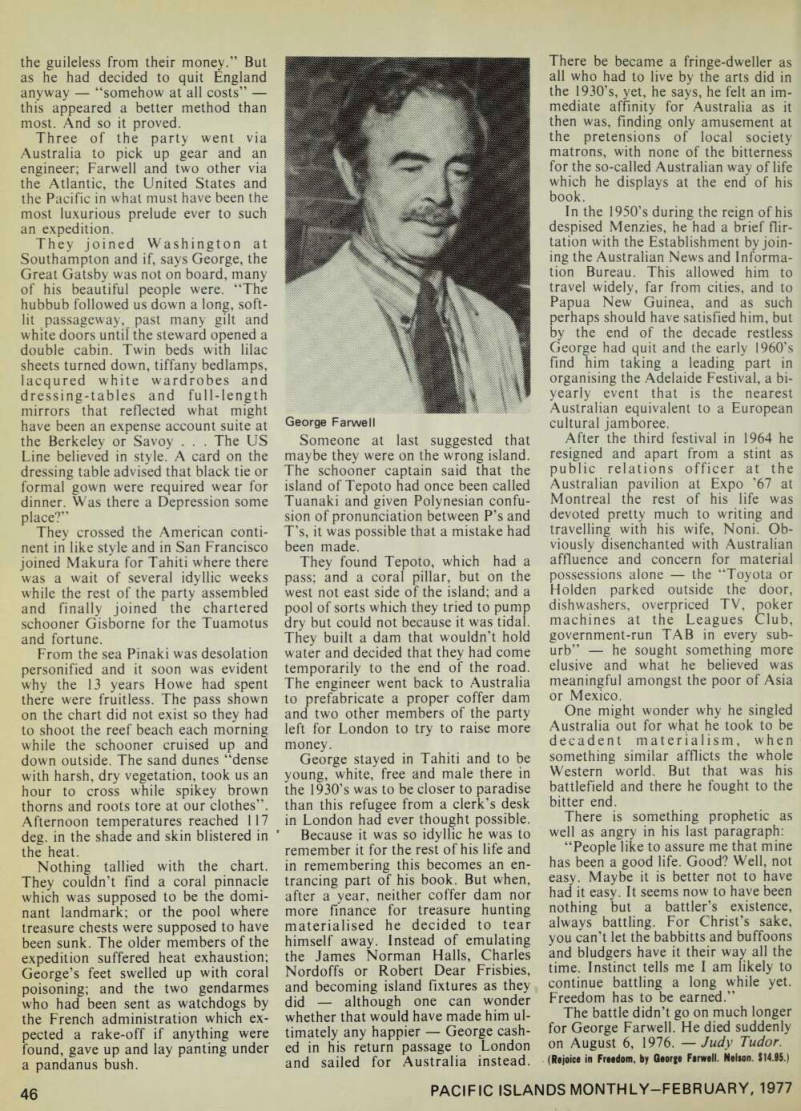
George Farwell