Magazine
pp. 38-43 · Read in the full issue


On Enewetak Atoll it’s “Paradise Regained”
The Enewetak people say that, as far as they know, they have always lived on Enewetak Atoll, and that “there have always been two big chiefs (‘iroij’) and two groups, because there were two big islands”.
They state that these were the people of Enjebi Island and the people of Enewetak Island, both of whom lived on the atoll of Enewetak. They claim that the two groups have never warred against each other, but have always co-operated very closely.
According to those who know the history of their people the chiefs, the wise old men and women, and those few of the younger people who have learned the ancient lore from their elders four separate groups of Marshallese arrived on Enewetak Atoll before the coming of the Europeans. These latter came from the atolls of Bikini, Ujae, Wotto, and other atolls many miles to the east of Enewetak. These invaders, apparently castaways, either fought the Enewetak people, or merely stayed a while before returning to their home atolls. Apparently none of them remained on Enewetak.
Enewetak was discovered quite by chance by European ships passing through the area on the way to the East. The German scholars Kramer and Nevermann say that “Alvaro de Saavedra found Enewetak on October 1, 1529”. There is no evidence or tradition of contact between the Spaniards and the Enewetak people’ either then or at any other time.
It seems unlikely that significant contacts with Europeans occurred before the 19th century.
The sighting of the isolated atoll was next reported in 1792 by Captain Bond in the English ship Royal Ad miral. Other sightings followed and were duly reported by English cap tains during the remainder of the cen tury.
These 18th century contacts are not a part of the oral tradition of the
For generations to come, the people of Enewetak Atoll, Marshall Islands, will mark September 16 as a holiday, a day of rejoicing.
For it was on that day in 1976 that the United States ended 32 years of use and occupancy of Enewetak, and formally handed back the atoll to its people.
As a bonus, they were also given nearby Ujelang Atoll, where they had been living in exile ever since, in 1947, they were removed from Enewetak to enable the US to use their home for nuclear testing. In all, 43 nuclear blasts, including the first hydrogen bomb explosion in 1952, were con ducted between their removal and 1958, when nuclear testing was ended in the Enewetak-Bikini area.
From Majuro, American scholar JACK ADAIR TOBIN, author of a doctoral dissertation on the Enewetak people which was presented at the University of California, Berkeley, fills in the background to their story.
Enewetak people, and as far as can be discerned, had very little, if any, effect on their culture.
More frequent and purposeful European visits began in the latter part of the 19th century, as the islands of the Pacific were opened up for trade and missionary activity.
The Germans formally established their administration over the Marshall Islands in 1886, but had been trading in the area for years before that.
Enewetak informants tell how a German warship put in to Enewetak Atoll shortly after the acquisition of the Marshalls, and confirmed the two chiefs in their authority, giving them medals of office. German traders followed, bringing in coconut seedlings and asking the chiefs to tend them and to sell the copra so produc
ed to them. Trade goods were ad vanced to the chiefs against the equivalent in future copra production.
The Enewetak people thus became involved in the economy of the outside world. They began moving from a subsistence economy to a mixed cash and subsistence economy. This brought changes in the patterns of work and consumption.
The Germans did not station any agent on Enewetak, nor were there any resident Europeans or other aliens. Foreign visitors were in frequent during the German period, and the inhabitants were left pretty much to themselves.
The Japanese seized Enewetak, along with the rest of the German possessions in Micronesia, in the autumn of 1914.
Enewetak (and Ujelang), unlike the rest of the Marshalls, were ad ministered from the Branch Bureau of the South Seas Administration (“Nanyo Cho”) on Ponape Island in the Eastern Carolines. Infrequent trips were made by Japanese officials to Enewetak for administrative and commercial purposes.
As had been the case with the Ger mans, contact with the Japanese was very slight. There were no Japanese officials of any kind on Enewetak.
Three Japanese, a trader and his two assistants, comprised the only presence of the administering nation on the atoll. No schools were es tablished, but several young people were sent to Ponape to attend govern ment and Protestant mission schools.
The pace changed dramatically in the late 19305. The Japanese Imperial High Command had decided to make Enewetak an important link in its strategic plans for the conquest of the Pacific area.
During 1939-41, thousands of ar my, navy, marine, and engineering personnel, and Korean and Okinawan labourers, poured into Enewetak.
Elaborate fortifications were install
ed, and a large airfield was built on Enjebi Island. Marshallese youth from all over the chain were pressed into service as labourers on the for tifications on Enewetak. The focal people were also conscripted for the work.
These fortifications were assaulted and overcome when US forces in vaded Enewetak in February, 1944.
The Japanese had refused to allow the remaining Marshallese and Enewetak to leave the two main islands of the atoll. It is thought that they feared the islanders would con tact the enemy forces and furnish them with information of military value. But some of the islanders had already fled to the smaller islands, and others were able to flee when the initial American bombardment started. It is said they did provide useful intelligence to the invading forces.
A number of Marshallese labourers and natives of Enewetak were killed or wounded during the bombardment, and during the subsequent fighting.
This experience is recalled with sadness, and memories of great fear.
After the Americans had secured Enewetak the Marshallese labourers who wanted to go were sent home im mediately. The local people were fed and housed by the US Navy. They look back on this period of free and lavish supplies of food and clothing, such as they had never seen before, as a “golden age”.
The US Navy continued in occupa tion of Enewetak Atoll, cleaned up the debris of battle, and established a huge advance base there as the war in the Pacific continued.
The Navy continued feeding, clothing and housing the Enewetak people on Aomon Island, on their home atoll, until 1946, when they were moved to Meik Island on Kwa jalein Atoll, over 320 km (200 miles) to the south-east, in preparation for the atomic tests to be held on Enewetak.
They were on Meik Island for a month. They were then returned to Aomon Island where they stayed for less than a year. The US Government then decided to move them to Ujelang and to use Enewetak as a permanent testing site for atomic weapons.
Ujelang Atoll, which was then un inhabited, had previously been selected as the relocation area for the displaced Bikini people, whose own home atoll had been appropriated earlier for atomic experiments. But the Bikini people were now told they
had to go elsewhere. The Enewetak people were to live on Ujelang.
The US Navy cleared brush on the atoll, and built a village of wooden, sheet-metalroofed structures.
Many Enewetak people have told me; “We did not give the Navy any trouble when they told us to leave Enewetak. We hated to go, but we obeyed . . .” One must know the deep attachment felt by all Marshallese to their ancestral home to appreciate the
difficulty experienced by the Enewetak people in planning to leave their homeland, perhaps forever. •On December 21, 1947, 142 Enewetak people went ashore to take up residence on Ujelang.
The coconut trees planted by the Germans and Japanese were still stan ding and bearing. Seedlings of bread fruit and pandanus were brought ashore and planted. Thus a new life
Continued on page 43
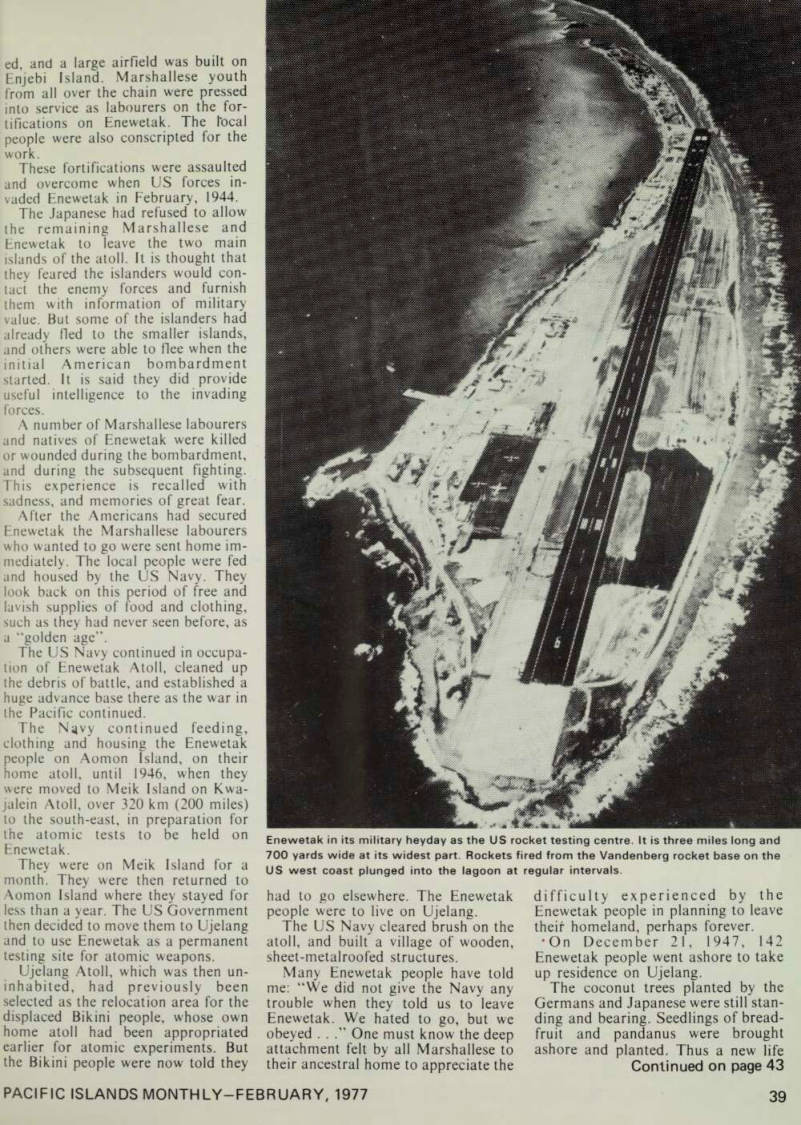
Enewetak in its military heyday as the US rocket testing centre. It is three miles long and 700 yards wide at its widest part. Rockets fired from the Vandenberg rocket base on the US west coast plunged into the lagoon at regular intervals.
began for the uprooted Enewetak peo ple. No American official remained on Ujelang, nor was there radio com munication with the outside world.
Long periods of complete isolation and privation ensued.
The Enewetak inhabitants, who were and are well organised, with good leadership, attempted to adjust to their new location. There were several formidable problems to cope with. The most obvious was the great disparity in size between Ujelang and Enewetak.
The total dry land area of Ujelang is only 1.08 sq. km (0.67 sq. m), and much of this is rocky and poor. The area of the lagoon is only 41 sq km (25 sq m). On the other hand, the total dry land area of Enewetak Atoll is 3.64 sq km (2.26 sq m), much of which is well suited for agricultural use. The total lagoon area is 624 sq km (388 sq m). These figures are reflected of course in the much less abundant production of food, and the drastical ly reduced food potential, especially from the reefs, lagoon and surroun ding sea on Ujelang.
Logistics was another major problem. The geographical location of Ujelang is much less favourable in relation to the sources of needed im ported foodstuffs and other com modities than is the case with Enewetak.
The tendency for the population to rise, and the consequent added pressure on scant natural resources, was another problem. (As of November, 1972 there were 340 peo ple living on Ujelang, with 71 Enewetak people living elsewhere.) The unfavourable economic situa tion and the persistent desire to return to Enewetak finally stimulated agressive action by the people. In 1967 they threatened to evacuate the atoll, and in 1968 the leaders petition ed the United Nations for assistance in returning to Enewetak.
Relief shipments of food were sent to the community. An ex gratia pay ment of $ 1,020,000 was made to them in 1969. This was placed in a trust fund, the interest from which was of assistance. Other funds were allocated for the construction of badly needed public facilities on the atoll. The Ujelang community assumed respon sibility for the labour involved.
The efforts to improve the situa tion, while welcome, did nothing to lessen the desire of the people to return to their ancestral home. They continued to want, indeed to yearn, to return to their “paradise lost . .