The gaping
p. 35 · Read in the full issue
hole behind NZ tourist posters
By John Bridges
“I’m not unaware that there are problems and troubles within the building industry. It’s obvious that they can’t provide enough homes for everyone. But what’s needed is an immediate and large injection of funds and materials to solve our problem.” So says Fred Ellis.
Fortunately for some of Auckland’s homeless Polynesians, Fred Ellis has a five-bedroom house in Ponsonby, a social conscience as wide as his girth and an un derstanding landlord who hasn’t hiked his rent because Fred is trying to help out.
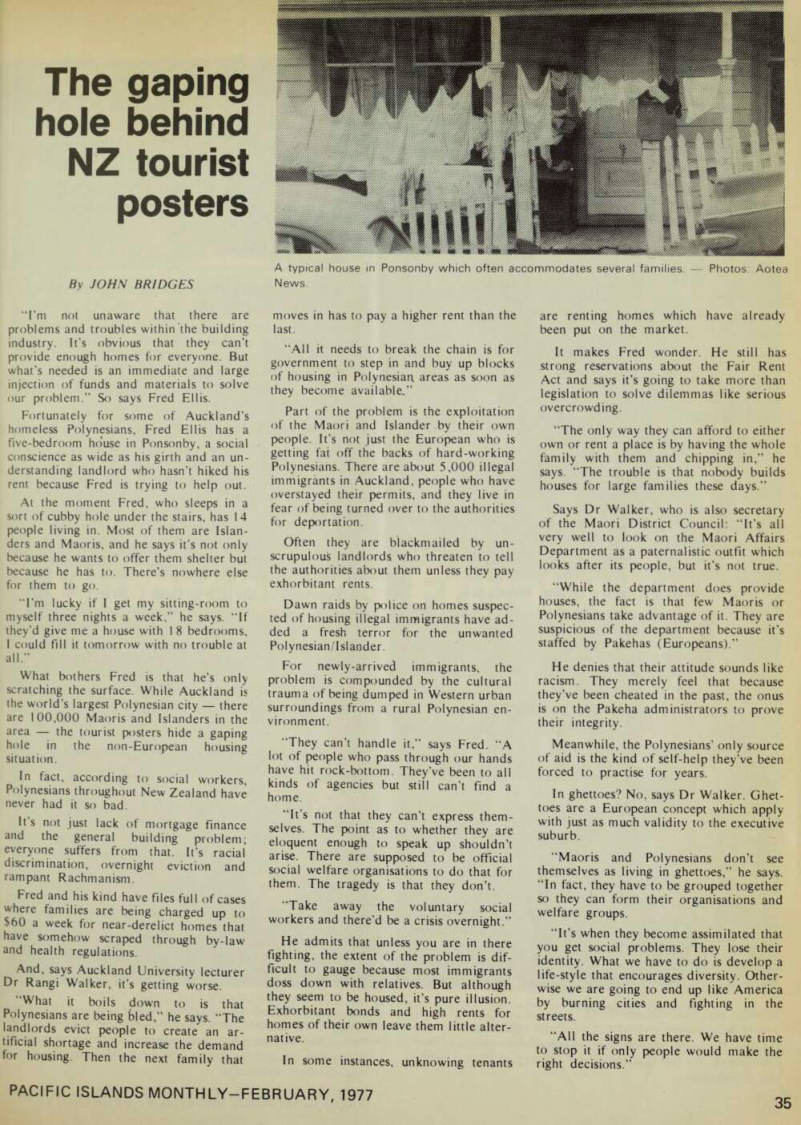
At the moment Fred, who sleeps in a sort of cubby hole under the stairs, has 14 people living in. Most of them are Islan ders and Maoris, and he says it’s not only because he wants to offer them shelter but because he has to. There’s nowhere else for them to go.
“I’m lucky if I get my sitting-room to myself three nights a week,” he says. “If they’d give me a house with 1 8 bedrooms, I could fill it tomorrow with no trouble at all.”
What bothers Fred is that he’s only scratching the surface. While Auckland is the world’s largest Polynesian city there are 100,000 Maoris and Islanders in the area the tourist posters hide a gaping hole in the non-European housing situation.
In fact, according to social workers, Polynesians throughout New Zealand have never had it so bad.
It’s not just lack of mortgage finance and the general building problem; everyone suffers from that. It’s racial discrimination, overnight eviction and rampant Rachmanism.
Fred and his kind have files full of cases where families are being charged up to $6O a week for near-derelict homes that have somehow scraped through by-law and health regulations.
And, says Auckland University lecturer Dr Rangi Walker, it’s getting worse.
“What it boils down to is that Polynesians are being bled,” he says. “The landlords evict people to create an ar tificial shortage and increase the demand for housing. Then the next family that
moves in has to pay a higher rent than the last.
“All it needs to break the chain is for government to step in and buy up blocks of housing in Polynesian areas as soon as they become available,”
Part of the problem is the exploitation of the Maori and Islander by their own people. It’s not just the European who is getting fat off the backs of hard-working Polynesians. There are about 5,000 illegal immigrants in Auckland, people who have overstayed their permits, and they live in fear of being turned over to the authorities for deportation.
Often they are blackmailed by un scrupulous landlords who threaten to tell the authorities about them unless they pay exhorbitant rents.
Dawn raids by police on homes suspec ted of housing illegal immigrants have ad ded a fresh terror for the unwanted Polynesian/Islander.
For newly-arrived immigrants, the problem is compounded by the cultural trauma of being dumped in Western urban surroundings from a rural Polynesian en vironment.
“They can’t handle it,” says Fred. “A lot of people who pass through our hands have hit rock-bottom. They’ve been to all kinds of agencies but still can’t find a home.
“It’s not that they can’t express them selves. The point as to whether they are eloquent enough to speak up shouldn’t arise. There are supposed to be official social welfare organisations to do that for them. The tragedy is that they don’t.
“Take away the voluntary social workers and there’d be a crisis overnight.”
He admits that unless you are in there fighting, the extent of the problem is dif ficult to gauge because most immigrants doss down with relatives. But although they seem to be housed, it’s pure illusion.
Exhorbitant bonds and high rents for homes of their own leave them little alter native.
In some instances, unknowing tenants
are renting homes which have already been put on the market.
It makes Fred wonder. He still has strong reservations about the Fair Rent Act and says it’s going to take more than legislation to solve dilemmas like serious overcrowding.
“The only way they can afford to either own or rent a place is by having the whole family with them and chipping in,” he says. “The trouble is that nobody builds houses for large families these days.”
Says Dr Walker, who is also secretary of the Maori District Council: “It’s all very well to look on the Maori Affairs Department as a paternalistic outfit which looks after its people, but it’s not true.
“While the department does provide houses, the fact is that few Maoris or Polynesians take advantage of it. They are suspicious of the department because it’s
staffed by Pakehas (Europeans).”
He denies that their attitude sounds like racism. They merely feel that because they’ve been cheated in the past, the onus is on the Pakeha administrators to prove
their integrity.
Meanwhile, the Polynesians’ only source of aid is the kind of self-help they’ve been forced to practise for years.
In ghettoes? No, says Dr Walker. Ghet toes are a European concept which apply with just as much validity to the executive suburb.
“Maoris and Polynesians don’t see themselves as living in ghettoes,” he says.
“In fact, they have to be grouped together so they can form their organisations and welfare groups.
“It’s when they become assimilated that you get social problems. They lose their identity. What we have to do is develop a life-style that encourages diversity. Other wise we are going to end up like America by burning cities and fighting in the streets.
“All the signs are there. We have time to stop it if only people would make the right decisions.”
A typical house in Ponsonby which often accommodates several families. - Photos: Aotea News.