Nutshell
pp. 29-33 · Read in the full issue
The
News
In A
Nutshell
North. Solomons Holiday
September I has been fixed as an annual public holiday for the North Solomons Province. The Premier of the North Solomons Provincial .Government, Dr Alexis Sarei, said celebrations on September I, 1976, marked the adoption of the new name from Bougainville to North Solomons Province, flying of the new flag alongside the Papua New Guinea national flag, and agreements reached between the leaders of the North Solomons and the PNG government. Dr Sarei said that the Prime Minister, Mr Michael Somare, had approved the celebrations.
Crane’S Yeoman Service
A heavyweight mobile crane did yeoman service last December lifting vessels to safely when tropical cyclone Kim hit Avarua and Avatiu harbours on Rarotonga, Cook Islands.
Among craft saved were launches and lighters belonging to the government Waterfront Commission, and an American cruising yacht, Fiesty Lady.
The inter-island vessel, Blue Water, was not so lucky. In the course of the blow she struck the wharf at Avatiu, was holed, and was only saved from sinking by prompt attention from the New Zealand Ministry ol Transport's fire engine whose pumps coped with the inflow of water until the weather improved.
Another craft to suffer was the fishing vessel Morning Star, owned by the well known island identity, Tekake Williams.
Morning Star's cabin was smashed by the Hying roof of the old headquarters building of A. B. Donald & Co. at Avatiu, which was one of a number of buildings on Rarotonga which emerged from the strom open to the heavens.
Talking Shop By Satellite
Directors of education from a number of island nation or territory members of the South Pacific Commission held a two-hour seminar in December with one exception they didn’t have to move more than a few hundred yards from their offices to do it.
The exception, Albert Sanagustin, Director of Education for Guam, had to make the short air trip to Saipan, the nearest Peacesat terminal location.
The satellite-borne discussion also in volved terminals in Papua New Guinea, Cook Islands, Niue, Western Samoa and New Caledonia. Education authorities in Honolulu and Wellington took part as observers.
Agenda items for the seminar included teacher education and teacher exchange, general curriculum development, and the possibility of creating a South Pacific Commission board for education co operation.
Tongan Workers Wanted
New Zealand’s Tongan Work Permit Committee chairman Mr Clive Edwards went to Tonga in December with a list of 15 companies wanting Tongan workers un der the new 1 1-month work permit scheme.
One of the businessmen involved, Mr Peter Norfolk, operations manager of Jaybel Nichimo, said shortage of workers wasn’t the reason for employing Tongans.
It’s because of the difficulty in finding keen and willing workers.
Another businessman, Mr Bill Witstyn, personnel manager for Ceramco’s heavy clay division, once had about 60 Tongan workers, but is down to 27 of whom about 20 are registered over-stayers. Some are key workers he can't afford to lose.
Staff particularly young people come and go “like wildfire,” he says, ad ding: “Tongans have the incentive to work - and their money helps the Island economy.”
Cooks Chiefs’ Demand
Some arikis (chiefs) in the Cook Islands are threatening legal action against the Premier, Sir Albert Henry, unless he con venes a meeting of the House of Ariki by the end of February. Sir Albert, un worried, questioned whether those arikis were qualified as members of the House of Ariki under the House of Ariki Act. (The House of Ariki, under the con stitution, is a consultative body, particular ly on land and native customs.) The Ui Arikis of Rarotonga recently considered legislation passed by the Legislative Assembly, particularly the Leases Restrictions Act. Mr laveta Short, a barrister and solicitor, at the invitation of the Ui Arikis, explained the effect of the act.
At the end of the meeting Mr Short was directed to write to Sir Albert recording the Ui Arikis' concern that no meeting of
the House of Ariki had been convened since 1974. (A meeting of the House of Ariki may be convened by the High Com missioner at the recommendation of the Premier.) Mr Short was directed to advise Sir Albert that he should call a meeting of the House of Ariki before the end of February, otherwise legal action might be taken to ensure compliance with the con stitution.
The Ui Arikis also recorded their disap pointment and concern that the Leases Restrictions Act was not referred to the House of Ariki before its passage through the Legislative Assembly.
The government in the past had said that all legislation relating to land custom and the general welfare of the people would be referred to the House of Ariki for con sideration before it was finally dealt with by the Legislative Assembly. The Ui Ariki fell that if the government wished to cultivate a harmonious relationship it had to give due recognition and respect to the House of Ariki, and not ignore it as it had with the Leases Restrictions Act and other legislation.
Sir Albert, in addition to doubting the qualifications of the Ui Arikis, also doubled whether Mr Short had given a true interpretation of the act.
Distaff Side Push In Png
For the first time in Papua New Guinea politics an organised attempt is to be made to get a group of women into Parliament.
Nilai Ra Warden “The Voice of Women” in the Rabaul area is making the move.
The president of Nilai Ra Warden, Mrs Demaris Tonga, announcing the cam paign, said that one of the biggest criticisms expressed by women about the present political scene was that most men refused to involve women. “We are just forgotten when men start dealing in politics”, she said.
Nilai Ra Warden plans to nominate one woman candidate for each of the four elec torates in the Rabaul area. But the group’s involvement could extend if sufficient sup port is received.
There is only one woman, Miss Josephine Abaijah, at present in PNG’s 100-seat National Parliament. Only three women, one of them an Australian, have ever stood for parliament in PNG.
Cargo Cultism On Rise
A swing to cargo cultism in rural villages is worrying the newlyformed East New Britain provincial government in Papua New Guinea.
The government has been told that some villagers are turning their backs on agriculture and are seeking prosperity through potential cargo cults. This includ ed the operation of secret societies and the exhuming of bodies. The latter practice is seen as part of a process of absorbing the wisdom and knowledge of ancestors.
Mr John Golpak told a special meeting
of the government in December that urgent action was needed to stop a serious cargo cult situation developing in the Bainings area, within 40 km of Rabaul, and at Pomio further down the coast.
He said that because of the connotations of cargo cult many authorities, including the police themselves, were frightened to investigate.
The Deputy Speaker, Mr Joe Eko, told the meeting that some commercial crops in the Pomio area were reverting to bush because the people were no longer in terested.
The East New Britain Premier, Mr Stanley Tomarita, said that members of the government had a responsibility to in form the police of any cargo cult activity such as exhumation of bodies, illegal courts, and illegal taxes, no matter how unpopular it might be to do so.
Outsiders Train In Png
Three Gilbertese and one Fijian are to begin training this year at Papua New Guinea’s Joint Services College near Lae.
Announcing this in December, the PNG Defence Minister, Sir Maori Kiki, said that informal talks had already been held with other South-west Pacific countries regarding a possible centralised military training scheme in PNG.
Sir Maori said the expense of setting up an efficient officer training college was prohibitive for many of the smaller South west Pacific countries, who would not, in any case, have sufficiently large enrolments to justify the effort.
PNG believed that by making its college available it could make a big contribution to officer training among South-west Pacific countries.
Gilberts' Resident C.J.
The Gilbert Islands will soon make an appointment of a chief justice who will live and work in the group. The present chief justice, who is also Chief Justice of the High Court in the Solomon Islands, finds difficulty in making frequent visits to the Gilberts. The new official will probably be recruited in the UK. When appointed he will be required, apart from attending to normal High Court duties, to review the work of magistrates, and hear appeals from decisions of magistrates.
Png Plane Crash
A Catholic missionary pilot priest.
Father Peter Cullen, 45, formerly of Melbourne, and two Papua New Guinean schoolboys were killed in November when their Cessna 206 crashed on the mountain ringed airstrip at Kainteba, 60 km inland from the Gulf of Papua.
A fourth passenger, a Papua New Gui nean man, was seriously injured in the crash.
“It’s one of the roughest and most frightening strips in the country,” said Archbishop Virgil Copas of Kerema, a mission headquarters in the area.
Party.
Melanesians Sentenced
A Noumea court in November sentenced two young Melanesians for their part in distributing leaflets in January 1976 calling for Kanaka protest over the fatal shooting of a Melanesian youth by a French police officer.
Miss Dewe Gorodey was sentenced to two weeks imprisonment and Nidoish Naisseline received a suspended sentence of two months and a fine of about SA4OO.
The case was part of the Kamouda affair, which was sparked off at the end of December 1975 when Richard Kamouda was shot dead in Noumea’s central square when the police intervened in a midnight encounter between youths who had been drinking. In the ensuring shock over the apparent loss of nerve by the police, a pamphlet was distributed by leaders of the Melanesian rights movement, calling for a general uprising of protest against the French authorities.
Several months later Miss Gorodey visited Australia and spoke on national radio to plead the Kanaka and autonomist causes in New Caledonia.
Meanwhile, in late November, the ex police officer charged with the fatal Kamouda shooting, Serge Blairet, was given a suspended sentence of two weeks
imprisonment.
The Chopper!
The staff of the Cook Islands Broad casting and Newspaper Corporation was told in December that because they did not appear to take their work seriously the cor poration could be directed to close down.
The CIBNC chairman, Mr Hugh Henry, said he had a letter to that effect from the Minister in charge of broadcasting, Mr Tupui Henry.
Mr Hugh Henry said the reason for con cern was that the minister received many complaints from the people and he was
taking positive steps, which could lead to a close-down. During the close-down the staff could be fired, and only those who did their work conscientiously would be re
engaged.
Mr Hugh Henry told a staff meeting that Mr Tupui Henry had been under at tack in the cabinet and by the public for lack of care taken by both the radio and newspaper staff. He read a seven-page letter from Mr Tupui Henry, the gist of which was that unless the Cl BMC followed certain directives, the CIBNC would be closed and the staff suspended.
About two years earlier there was a similar situation and the CIBNC was clos ed for three days. Mr Hugh Henry said it was necessary for the CIBNC and the staff to present solutions to problems which would satisfy Mr Tupui Henry.
Mr Tupui Henry at later meetings with the CIBNC and staff explained his direc tives. He discussed with announcers and management improvements he required.
The broadcasting section was his main concern but he still was looking seriously at a reveiw of the newspaper division.
“Although the broadcasting division is making some improvement, I am still not satisfied with the progress,” Mr Tupui Henry said.
The "Vice” Is Not Pleased
Dr James Maraj, vice-chancellor of the University of the South Pacific, speaking in Honiara recently, chided South Pacific governments for failing to support their own university. Dr Maraj said that while he saw the university as the biggest resource base in the South Pacific and as a unifying factor in the region, he doubted whether Islands governments were taking it seriously. Some governments were not sending enough students. On top of that not a single building on the campus in Suva came from funds of regional
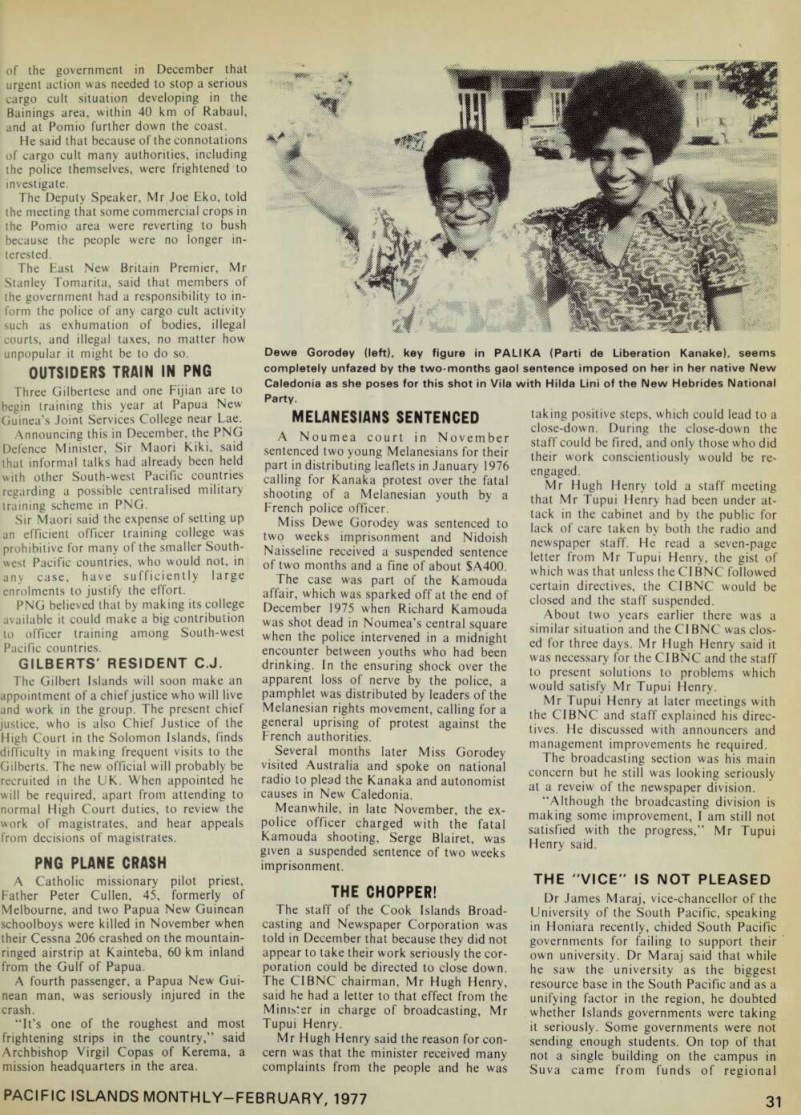
Dewe Gorodey (left), key figure in PALIKA (Parti de Liberation Kanake), seems completely unfazed by the two-months gaol sentence imposed on her in her native New Caledonia as she poses for this shot in Vila with Hilda Uni of the New Hebrides National
governments Britain, Australia, New Zealand and Canada had paid for the lot.
The University suffered because of the habit among Pacific politicians of allowing a dispute over one subject to cloud their thinking over another unrelated matters.
Illegal Migrants Rapped
People trying to evade Australia’s im migration laws were at best unfair, at worst dishonest, the Australian Minister for Immigration, Mr MacKellar, said recently.
Mr MacKellar added: “1 have asked the department as far as possible to tighten controls on people entering the country.
Offices overseas will be asked to look more closely at the bona fides of people applying for visitor visas.
“This will apply particularly to people of nationalities which have shown up in our records as being among those most con sistently flouting entry requirements,” he said.
Fiji To Take Over C&W
Cable and Wireless, which has been part of the Fiji scene for many years, will soon be no more. Independent Fiji naturally wanting to do its own thing, is set to acquire a 51% interest in the British Government-owned Cable and Wireless through a new company, Fiji International Telecommunications Ltd (Fintel).
Cable & Wireless will become Fintel, which will operate out of that handsome building in Victoria Parade, Suva, which has been the C&W headquarters for many years.
The shareholding will cost Fiji about 5F3.5 million, about $1 million less than originally estimated. Fiji will take up an initial 10% very soon, and is required to take up the balance of equity to give it its 51% shareholding by 1982. Fintel will retain the C&W staff and management. But C&W retains ownership of its repair ships and ship-servicing station at Walu Bay.
The Fiji Minister for Communications, Mr Jonati Mavoa, said Fintel would be a commercial operation. Returns would be used to finance development projects. The government had already negotiated a 25% increase in international telecommunications rates, which came into effect in August, 1976.
There could be another increase this year. C&W had not increased its rates for 15 years.
Mr Mavoa said the government bought into C&W because it regarded it as a vital means of communication with other countries. On a purely commercial basis the government saw it as a good investment.