Early Days In Png Radio When
pp. 49-51 · Read in the full issue
The Planners Hadn’T A Clue
People such as lan Mackay, who write books like Broadcasting in Papua New Guinea, are braver than I, for, where written records are not available for one reason or another, reliance is placed on as he writes in acknowledgements at the beginning of his book informants wracking their brains for old, forgotten incidents and patiently answering many questions until the book is published.
Then, memory becomes most inac curate.
The history of broadcasting in Papua New Guinea is here recorded by Mr Mackay; he describes the many controversial issues, the differences of opinion, the inability of the Australian Broadcasting Commission to provide any local programmes (indeed, its very reluctance to do so).
For 16 years, as Mr Mackay points out, the ABC handed over respon sibility for local programmes to the government, to the Department of Education. On page 13, he levels a charge of inaccuracy at the writer of a letter to African and Pacific countries asking for information on their broad casting activities in relation to native residents. The writer stated broad casting in Papua New Guinea was controlled by the Advisory Com mittee on Broadcasting, which is con sidered inaccurate by Mr Mackay.
This statement is not inaccurate in relation to broadcasting to local residents, for the ABC at that stage never even saw the scripts of the local programmes which were being broad cast from its studios. Who on the ABC could have understood them anyway, since at that time the broad casts were entirely in the vernacular?
But there is an inaccuracy in Mr Mackay’s account the misspelling of the name of the writer of that letter, who is also the writer of this review.
What the hell! It’s only an “e” (Editor).
In 1947 the ABC did not wish to have anything to do with the tricky business of broadcasting to locals. It simply handed over its facilities to the Department of Education because it recognised its own incompetence in this field.
The ABC, as Mr Mackay implies, might well have continued with the same attitude had it not been finally
Books
pushed into acknowledging that the population of the country consisted of considerably more than expatriates from Australia (whom it did supply with a well-balanced, Australian-type programme).
Mr Mackay is meticulous in giving credit where it’s due. But I suppose anyone reading it who was involved with that period of ABC development could think of someone who hasn’t been mentioned.
He names Kate Vellacott-Jones who put the Papua New Guinea news service on a firm footing, but forgets to mention Stuart Inder, who took over from her in 1953 and who for the next two years, by his daily bulletins of Papua New Guinea news to the Australian Broadcasting Commission in Sydney, kept the Australian public, and politicians and others of conse quence, constantly reminded that Australia had responsibility for the
development of Papua New Guinea.
These bulletins, inserted by the ABC into its Australian national news broadcasts, probably did more to help Papua New Guinea than did any other single institution at that time.
Another name that might have been mentioned is that of Sinaka Goava.
Although Morea Hila may have been the first Papuan announcer, Sinaka was the first serious Papuan broad caster.
And I’m disappointed that Fred Warren is used in the book as a sort of comedy relief, for Fred kept that sta tion on the air for many years. Super vising technicians came and went but Fred went on forever.
Efficient, helpful in a snarling sort of way, devoted to his duty at 9PA, if anyone concerned with broadcasting in Papua New Guinea deserves a knighthood, it’s Fred.
These comments are minor in assessing a book which covers the life of broadcasting in Papua New Guinea with thoroughness.
But I don’t know what good such books serve, except that they are more readable than official files, and who will buy the book at $l5? Probably only those who are mentioned in it, and the libraries.) The appendices and index at the back of the book are most useful.
Perhaps a graph of Paul Hasluck’s
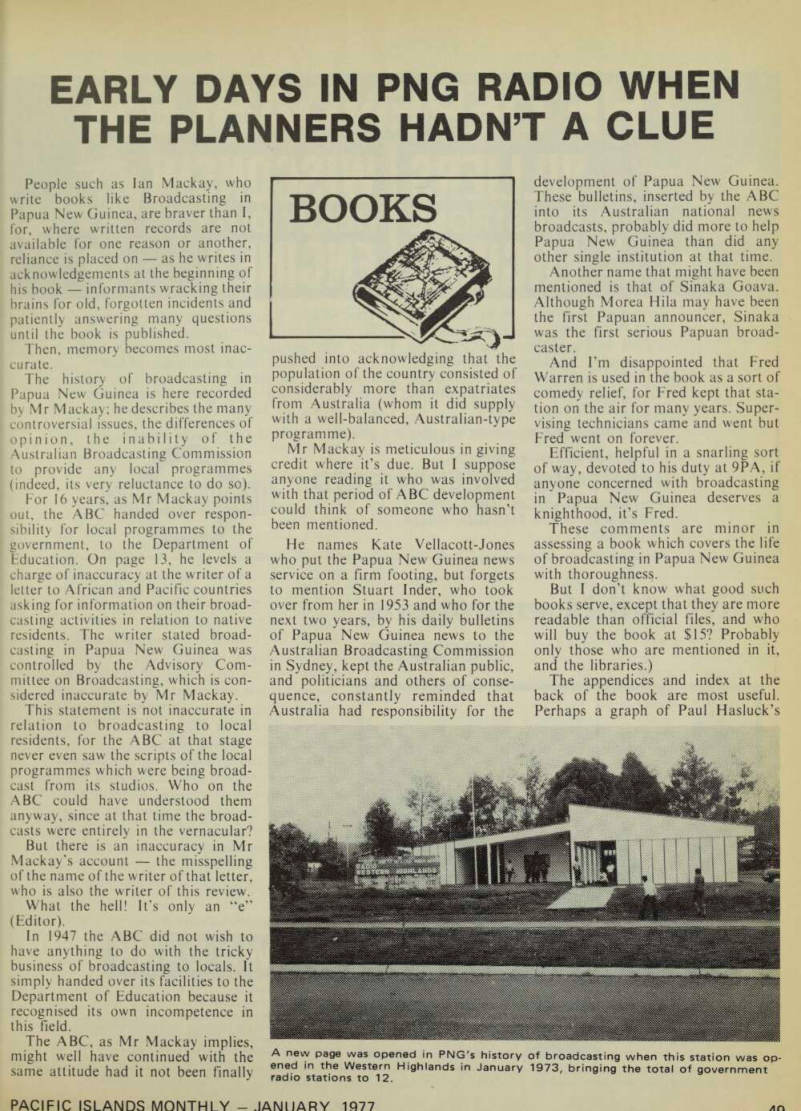
A new page was opened in PNG's history of broadcasting when this station was op ened in the Western Highlands in January 1973, bringing the total of government radio stations to 12.
vacillations and changes of mind about the broadcasting situation might reveal one of the reasons why broadcast planning seemed so haphazard at that time.
It is strange reading about events in which one took part. They seem to assume an air of unreality. For in stance, the 1961 Broadcasting Com mittee described in the book sounds, when reading about it, as though it consisted of expert gentlemen, all of whom knew what they were about. In fact, none of us really had a clue.
Many years before this, when I had gone to London to talk with learned gentlemen who were concerned with the same problems of introducing broadcasting to developing countries notably Julian Huxley, who was concerned with broadcasting to West Africans I stated boldly that I had come to learn. Disappointment was expressed. Then one of the gentlemen exclaimed, “You won't get much from us! We hoped you could solve some of our problems!”
So it seems that, in those earlier days, all of us were uncertain how to proceed. It’s the history of uncertain ty that Mr Mackay records in Broad casting in Papua New Guinea
Peter Livingston.
BROADCASTING IN PAPUA NEW GUINEA. By lan K.
Mackay. Published by Melbourne University Press, PD Box 278, Carlton South, Victoria, Australia 3053. $l5)
A Fiji Operation
lova S. Geita, a young Papua New Gui nean, is in Suva for three years as editor of Lotu Pasifika Publications, which is own ed by the Pacific Conference of Churches.
Early in 1977 Lotu Pasifika Publications will launch The Pacific Islands Children’s Magazine on a regular basis. The pilot issue was reviewed in the October PIM.
Mr Geita says about 35,000 copies will be printed for distribution throughout the Pacific region.
Lotu Pasifika Publications has publish ed a number of journals and recipe books.
The journals deal mainly with social and economic matters, and include a “little politics”.
To come out soon is a Samoan recipe book, which follows a book on Fijian recipes. There will also be a book by Paul White about jungles in three languages PNG Pidgin, Fijian and Tongan. A survey is now under way in publishing French literature.
The publisher of Luto Pasifika Publications is a Fijian, Mr Aisake Raratabu, who recently returned to Fiji from the Oxford Polytechnic in the UK where he attended a short publishing course. The Rev David Williams is consul tant to the publisher.