Magazine
pp. 42-47 · Read in the full issue

Drama In The Dusty Files:
Fragments Of Fiji History
The five stories below are based on research done by P/M contributor A. M. QUANCHI, of Melbourne's Monash University, into the records at the National Archives in Suva, Fiji.
They all belong to the period 1860-71, when Europeans in Fiji were few in number and had not yet learnt that the land was neither free, easy nor necessarily profitable. Their main theme is the ageless one that dreams of easy fortunes usually end up in despair and disillusion.
About 20 miles east of Rabi Island, in open water, lie the six Ringgold Islands. Today, ocean liners and con tainer vessels ply the main north-east passage and lights warn of these scattered reefs and islets.
In 1863 a small schooner headed for the Ringgold Islands with a strange purpose.
In that same year, in a deal sur rounded by mystery, ownership of the islands had passed into the hands of two new arrivals from Samoa, the Americans Gilliam and Thompson.
Discussion in the beach community around Levuka naturally turned to the newcomers, but before anybody could get a clear idea of what they were up to, they had slipped out and crossed to Vanua Levu to meet the powerful chief Tui Cakau.
The British Consul made what he called a “routine trip” to Vanua Levu and the word quickly came back buried treasure!
Soon after their arrival Gilliam and Thompson made inquiries with the American Consul, Dr Brower, who had directed them to Tui Cakau as the owner of the islands. Tui Cakau was aware of the Europeans’ desire to have access to parts of his domain, and its sparsely populated or un inhabited areas were of little conse quence to him. The promise of gold with which to purchase muskets for local warfare made him receptive to the offer by Gilliam and Thompson.
The bargain was completed for the then fabulous price of $250, paid in spectacular manner with 25 Chilean $lO gold coins.
They took possession, and for two
months carried out a fruitless excava tion, for, as with most buried treasure stories, there was none. (It is interesting to note how the talk of treasure on the Ringgolds has persisted over the years. As late as the 19505, Taveuni planters were still entertaining similar magical il lustions.) As it became obvious to the two searchers that the treasure was not to be found, they prepared to leave, hav ing suffered a double loss: Tui Cakau had also enticed away the two Sa moan girls they had brought with them.
They returned to Levuka and then disappeared, leaving the land deeds to be disposed of by Brower. The land changed hands twice before eventual purchase by Dr Brower himself.
He paid $l5O for a half share in the six little specks and finally in 1923 was rewarded with a nominal com pensation by a tribunal in London, since the islands had been reclaimed by their Fijian owners in the interven ing years. His “buried treasure” was the grand sum of one shilling.
The Coloured
The coloured man was John Brown, a Negro born in New Bedford in the United States. Both his parents were servants, and to escape a similar fate he ran away on one of the many whal ing vessels then based in the New England ports.
After serving as a boat steerer in the South Seas whaling grounds, he arrived in Fiji in the brig Phantom
and was paid off with $l2O in cash and $lOO in trade goods.
According to his own account, in 1865 he purchased the Nabula tikina block of land at Serua and lived there with his wife and family except for a period on a Suva plantation, and brief service as a sergeant in the militia at the time of the Kai Colo disturbances.
He said he gave the local chief, Tui Canou, $l,OOO for the land and later added an axe and 20 muskets.
He said that a fire had consumed his house and he lost his deeds, but he continued to live there, cultivating a small vegetable garden, at peace with the local people.
Brown’s account of his own life was not entirely clear as he spoke English poorly and his Fijian was limited. But at least on the face of it it seemed a case where lands had been alienated in a bonafide manner, rather than “on spec” by a land-jobber.
Later, when ownership of the lands was being disputed, a local chief Tui Canou spoke out and a tale unfolded quite at variance with the “coloured man’s” version.
Indeed, where had an illiterate Negro earned $l,OOO to pay for the land, let alone the axe and muskets in the two years between his arrival and the alleged purchase in 1862?
And wasn’t the price excessively high, considering that similar blocks were selling for $2O or $3O?
Tui Canou’s story was that the coloured man had arrived and had seduced a daughter of a neighbouring tribe, the Nui Davui Tukia. To save him from being clubbed to death as planned by the outraged tribesmen,
Tui Canou took him into his own peo ple and allowed him to live on a piece of land owned by one of his relatives.
In a strongly resentful mood, Tui Canou denounced Brown’s claims that he had paid money or muskets, or that a deed was ever drawn up. He admitted Brown had lived at Nabula until he ran off with one of Tui Canou’s own nieces, and that later he returned to settle on the land per manently, planting gardens and siring a family. They had always been friendly, but Tui Canou could not help but display an animus towards the man when he heard of his lies and exaggerations about money, muskets and deeds.
In the light of the conflicting stories, and unsure where the truth ac tually lay, but influenced by Brown’s long occupancy of the land, the Land Commissioners allowed him 50 acres within the Nabula tikina boundaries.
Brown remained there on the fringe of society, and, like many negroes in Fiji, never fully won entrance to either the Fijian or European community.
‘Tainted With
Fra Up
In order to provice a legal title to the lands of the European settlers, an ordinance was passed calling for the presentation of claims for lands purchased before the cession of Fiji to Britain in 1874. In the course of in vestigations into the equity of these claims, the Lands Claims Com missioners questioned the rights of the chiefs to sell, the fairness of the price, the legality of deeds, the distribution of goods and cash to the taukei (ac tual owners of the lands) and the use made of the land by the European claimants and the Fijians of the locality.
In 400 of the 1,300 claims these conditions were so clouded in doubt that they were disallowed.
The commissioners’ most virulent tongue-lashing fell on Thomas Robin son Shute, an American who arrived in Fiji before the rush of settlers at the end of the 1860 s, and who claimed, among many thousands of acres in other areas, 7,000 acres he had ob tained in 1868 at Vuni Saweni in Natewa Bay.
After examining the trickery by which he won the deeds, and his fabrication of a veneer of legality before he finally sold out in October, 1873, the commissioners found it im possible to restrain themselves.
They said: “We think it un necessary to pursue this claim any further. Every step in it appears to us tainted with fraud and chicanery, an immoral contract for the sale of an impossible piece of land the precise boundaries of which nobody knew at the time of sale, or knows to this day is bolstered up by fraudulent and fictitious documents attested to by persons who admit not to have seen what they attest to have seen, fortified by informal documents purporting to be confirmations, certificates, acknowledgments of previous acknowledgments, subscribed by per sons whose signatures were obtained in public houses, or houses so close thereto as not to be distinguishable therefrom, or at unguarded moments late at night when the person signing was too drunk or too sleepy to know or care what he was signing, and we have therefore the honour to recom mend that this claim be disallowed.”
Unfortunately, Morgan and Thomas, who had paid Shute $l,OOO for the land, received nothing for their gamble.
The Na Savusavu people, however, were the big winners. Their per formance in battle reaped them a profit. In 1868, in the course of his ef forts to clinch his deal, Shute had vir tually equipped the Na Savusavu army for the war he launched on the Ketei people. Provoked by intrigues to murder their own chief, the Na Savusavu went on to win the battle, and, due to the Lands Com missioners’ ruling, they also kept their lands intact.
A Memorable
trial
Many grim stories have been told of the system of indenturing labour from other Pacific islands to work on the plantations in Fiji.
One particularly grisly episode, however, has never been brought into the light of day.
The New Hebrides had become a happy hunting ground for recruiters of labour for Fiji’s new cotton plan tations, and a planters’ company was formed to profit from the demand for labour. Individual settlers also risked their lives and their fortunes on in dividual forays to obtain men. These gave rise to many murderous episodes.
A former grocer by the name of Norman was eaten, and a wealthy colonial merchant met a similar fate at the end of his man-hunting expedi tion in a small cutter in the Fiji group.
These ‘outrages’ against Europeans were splashed all over the colonial papers, while the other side of the story, the treatment meted out to labourers, was largely ignored.
One islander was gaoled in 1871, and kept there for 14 months, for much of the time in irons. The hair raising story emerging during his eventual trial never reached the papers. He was accused of murdering a planter at Sigatoka. The official ac count ignored the statement made by the accused and made only passing reference to the provocation for the crime, tending to judge the case as
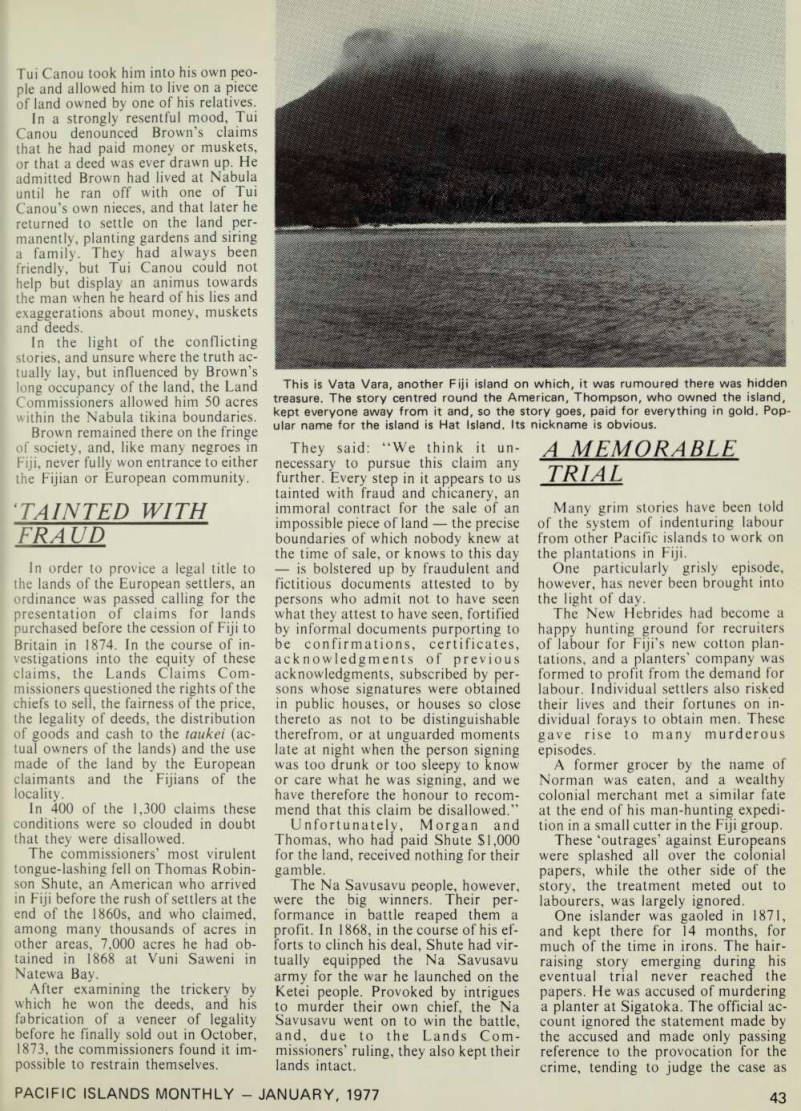
This is Vata Vara, another Fiji island on which, it was rumoured there was hidden treasure. The story centred round the American, Thompson, who owned the island, kept everyone away from it and, so the story goes, paid for everything in gold. Pop ular name for the island is Hat Island, Its nickname is obvious.
relating to only the final, mortal scuf fle, and not seeing this as merely the end result of a long-festering hostility between the labourers and the planter.
After the trial, the Fiji papers failed to publish the statement of the ac cused, and thus the true story of Kapitani, a native of Tanna, remained hidden.
At the beginning of the trial Kapitani pleaded guilty, but after several legal exchanges the noted barristers before the bench agreed to enter a plea of not guilty so that the full evidence could be brought to light.
It never was.
In 1903, David Wilkinson, an old Fiji identity, wrote to the British Government about the character of G.
R. Burt, the partner of the slain planter Underwood, and in this letter he recalled the memorable trial of 1871.
Before the court, the families of both Burt and Underwood had testified as to the cruelty imposed on the indentured labourers. They said that the two men took it in turns to string up alleged malcontents, and would flog the men repeatedly or burn their flesh with hot irons.
They also habitually lied about the due time for the labourers to return home.
According to Wilkinson, when Kapitani gave his evidence, the court heard “a most horrible and heart rending recital of vicious human ill usage”.
He wrote: “Finally, six youths were put in a small native house about six foot by eight foot, the floor having been covered with chopped branches of lemon and orange trees, and so full that there was no room for any of them to lie down except on the thorny sticks, and were kept there for four days locked in and never allowed out
side for any purposes, and had a drink of water allowed them twice a day.
“The outside of the house was laid so thick with lemon branches that no one could approach and pass anything through the walls or roof to the im prisoned.
“On the morning of the fifth day a number of their fellow labourers came to Underwood as he was going to open the door and give the imprisoned their usual drink of water, and re quested that they be set at liberty.
Underwood refused and threatened that if they did not leave at once and go back to work, they would be in carcerated also. As they did not leave he faced round and struck and knock ed down one of the boys. Then a rush was made and Kapitani, seizing an axe, felled Underwood to the ground.
I think he said in evidence he struck him three times, and most of those standing round had a blow at him.
They then carried the lifeless body into the house, and liberated their im prisoned fellows.
“Some pistol shots were fired and hit Underwood, but it was believed they were from his own pistol which discharged during the struggle.”
Kapitani finished his evidence, saying: “That is all, and that is the truth, and now I am ready to die ac cording to the white man’s custom and law.”
The judge, C. R. Forwood, reserved judgment and an outburst occurred in the crowded courtroom. There were a few cries of “Hang him!”, and somebody said that if the court couldn’t maintain justice Kapitani would be hung on the yardarm of the next US warship to enter port, as an example that the white man could not be treated with impunity.
At the re-hearing a verdict of guilty of manslaughter was reached, with a strong recommendation for mercy on
account of the terrible mistreatment and provocation.
Kapitani was given 12 months hard labour, with one week in four to be served in irons. After three months he was released into the care of the Vunivalu of Bau, Ratu Seru Cakobau, and was immediately given his freedom. He was given a job in the retinue and a garden plot of his own and remained there, choosing not to return to Tanna.
For many years after he enjoyed the sympathy of both the Fijians and the Europeans, who recognised him and remembered the memorable trial of 1871.
A Mos
Melancholy
Letter
Pierce Jones Williams and his wife Sophie, accompanied by their two children and a maidservant, set out travelling saloon class from Port Phillip Bay (Melbourne) to Suva on August 23, 1870.
Eight years later, destitute, a widow with a sick child and her own health failing, Sophie wrote from Warrnam bool where her relatives lived, that she had not the means to return to Fiji to tend to the fate of the lands they had settled on and on which her husband had been buried on August 24, 1871, just one year after their departure from Melbourne, “when it had pleas ed the Almighty to take him”.
Planters have been written into history as self-centred men, racist and typically aggressive, blunt, and often boozed or debauched. Pierce Williams did not fit this caricature.
He was not one of the restless, chasing eldorados, nor was he an im poverished “son of the soil”, tired of struggling against harsh Australian
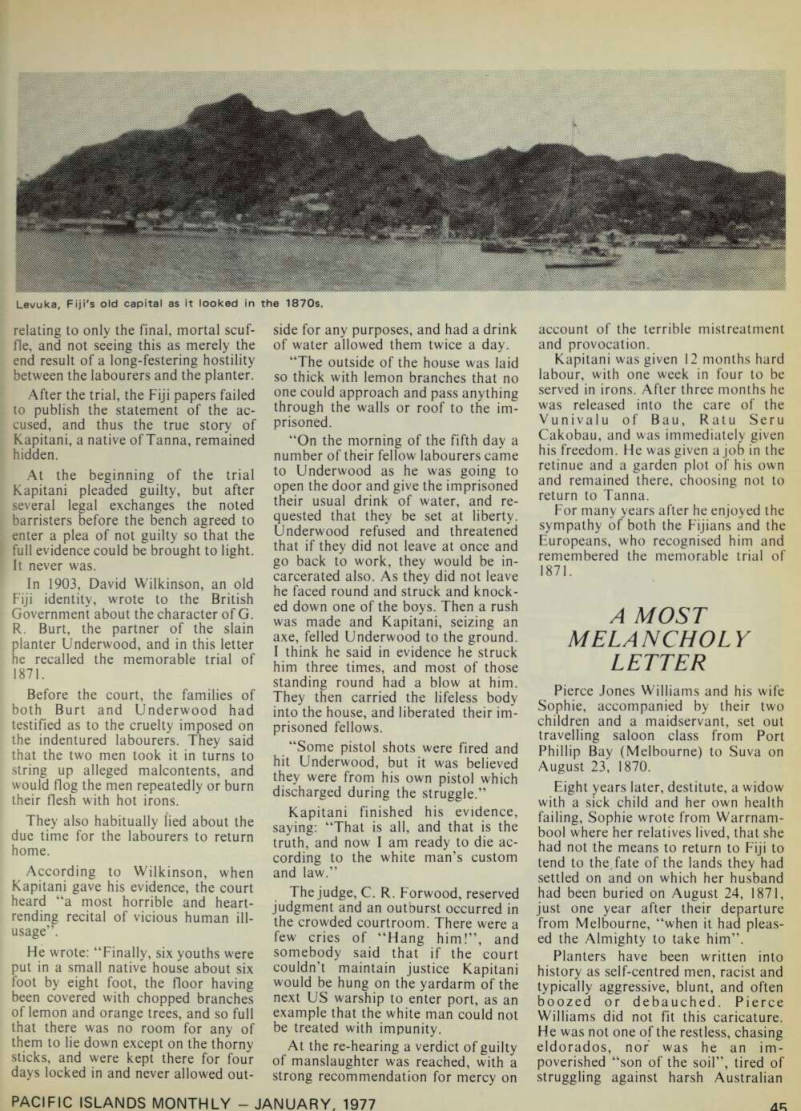
Levuka, Fiji's old capital as it looked in the 1870s.
conditions, these being contemporary stereotypes of the origins of the rush settlers.
He was a settled, married man, a clerk of reasonable means, and being a resolute man committed himself ful ly to becoming a successful planter.
' As soon as he and his family arriv ed at Suva promontory he selected 750 acres between the Vatuwaqa and Samabula rivers, overlooking Laucala Bay. At the end of that sad year, Sophie recalled “how bright and prosperous the plantation was looking” for' Pierce was one who “went in heavily for planting, as witness the rapidity with which he had such a large quantity of cotton planted”. He had 100 acres cleared, 80 under cotton, and employed 12 Tokelau men, eight local Fijians, and for brief periods had as many as 400 men working on clearing operations.
The cotton was “splendid”, but when Pierce passed away as the result of fever and the “strenuous labour in the tropical conditions”, wind blew the flowering cotton balls to the ground before Sophie could manage to collect more than a few pounds.
In that one year wells had been sunk, a fine native house with wooden floors and an iron roof erected, and Pierce had expended all the money
they had in hopes of reaping the returns promised by the high prices being fetched by Fiji cotton on the London market at the time.
On his death Sophie was left with nothing, as they had sold up all their possessions in Melbourne, intending to settle permanently in Fiji. The cost of establishing the plantation had been high, but Sophie knew little of these business matters, for “unfor tunately he did not communicate much of his affairs to me”. The land had cost £375 and Fred Armstrong and Henry Cuthbert, two of his neighbours, estimated that over £4OO had been spent on improvements and as much as £6OO on labour.
Sophie’s immediate reaction was to keep going, but “the men all ran away the night he died; if they had stayed, with Mr Surplice as manager, we could have managed”.
Pierce was placed in the soil he had claimed and toiled for.
To add to Sophie’s wretched situa tion, the day after her husband was buried she was confronted by several of the local Suva people who had on occasions worked on the plantation.
They demanded money for jobs they had done, and when Sophie refused they returned several times and in timidated the isolated woman,
threatening to kill her and burn her house down.
When new of this reached the white community centred around Nabukalou Creek on the other side of the promontory, a meeting was called and the family was evacuated by boat.
Later, the opportunism of the local people was rewarded by their arrest, and Sophie thankfully wrote how she had been saved “only by the kindness of Mathews, Ryan and others and a meeting of the Suva peo ple who fetched us away”.
Sophie stayed with a Suva family at Walu Bay and, three months later, after her brother had sent money for their passage, she and her two small girls, Annie and Eliza, returned to Victoria.
In 1878, when Henry Cuthbert was acting on her behalf to secure the legal titles to the land, Sophie wrote: “I feel an attraction to Suva. My husband is buried there and I was befriended when I was really in need. I am sure you will think this a most melancholy letter . . . believe me, I cannot endure the thought of losing that land.”
In 1881, Sophie received a Crown grant. She died in Richmond, Vic toria, in 1884.