For Independence
p. 20 · Read in the full issue
They Seek Support
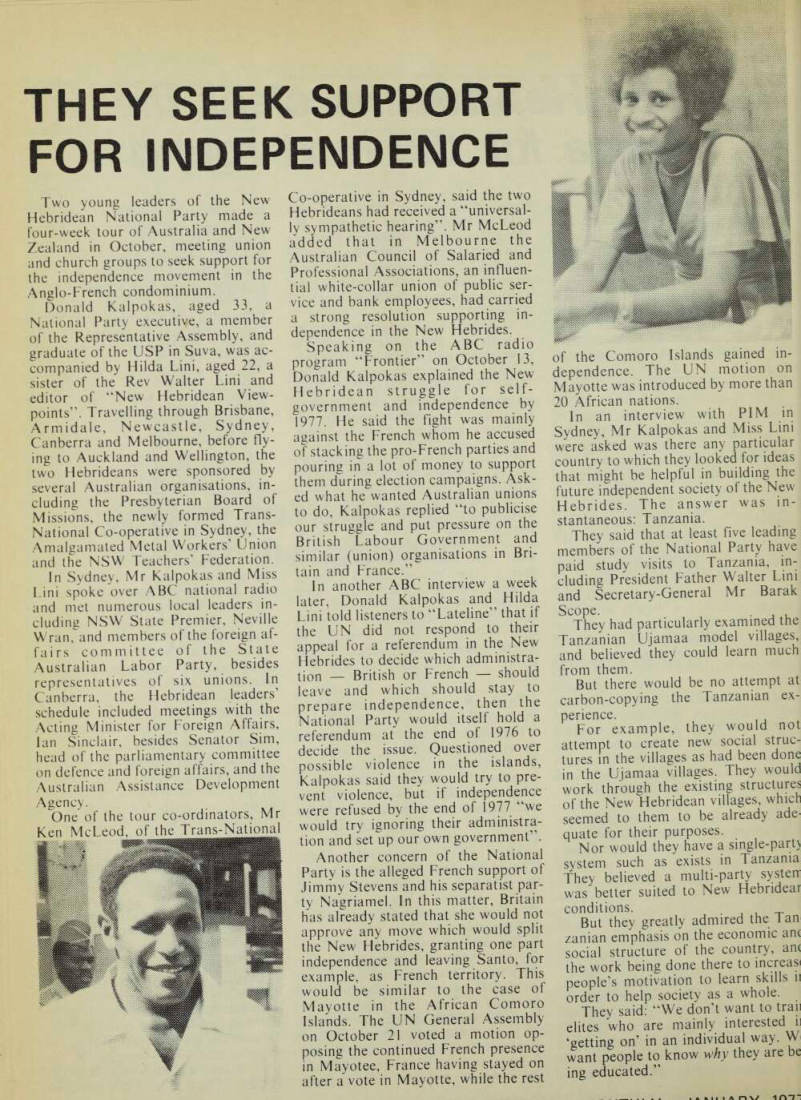
Two young leaders of the New Hebridean National Party made a four-week tour of Australia and New Zealand in October, meeting union and church groups to seek support for the independence movement in the Anglo-French condominium.
Donald Kalpokas, aged 33, a National Parly executive, a member of the Representative Assembly, and graduate of the USP in Suva, was ac companied by Hilda Lini, aged 22, a sister of the Rev Walter Lini and editor of “New Hebridean View points”. Travelling through Brisbane, Armidale, Newcastle, Sydney, Canberra and Melbourne, before fly ing to Auckland and Wellington, the two Hebrideans were sponsored by several Australian organisations, in cluding the Presbyterian Board of Missions, the newly formed Trans- National Co-operative in Sydney, the Amalgamated Metal Workers’ Union and the NSW Teachers' Federation.
In Sydney, Mr Kalpokas and Miss Lini spoke over ABC national radio and met numerous local leaders in cluding NSW State Premier, Neville Wran, and members of the foreign af fairs committee of the State Australian Labor Party, besides representatives of six unions. In Canberra, the Hebridean leaders schedule included meetings with the Acting Minister for Foreign Affairs, ian Sinclair, besides Senator Sim, head of the parliamentary committee on defence and foreign affairs, and the Australian Assistance Development Agency. ..
One of the tour co-ordmators, Mr Ken McLeod, of the Trans-National
Co-operative in Sydney, said the two Hebrideans had received a “universal ly sympathetic hearing’’. Mr McLeod added that in Melbourne the Australian Council of Salaried and Professional Associations, an influen tial white-collar union of public ser vice and bank employees, had carried a strong resolution supporting in dependence in the New Hebrides.
Speaking on the ABC radio program “Frontier’’ on October 13, Donald Kalpokas explained the New Hebridean struggle for self government and independence by 1977. He said the fight was mainly against the French whom he accused of stacking the pro-French parties and pouring in a lot of money to support them during election campaigns. Ask ed what he wanted Australian unions to do, Kalpokas replied “to publicise our struggle and put pressure on the British Labour Government and similar (union) organisations in Bri tain and France.”
In another ABC interview a week later, Donald Kalpokas Hilda Lini told listeners to “Lateline” that if the UN did not respond to their appeal for a referendum in the New Hebrides to decide which administra tion British or French should leave and which should stay to prepare independence, then the National Party would itself hold a referendum at the end of 1976 to decide the issue. Questioned over possible violence in the islands, Kalpokas said they would try to pre vent violence, but if independence were refused by the end of 1977 “we would try ignoring their administra tion and set up our own government”.
Another concern of the National Party is the alleged French support of Jimmy Stevens and his separatist par ty Nagriamel. In this matter, Britain has already stated that she would not approve any move which would split the New Hebrides, granting one part independence and leaving Santo, for example, as French territory. This would be similar to the case of Mayotte in the African Comoro Islands. The UN General Assembly on October 21 voted a motion op posing the continued French presence in Mayotee, France having stayed on after a vote in Mayotte, while the rest
of the Comoro Islands gained in dependence. The UN motion on Mayotte was introduced by more than 20 African nations.
In an interview with PIM in Sydney, Mr Kalpokas and Miss Lini were asked was there any particular country to which they looked for ideas that might be helpful in building the future independent society of the New Hebrides. The answer was in stantaneous: Tanzania.
They said that at least five leading members of the National Party have paid study visits to Tanzania, in cluding President Father Walter Lini and Secretary-General Mr Barak Scope.
They had particularly examined the Tanzanian Ujamaa model villages, and believed they could learn much from them.
But there would be no attempt at carbon-copying the Tanzanian ex perience.
For example, they would not attempt to create new social struc tures in the villages as had been done in the Ujamaa villages. They would work through the existing structures of the New Hebridean villages, which seemed to them to be already ade quate for their purposes.
Nor would they have a single-party system such as exists in Tanzania, They believed a multi-party system was better suited to New Hebridear conditions. . But they greatly admired the 1 an zanian emphasis on the economic anc social structure of the country, anc the work being done there to increase people’s motivation to learn skills n order to help society as a whole.
They said: “We don’t want to trail elites who are mainly interested ii ‘getting on’ in an individual way. W( want people to know why they are be ing educated.’’