Claim To The Sea’S Riches
pp. 53-57 · Read in the full issue

Business
The Islands Stake Their
From a Suva correspondent
Ten small Pacific Islands countries have made up their minds to stake their claim to the niches in the seas in the area within 200 miles of their coasts.
Just when and just how are matters still to be settled. But after the special South Pacific Forum meeting in Suva in October a satisfied Australian Foreign Minister, Mr Andrew Peacock, chortled that the decision, taken with the full backing of his own country and New Zealand was “most significant”.
The reason, he said, was that the consensus of the Oceania countries could “spill over” and be the trigger needed to get the rest of the world to agree on a new code of maritime law on sea limits at the next session of the United Nations Law of the Sea con ference due to open next May.
That session would be the sixth in a so-far-unsuccessful series, Mr Peacock said after the Suva meeting.
“It is my opinion that if we cannot obtain consensus at the sixth session of the UN we may lose, for at least a decade, any opportunity of obtaining a Law of the Sea Convention”, he said.
Such a lost opportunity would un doubtedly be an economic disaster for the small, poor countries of the South Pacific, as Japanese, Korean, Taiwanese and now Russian fishing boats close in around their coasts to sweep the sea clean of fish and anything else worthwhile going.
Scheduled for two and possibly three days, the Suva conference found such easy agreement on the sea law issues that it wrapped up its real business in a day, with a brief second day session to approve a declaration.
This told the rest of the world that as far as Forum countries are con cerned: • They have a common interest in seeing world agreement on the law of the sea adopted. • They will all establish 200-mile
exclusive “economic” zones at the time they think is right, and in con sultation with each other. • They will harmonise their fisheries policies in the region and co-ordinate negotiations with coun tries outside the region who have fishing fleets in the Island waters.
The Forum has instructed the South Pacific Bureau for Economic Co-operation (SPEC) to look into the setting up of a fisheries agency to achieve its objectives, particularly in conserving fish stocks and making best use of them.
SPEC has to report to the next Forum meeting due to take place at Port Moresby next August.
It was asked to prepare its study in consultation with the South Pacific Commission, which has already done some work in the area, and delve into the delicate question of how any com mon fisheries and sea limits policy should be enforced.
Western Samoa’s Prime Minister, Tupuola Efi, said Forum countries didn’t want to “pre-empt” the May UN conference by unilaterally declar ing their 200-mile limits before the conference. But Papua New Guinea
and some other countries had hinted that they might feel obliged to, and if the UN conference collapsed in dis agreement there was no doubt all Forum countries would go it alone.
Mr Efi emphasised that the Forum hadn’t yet committed itself to setting up the fisheries agency. There were a lot of technicalities to sort out, like costs, administration details, and how to conduct surveillance and policing, before making a final decision.
Another worry, he explained, was the feeling that in negotiating with fishing nations most Forum countries would be talking to people who know much more about what marine resources the South Pacific had than the region’s people did themselves.
“If we are going to hold our own in negotiations with them, surely we have to inform ourselves about what is there and how we are going to protect it,’’ he said.
New Zeners Prime Minister, Robert Muldoon, noted that the small countries seemed to take it for granted that the Australians and New Zealanders would bear the burden of surveillance.
After all, he said, both countries were doing a lot of patrolling in the region already. The big long-range RNZAF Orion waiting at Nadi to take him home wasn’t just there as his personal taxi.
Mr Muldoon mentioned that the RNZAF was about to buy 10 smaller Andover patrol planes, which have a shorter range than the Orions. Asked if New Zealand would like to operate the Andovers from new outer islands airstrips being built by Fiji and elsewhere, Mr Muldoon said such a matter was “six months off’ from consideration yet; but he didn’t dis miss the idea.
While Mr Muldoon appeared to think that watching for poaching fishing boats and other economic zone trespassers would be no great
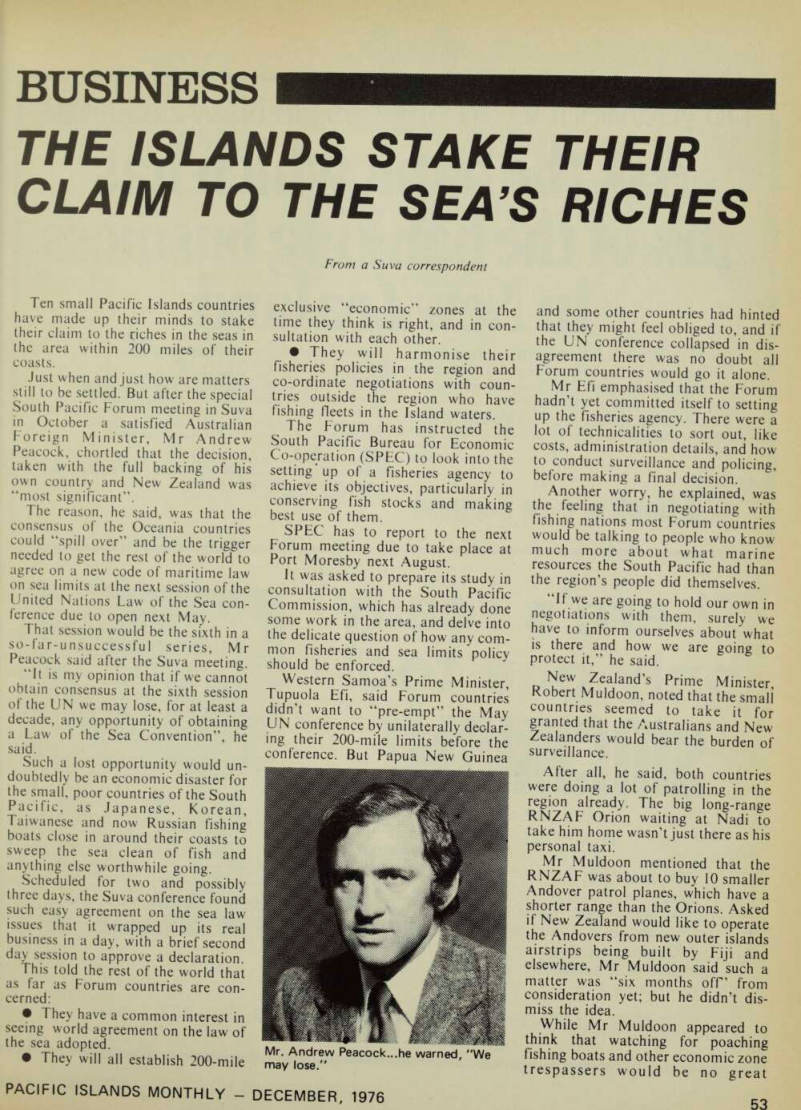
Mr. Andrew Peacock...he warned, "We may lose."
problem, he hinted that policing would be another matter altogether.
He thought it would be more a matter of licensing people to fish in an area, fixing quotas and season, and cancell ing the licences of those who broke conditions.
“This is where regional co operation would be valuable,” he said.
“Sanctions could be expected from one country to another”.
For Australia, Mr Peacock was far more cautious in making predictions on the enforcement of national rights.
“Surveillance is going to be dif ficult and expensive” he said, “If you have in mind the use of long-range maritime aircraft, the cost of operating them could outweigh the return from fisheries”.
Australia would “quite clearly” have a role to play, but what, and how, would be found out when SPEC produced its feasibility study at Port Moresby.
Tonga is not
bankrupt, but ...
“The Tonga Government is not banktrupt. It is only in financial dif ficulties.”
So said the acting Minister of Finance, Dr S. Tapa, in the House in October in reply to a question from a people’s representative.
Strong rumours had been cir culating both locally and overseas to the effect that the government was
bankrupt.
An informed government source has said that the meaning of the minister’s statement was simply that the government was heading for bankruptcy unless drastic measures are taken and enforced immediately.
The first indication that govern ment finances were not in a healthy state was when the government decid ed earlier this year that civil servants’ back pay in respect of the 1975-76 financial year would be paid in four instalments: December, 1976, June, 1977, December, 1977 and June, 1978.
Because of the reported financial difficulties, the government recently took a number of measures aimed at correcting or at least alleviating the
existing unhealthy conditions:
devaluation of the pa’anga (by 6 per cent against the Australian dollar) reduction in overseas travel of govern ment officials, reduction of overtime to the very minimum, increase in government charges, etc.
Speculation is rife that the pa’anga will again be devalued before the end of this year, and already speculators are quietly buying up overseas curren cy notes in anticipation of a Christ mas bonus.
How the government suddenly finds itself in an embarrassing situa tion is a difficult question to answer, ft appears to be due to a number of factors. The main reasons appear to include a lack of proper planning of the relation between government in come and expenditure, payments amounting to over $400,000 on behalf of Pacific Navigation Co Ltd, ex cessive wage and salary increases and overseas economic forces which are, according to Dr Tapa, beyond the control of the government.
The latter reason was the one given by the acting Minister of Finance as the major one. But as the editor of the Chronicle in a recent editorial stated, surely not all the current problems can be caused by external factors.
What appears to have been the main cause is that since the late 19505, Tonga has been living beyond its means without adequate forward planning.
Things, however, are not all so bad that they cannot be resolved. The situation can be salvaged, even though the civil servants may have to forego their promised back pay.
Can Tonga’s PNCL
be kept afloat?
Mr George Fulcher, on secondment from P&O recently took over the management of Tonga’s debt-ridden Pacific Navigation Co. Ltd.
It is understood that the second ment arrangement is an indication of P&O interest in taking up shares in PNCL. Mr Fulcher was brought in by business expert, Mr Ellem, of Sydney, who, a few months ago, was ap pointed by the Tonga Government to look into ways of keeping the national line afloat.
Nothing definite is known about the nature and duration of the in volvement of Messrs Ellem and Fulcher with PNCL, but informed sources claim they will be with the company for the next six months.
Mr Ellem is reported to be charging PNCL a fee of $3OO a day for his ser vices.
While these two men could do a lot to assist PNCL, it is a doubtful ques tion whether they can refloat the line as it is so heavily in debt.
Shipping experts in Tonga claim that nothing snort of a miracle will save the company. In their opinion, it should have been liquidated long ago.
But it is reported that the Tonga Government still believes the com pany can be made to run profitably and is prepared to continue assisting it financially.
The burden the
white man left behind
PNG’s Prime Minister, Mr Somare, has criticised the “massive bureaucracy” which his country had inherited from Australia. He was ad dressing a meeting of public service commissioners from 11 nations in the South Pacific, including PNG, Australia and New Zealand.
The commissioners were holding a five-day seminar in Port Moresby to pool their knowledge of public service procedures, problems and aims.
Mr Somare said the Australian public service pattern had been overlaid on PNG when Australia was the administering nation there.
But public service machinery which suited one country did not necessarily suit another.
PNG was now reorganising its public service, particularly to suit the requirements of provincial governments which were being es
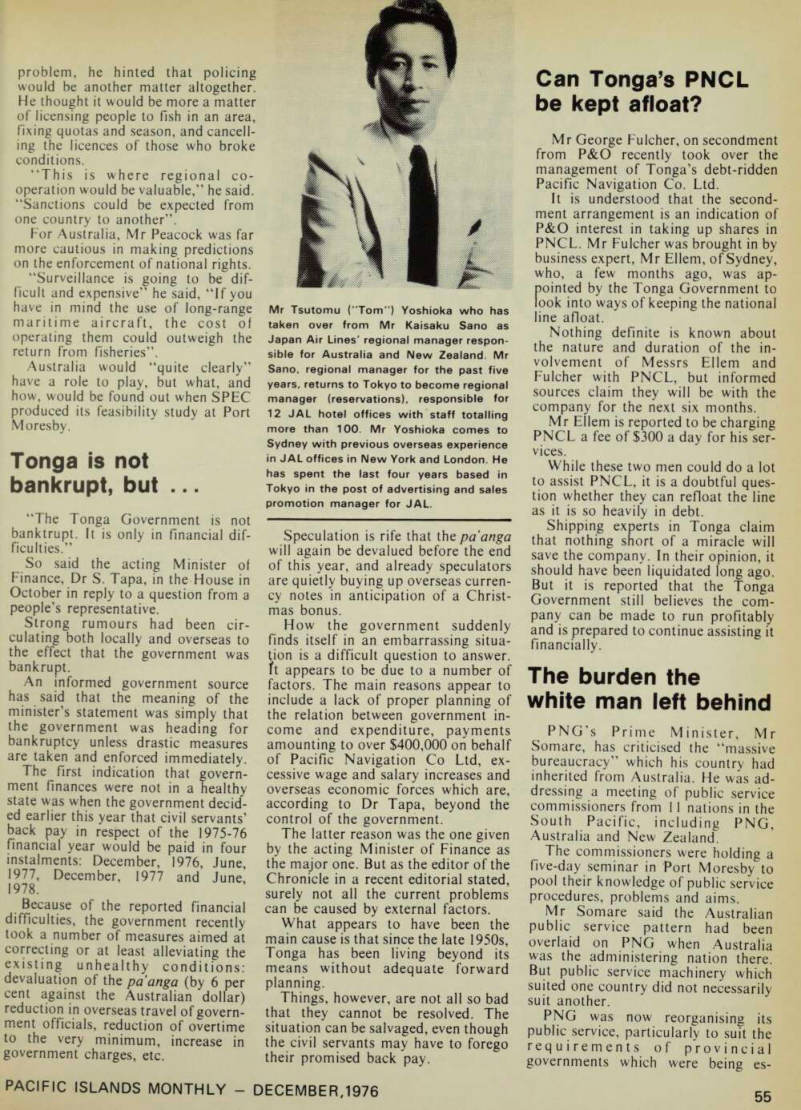
Mr Tsuttomu ("Tom”) Yoshioka who has taken over from Mr Kaisaku Sano as Japan Air Lines' regional manager respon sible for Australia and New Zealand. Mr Sano, regional manager for the past five years, returns to Tokyo to become regional manager (reservations), responsible for 12 JAL hotel offices with staff totalling more than 100. Mr Yoshioka comes to Sydney with previous overseas experience in JAL offices in New York and London. He has spent the last four years based in Tokyo in the post of advertising and sales promotion manager for JAL.
tablished. But this was proving a dif ficult task because of the massive bureaucracy which had grown up un der Australian influences.
Mr Somare said that as far as his country was concerned, the proposed provincial governments some of which are already established would be an important process of decentralisation in public service ac tivities. He believed this would be valuable because of the obvious need for a better government contact with people outside the main towns.
Mr Somare also warned about trends in which the public servant saw himself as the master rather than the servant. He said the affliction was also apparently affecting some politicians.
Nauru enters
Indian market
Nauru has another customer for rock phosphate. President Hammer deßoburt, of Nauru, recently negotiated a deal with the Indian Minister for Petroleum, Mr K. D.
Malviya, to produce phosphoric acid from rock phosphate in a joint ven ture. The annual requirement is ex pected to be about 300,000 tonnes.
Nauru is willing to supply up to one million tonnes a year if acceptable terms are negotiated.
The agreement provides for share capital of $374,882.84, with Nauru having a holding of up to 40%.
New Travelodge
is going up
Work has begun on the building of the new 186-room Travelodge hotel in Mary Street, Port Moresby. The hotel, due to be completed in mid -1978, will be a welcome supplement to the Papua New Guinean capital’s current stock of beds.
The 10-storey building has been planned in a tri-arc design. It will offer restaurants, coffee shop, special ty shops, mezzanine lobby, cocktail bar, public lounge bar and a function room which can be split into three separate areas.
All rooms will have sweeping views of the Coral Sea and Fairfax Har bour. There will be a number of special guest suites on the hotel’s top floor, and two underground parking levels.
Carpenter’s big
gains in Islands
The South Pacific companies in the W.R. Carpenter group, with headquarters in Suva, made a significant contribution to the overall profit in the latest financial year. The South Pacific companies returned a record net profit of $4,287,000. The net operating profit of the group, with headquarters in Sydney, was $9.1 million, compared with $B.l million in 1974-75. The parent company is paying a final dividend of 5.5 c a share, making a 10.5 c a share payout for the year.
The group’s trade revenue was $160.3 million, down by 1.3% compared with 1974-75. The directors expect a 10% increase in operating profit for the current financial year.
Has Fiji halted
its tourism slump?
Fiji’s tourist traffic was up 5.8 per cent in the first half of 1976 compared with the same period last year.
A total of 77,126 visitors came to the country, compared with 72,884 in January-June 1975, according to a September announcement by 'the Bureau of Statistics. The increase spelt a partial recovery from the bad
10.7 slump in Fiji’s tourist traffic last year.
But while visitor traffic has gone up, the amount of business being handled by Fiji hotels has decreased.
Because visitors are tendirfg to stay in the country for shorter periods, room occupancy rates were clown by three per cent as against last year from 49 per cent to 46 per cent.
Visitors in the first half of the year included 39.1 per cent Australians, J 8.9 per cent New Zealanders, 17.7 per cent Americans and 8.5 per cent Canadians.
Burns Philp
profit sags
Lower copra prices and a decline in the economy of the New Hebrides were two major factors in a lower profit for Burns Philp and Co Ltd in the year ended June 30. The net profit was $7.5 million, compared with $7.8 million in 1974-75.
Plantation earnings were down $1.2 million because of low copra prices.
The profits of the New Hebrides Company dropped by about $500,000.
Earnings of the Papua New Guinea company were also down by about $500,000 because of rising costs, lower margins and higher contributions for long service leave.
However, a number of the group’s Australian enterprises operated at profitable levels. The proportion of profits from Australian sources was about 61% compared with about 38% in 1974-75.
The group’s sales totalled $343 million, which was 16.8% higher than the previous year. The company expects better results in the current year from all Islands’ activities.
Burns Philp (SS) Ltd, which is based in Suva, although substantially owned by Burns Philp and Co Ltd, had a net operating profit of $1,335,000 in the latest financial year, compared with $1,112,000 in the previous financial year, although sales at $32,896,000 were below those of the previous term at $34,571,000. • New Guinea Islands Produce Co, of Rabaul, has been appointed the represen tative in the Gazelle Peninsula for the old established islands exporters, E.G. Barker and Co Pty Ltd, of Sydney and Melbourne. New Guinea Islands Produce Co, of which Mr Peni Pamm is trading manager, is a comparatively new com pany. It is the first nationally-owned com pany chosen to represent an Australian firm in PNG.