With ‘hook, line’ and
pp. 51-52 · Read in the full issue
Rob Wright
With ‘hook, line’ and 'famous canera'
Robertson Ramsay Wright, Rob to thousands who knew him, died suddenly in Fiji late in October, aged 70. Rob was a man of many parts, but it was as a photographer of world standing that he was best known. He was also an enthusiastic amateur fisherman and was regarded as an authority in this subject.
For many years he wrote a weekly column, “Hook, Line and Sinker” for the Fiji Times. It was to this column that fishermen looked each Saturday morning, no matter how world shaking might be the events reported on the front page. Some years ago Rob wrote a book, “Hook, Line and Snorkel” which was published by Pacific Publications.
A few years ago, on his retirement from the Fiji government service, Rob set up his own business in Suva, specialising in angling equipment.
In January, 1963, PIM published an article headed “The face behind the South Sea’s most famous camera”, a substantial part of which is republished below as a tribute to a popular, yet humble, man.
The South Pacific’s best-known photographer took his first look at Sydney in December since the time, 30 years ago, that he played in a band at Bondi.
“This place has changed so much I don’t know Pitt Street from Hyde Parkland the traffic is just plain mad, said Rob Wright, whose camera has recorded most of the im portant changes in the South Seas in the last 20 years. Somehow he has never found the chance to call in on Sydney since 1932.
That year the Sydney Harbour Bndge had only just been opened but Wright never crossed it until this visit.
“Glad to see it is still standing,” he grinned as Sydneysider David Ragg, who, like Rob, was born in Fiji, drove him across it.
Rob Wright is in charge of the photographic section of the Fiji Public Relations Office. His photographs have for years appeared regularly in the world’s leading magazines and in
newspapers and periodicals everywhere.
They are well known to PIM readers there are many of his prints in this issue. Two of his pictures not long ago were selected by the En cyclopaedia Bntannica to appear among the “Best 200 Press Pictures of a Decade”. For his work on behalf of Fiji (and Colonial Office) publicity he received the MBE in 1959.
Rob Wright was born Robertson Ramsay Wright at the Government station, Sigatoka, Fiji, in July, 1906, son of an Englishman whose family had originally migrated to Australia.
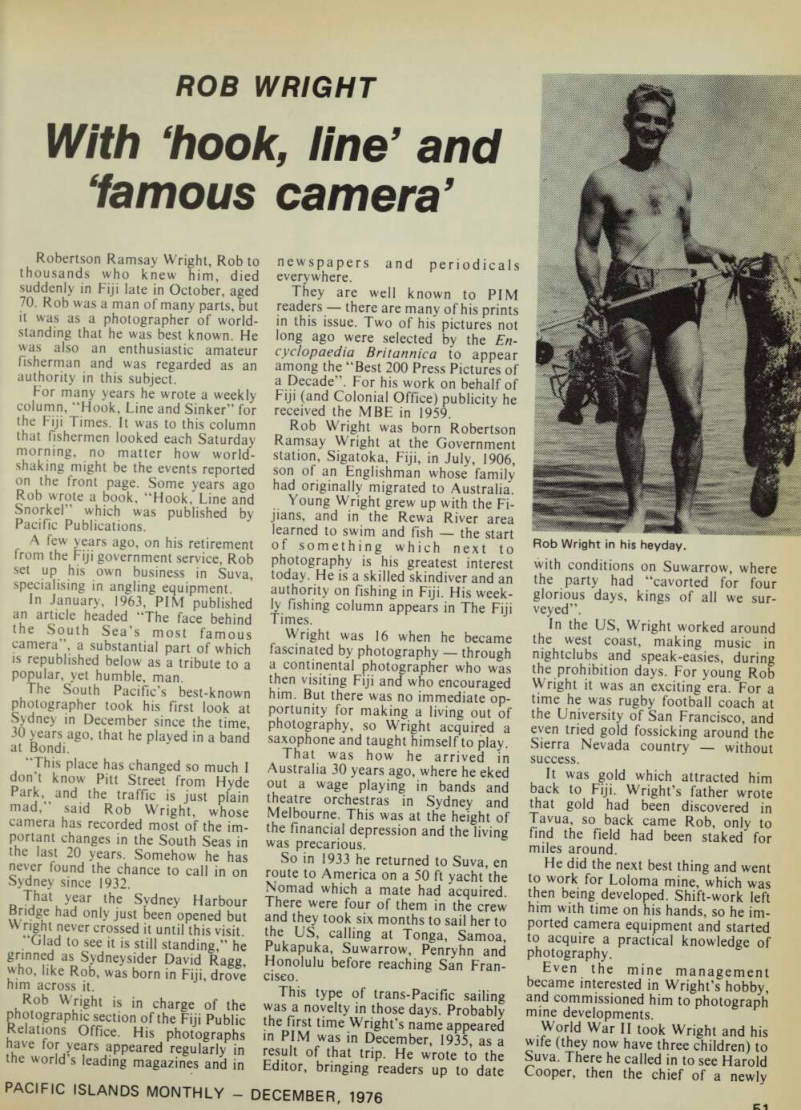
Young Wright grew up with the Fi jians, and in the Rewa River area learned to swim and fish the start of something which next to photography is his greatest interest today. He is a skilled skindiver and an authority on fishing in Fiji. His week ly fishing column appears in The Fiji Times.
Wright was 16 when he became fascinated by photography through a continental photographer who was then visiting Fiji and who encouraged him. But there was no immediate op portunity for making a living out of photography, so Wright acquired a saxophone and taught himself to play.
That was how he arrived in Australia 30 years ago, where he eked out a wage playing in bands and theatre orchestras in Sydney and Melbourne. This was at the height of the financial depression and the living was precarious.
So in 1933 he returned to Suva, en route to America on a 50 ft yacht the Nomad which a mate had acquired.
There were four of them in the crew and they took six months to sail her to the US, calling at Tonga, Samoa, Pukapuka, Suwarrow, Penryhn and Honolulu before reaching San Fran cisco.
This type of trans-Pacific sailing was a novelty in those days. Probably the first time Wright’s name appeared in PIM was in December, 1935, as a result of that trip. He wrote to the Editor, bringing readers up to date
with conditions on Suwarrow, where the party had “cavorted for four glorious days, kings of all we sur veyed”.
In the US, Wright worked around the west coast, making music in nightclubs and speak-easies, during the prohibition days. For young Rob Wright it was an exciting era. For a time he was rugby football coach at the University of San Francisco, and even tried gold fossicking around the Sierra Nevada country without success.
It was gold which attracted him back to Fiji. Wright’s father wrote that gold had been discovered in Tavua, so back came Rob, only to find the field had been staked for miles around.
He did the next best thing and went to work for Loloma mine, which was then being developed. Shift-work left him with time on his hands, so he im ported camera equipment and started to acquire a practical knowledge of
photography.
Even the mine management became interested in Wright’s hobby, and commissioned him to photograph
mine developments.
World War II took Wright and his wife (they now have three children) to Suva. There he called in to see Harold Cooper, then the chief of a newly
Rob Wright in his heyday.
With Hook.Liime
And Famous
Camera
formed Government Information Of fice.
Wright was employed on trial to take photographs for the London War Ministry of the war effort in the Islands and soon he found himself with a fulltime appointment. He and Cooper, commissioned in the Fiji Military Forces, travelled widely through the Pacific.
When the war ended the Informa tion Office didn’t and Wright found himself doing a publicity job for Fiji, with plenty of side trips to other islands particularly to Tonga, where Queen Salote had known him and his camera since he was a young man.
Wright has photographed most of the important Tongan historical oc casions in recent years including Queen Elizabeth’s visit there in 1954.
In the first few years after the war Wright found himself up against new competition. His wartime work had been excellent, but it had found ready publication anyhow because of the in terest in the Pacific.
But soon he was faced with stiff competition for magazine and newspaper space against top world photographers with first-class equip ment and fully fitted darkrooms men who didn’t have to conquer the climatic conditions of the South Sea Islands.
He spent hours experimenting to beat the climate. He concocted for mulas of his own, which could work well but which were too messy and cumbersome for everyday practice.
Wright had to forget the textbooks which called for a 68 degree temperature as being the ultimate for good photographic work. At times he would open raw film just after it had arrived in Fiji and find it ruined by fungus.
But Wright won through, over coming these technical difficulties and many others peculiar to the Islands, such as the problems of staff training.
He has always scrutinised personally even the mechanical work turned out in the darkroom, striving hard to keep it up to the high standards he had set.
It has mean more time and energy, but it is worth it, when an overseas editor writes to say, “Thank you, Rob Wright, for some very nice quality prints”.