On Independence Eve, What’S
pp. 15-16 · Read in the full issue
Going On In The Gilberts?
By January, 1977, the Gilbert Islands will have moved from their present political status to that of in ternal self-government. But perhaps more important is the fact that, within 12 or 18 months after that, the Gilberts will achieve full in dependence.
In early July, our Chief Minister, Naboua Ratieta, with two of his ministers and two private members of our House of Assembly, together with the Governor, Mr John Smith, left Tarawa for a constitutional con ference in London on the subject of self-government for our country or so it was announced by our only newspaper, the Atoll Pioneer, which is owned by the government.
This announcement gave rise to some confusion in the minds of some people on the islands as to just what the real situation is. Self-government is already planned. There may even be a constitution already drafted for that eventuality. So what other issues are our leaders required to discuss further in relation to self-government?
It seems there must be some other very important issue at stake which has not been publicly aired. Perhaps it may come to the surface before too long.
Our government, since it was form ed under its new leader, has been very busy trying to solve a number of problems, some of which are left over from the past. These include: • The long-standing dispute between the Gilberts and Banaba (Ocean Island) concerning the de mand for separation of the Banabans Irom the Gilberts, and the annual division of funds between the Gilberts Government in export duties and the Banabans in royalties. • The separation of the Gilberts and Tuvalu (formerly Ellice Island). • The planned establishment of the new Gilbert Defence Force. • The perspectives of full in dependence for the Gilberts.
We can be proud that our govern ment has been thinking very hard about our future political advance.
But what about the other side of the question, the economic side? How does our government intend to pay for the political advances that are
From REUBEN K. UATIOA on Bairiki
planned?
At present our main sources of in come are phosphate, copra, various forms of duties, and aid from the United Kingdom, Australia and New Zealand and various international agencies such as the World Health Organisation, the United Nations Development Plan, and others.
Phosphate, it is well known, will not for long be a source of income, as it has been estimated that our supplies will be exhausted by 1978. If this happens, the present income of several millions of dollars a year received by the government will dwin dle to nothing. There is the further problem that with the closing down of the phosphate industry 200 or more Gilbertese will be thrown out of work.
Perhaps these people will readjust
easily to their traditional way of life where money was considered unim portant, and one lived happily on fish, babai, breadfruit and coconut. If this happens, there will be no problem, But I, for one, am doubtful.
It may also be of interest to know that in June this year a conference was held, the first of its kind in our capital, Bairiki, Tarawa, between the governments of the United Kingdom, Australia, New Zealand, members of the Rabi Council of Leaders with their economic adviser, and also the Gilberts Government.
The purpose of the conference, ac cording to our government press and radio, was to consider and agree on the future price of phosphate. As far as the official announcement went, the old policy of tying the price of Ocean Island phosphate to the current rate being received by the Republic of Nauru for its phosphate was reaf firmed, and that was all. The agree ment reached was to be known as the Tarawa Agreement.
I am fully convinced that there was much more to this conference than meets the eye, and I would, therefore, like to pose the following questions; • Has the world or even the public of the Gilbert Islands been formally informed of the changes of rate on the share of the phosphate earnings that the Gilberts Government and the Banabans are getting? • Are the Gilbertese aware that an agreement in respect of this very im portant question has been signed
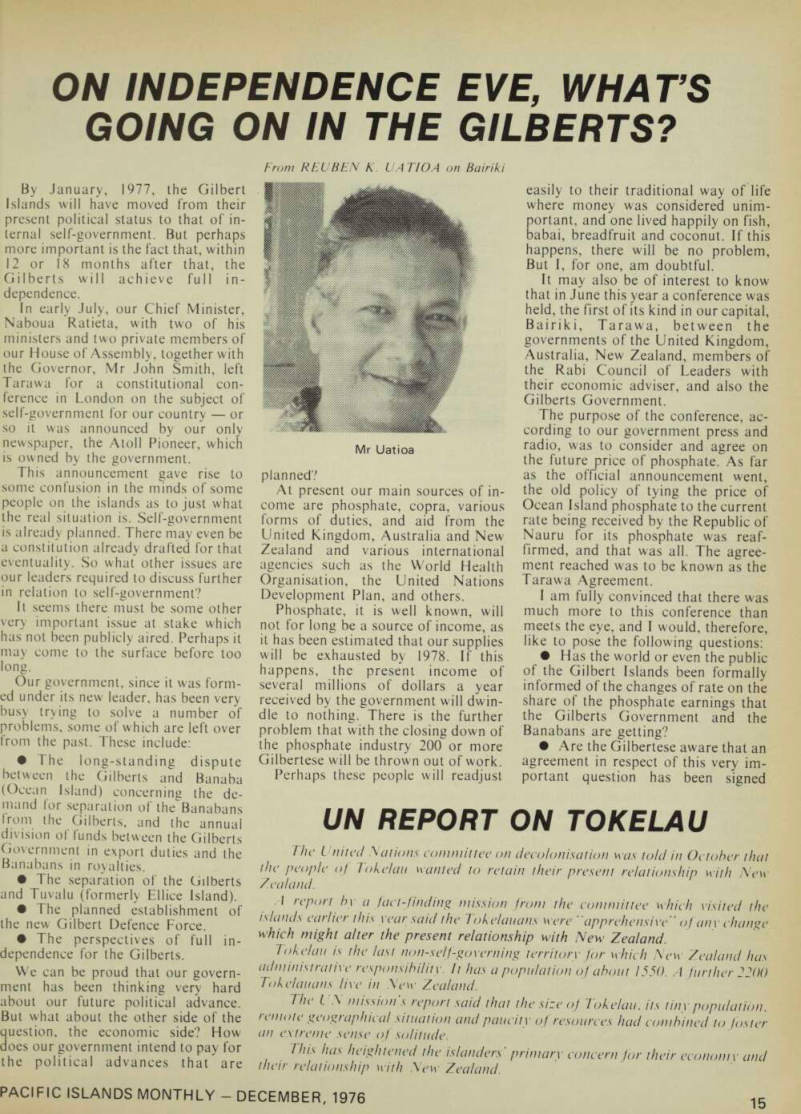
Mr Uatioa
between the British Government and the Banabans without the consent of the Gilberts Government? (It was in fact signed by a person who was not by any means recognised by the peo ple of the Gilberts at the time as one of their leaders.) • Is it a fact that this issue was discussed at the conference, and that the three governments and perhaps also our government under pressure agreed in favour of the Banabans? • Is all this an indication of our being “well cared for”, and “treated sympathetically”, by the British Government?
Then there is the matter of copra.
This is not a very promising earner at the best of times, since its overseas price fluctuates practically every month. We must also remember that with the closing down of the phosphate industry on Ocean Island, and with the smaller number of workers now required from our close friend and neighbour, the Republic of Nauru, many of our people will have to go back. Since one of our main foods, and our dessert to replace im ported sugar, both come from the coconut tree, we will be eating more coconuts anyway.
Of course the government can raise duties and taxes. But that will only put imported goods out of the reach of most people, let alone the un employed. Besides this, demands for higher wages from those lucky enough to be employed by government, GIDA, the Co-operative Federation and societies and perhaps the missions will, no doubt, cause unending problems for the government. I only wish people who have jobs would think a little about the good of the country, and not only about themselves.
Finally, there is the question of foreign aid. There is no doubt that when we move up to self-government the UK, Australia, New Zealand and others will continue their aid. My biggest worry is what will the British Government’s aid policy be like when we stand on our own feet in in dependence? Will they continue their aid as at present, or will things change?
I believe we should forget about foreign aid, even from the United Nations, and get down to the business of examining whether our likely in come in future is going to be able to meet the kind of spending the govern ment has in mind on such projects as the establishment of the Gilbert Defence Force, for example.