A plush
p. 14 · Read in the full issue
home for the Forum
From a Suva correspondent The South Pacific Forum’s new, plush, one million dollar headquarters in Suva were opened in October by New Zealand Prime Minister Rob Muldoon, whose country footed the bill for the building. But Australia, who paid for the furnishings, upstaged everyone, her Foreign Minister An drew Peacock announcing that Australia would give the Islands $6O million between now and 1979.
His golden “declaration of intent” was made at a meeting of the Forum on the Law of the Sea conference, held as the “opener”.
New Zealand also made use of the meeting to privately calm Tongan and Samoan fears about its revamped im migration policies and make a declaration of its total involvement in the South Pacific.
SPEC moved into the 14-building complex a month before the official opening by Prime Minister Muldoon.
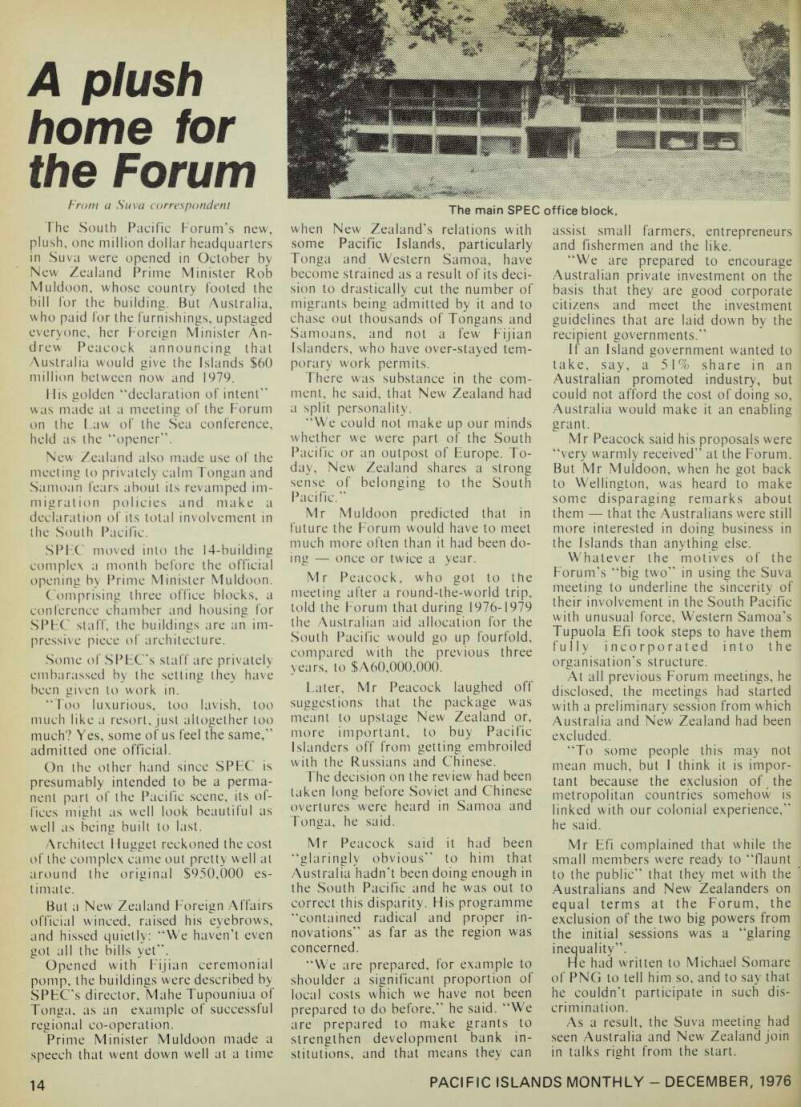
Comprising three office blocks, a conference chamber and housing for SPEC staff, the buildings are an im pressive piece of architecture.
Some of SPEC's staff are privately embarassed by the setting they have been given to work in.
“Too luxurious, 100 lavish, too much like a resort, just altogether 100 much? Yes, some of us feel the same,” admitted one official.
On the other hand since SPEC is presumably intended to be a perma nent part of the Pacific scene, its of fices might as well look beautiful as well as being built to last.
Architect Hugget reckoned the cost of the complex came out pretty well at around the original $950,000 es timate.
But a New Zealand Foreign Affairs official winced, raised his eyebrows, and hissed quietly: “We haven’t even got all the bills yet”.
Opened with Fijian ceremonial pomp, the buildings were described by SPEC's director, Mahe Tupouniua of Tonga, as an example of successful regional co-operation.
Prime Minister Muldoon made a speech that went down well at a time
when New Zealand’s relations with some Pacific Islands, particularly Tonga and Western Samoa, have become strained as a result of its deci sion to drastically cut the number of migrants being admitted by it and to chase out thousands of Tongans and Samoans, and not a few Fijian Islanders, who have over-stayed tem porary work permits.
There was substance in the com ment, he said, that New Zealand had a split personality.
“We could not make up our minds whether we were part of the South Pacific or an outpost of Europe. To day, New Zealand shares a strong sense of belonging to the South Pacific.”
Mr Muldoon predicted that in future the Forum would have to meet much more often than it had been do ing once or twice a year.
Mr Peacock, who got to the meeting after a round-the-world trip, told the Forum that during 1976-1979 the Australian aid allocation for the South Pacific would go up fourfold, compared with the previous three years, to $A60,000,000.
Later, Mr Peacock laughed off suggestions that the package was meant to upstage New Zealand or, more important, to buy Pacific Islanders off from getting embroiled with the Russians and Chinese.
The decision on the review had been taken long before Soviet and Chinese overtures were heard in Samoa and Tonga, he said.
Mr Peacock said it had been “glaringly obvious” to him that Australia hadn't been doing enough in the South Pacific and he was out to correct this disparity. His programme “contained radical and proper in novations” as far as the region was concerned.
“We are prepared, for example to shoulder a significant proportion of local costs which we have not been prepared to do before,” he said. “We are prepared to make grants to strengthen development bank in stitutions, and that means they can
assist small farmers, entrepreneurs and fishermen and the like.
“We are prepared to encourage Australian private investment on the basis that they are good corporate citizens and meet the investment guidelines that are laid down by the recipient governments.”
If an Island government wanted to take, say, a 51% share in an Australian promoted industry, but could not afford the cost of doing so, Australia would make it an enabling grant.
Mr Peacock said his proposals were “very warmly received” at the Forum.
But Mr Muldoon, when he got back to Wellington, was heard to make some disparaging remarks about them that the Australians were still more interested in doing business in the Islands than anything else.
Whatever the motives of the Forum’s “big two” in using the Suva meeting to underline the sincerity of their involvement in the South Pacific with unusual force, Western Samoa’s Tupuola Efi took steps to have them fully incorporated into the organisation’s structure.
At all previous Forum meetings, he disclosed, the meetings had started with a preliminary session from which Australia and New Zealand had been excluded.
“To some people this may not mean much, but I think it is impor tant because the exclusion of the metropolitan countries somehow is linked with our colonial experience,” he said.
Mr Efi complained that while the small members were ready to “flaunt to the public” that they met with the Australians and New Zealanders on equal terms at the Forum, the exclusion of the two big powers from the initial sessions was a “glaring inequality”.
He had written to Michael Somare of PNG to tell him so, and to say that he couldn't participate in such dis crimination.
As a result, the Suva meeting had seen Australia and New Zealand join in talks right from the start.
The main SPEC office block.