The Last Convulsion?
pp. 10-13 · Read in the full issue
The Spc: A Renewal Or
From JOHN CARTER, in Noumea
The palicnl has had treatment, more treatment is to come and latest reports are that the sufferer, the South Pacific Commission, is emerging from coma with a healthy flush dawning on its 29-year-old face.
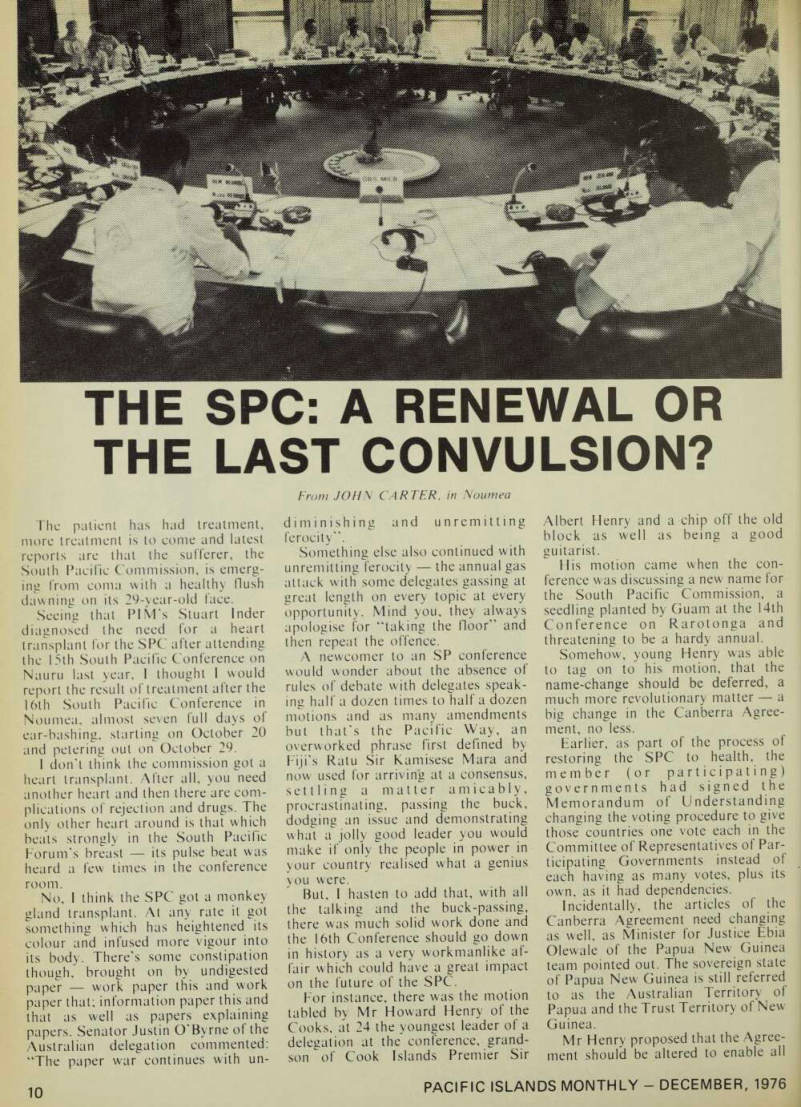
Seeing that PlM’s Stuart Inder diagnosed the need for a heart transplant for the SPC after attending the 15th South Pacific Conference on Nauru last year I thought 1 would report the result of treatment after the 16th South Pacific Conference in Noumea, almost seven full days of car-bashing, starting on October 20 and petering out October 29.
I don't think the commission got a heart transplant After all, you need another heart and then there are complications of rejection and drugs. The only other heart around is that which beats strongly in the South Pacific Forum's breast - its pulse beat was heard a few times in the conference No'. I think the SPC got a monkey uland transplant. At any rate it got something which has heightened its colour and infused more vigour into its bodv There's some constipation though brought on by undigested papef- work paper this andwork naner that* information paper this and Z t as wdl aT pape?s P papers. Senator Justin O'Byrne of the Australian delegation commented: "The paper war continues with un-
diminishing and unremitting ferocity Something else also continued with unremitting ferocity the annual gas attack with some delegates gassing at great length on every topic at every opportunity. Mind you, they always apologise for “taking the floor” and then repeat the offence.
A newcomer to an SP conference would wonder about the absence of rules of debate with delegates speaking half a dozen times to half a dozen motions and as many amendments but that s the Pacific Way, an overworked phrase first defined by Fiji's Ratu Sir Kamisese Mara and now used for arriving at a consensus, settling a matter amicably, procrastinating, passing the buck. dodging an issue and demonstrating what a jolly good leader you would make if only the people in power in your country realised what a genius you were.
' But, I hasten to add that, with all the talking and the buck-passing. there was much solid work done and the 16th Conference should go down in history as a very workmanlike affair which could have a great impact on the future of the SPC.
For instance, there was the motion tabled by Mr Howard Henry of the Cooks, at 24 the youngest leader of a delegation at the conference, grandson of Cook Islands Premier Sir
Albert Henry and a chip off the old block as well as being a good guitarist.
His motion came when the con ference was discussing a new name tor the South Pacific Commission a seedling planted by Guam at the 14lh Conference on Rarotonga and threatening to be a hardy annual Somehow, young Henry was able to tag on to his motion, that the name-change should be deferred, a much more revolutionary matter a big change in the Canberra Agree merit, no less.
Earlier, as PJ r^ of / he . P r^ ess t] ? f restoring the SPC to health the member (or part l c 1 pat l ng) governments had signedl the Memorandum of Und^. S r i a " d j i n J changing the voting procedure to give those countries one vote each in the Committee of Representatives of Par ticipatmg of each having as many votes, plus its own, as it had dependencies, Incidentally, the articles of the Canberra Agreement need changing as well, as M'" 18 ufnea Olewale of the Papua New Guinea team pointed out. The sovereign state of Papua New Guinea is still referred to as the Australian Territory of Papua and the Trust Terntory of New
Guinea^
Mr Henry proposed that the Agree ment should be altered to enable all
countries and territories of the Pacific to accede to it. He pointed out that only independent countries could accede to the agreement and he wanted equality.
That put the political cat among the pigeons. Politics are tabu in the SPC and this, complained some of the delegates from the French territories, was politics.
What Mr Henry wanted was for all the countries and territories to be on an equal footing with the nine Par ticipating Countries, who are the only signatories of the Agreement. He wanted the only qualification for full membership of the commission to be a geographical one, location in the South Pacific, and not political status.
But Mr Jacques Teheiura of French Polynesia took umbrage.
Mr Teheiura said he regarded the motion as political; that New Caledonia and French Polynesia were being forced to declare their political stand. It interfered with their internal affairs, but no one could force the non-independent territories to become independent if they didn’t want to be independent.
Then he got in a neat piece of political one-upmanship. Recently, he said, they had an election in French Polynesia and the candidate who wanted independence only got two per cent of the votes so that 98 per cent of the population who voted were against independence.
The storm passed, no one walked out and it was settled in the Pacific way.
Britain and New Zealand moved that the motion should be withdrawn although they were sympathetic towards the aspirations expressed in it, but Mr Henry refused to withdraw it.
However, he amended it and later, after some corridor diplomacy, he amended it again and it went through with almost everyone’s blessing. It directed the secretariat to study ways in which the legal implications in the Canberra Agreement could be sur mounted to permit all countries and territories, whatever their status, to become full members of the commis sion which, if it happens, could be the greatest change the SPC has un dergone.
As Australia’s Mr R. J. Percival said, it would mean that all the flags of all the countries would fly over Anse Vata beach. So, we’ll have Fiji’s, Tonga’s, Australia’s, New Zealand’s! three or four French Tricolors and a brace of Union flags, not to mention a
couple of Stars and Stripes and others.
That wasn’t the only discussion with a political tinge. There was an agenda item based on the theme of Regionalism; means to further con tacts between Island nations and territories. Wallis and Futuna had produced a paper which included complaints that there wasn’t enough regionalism; that their isolated islands weren’t considered by airline and shipping timetable compilers and that there wasn’t enough interchange of manpower and employment.
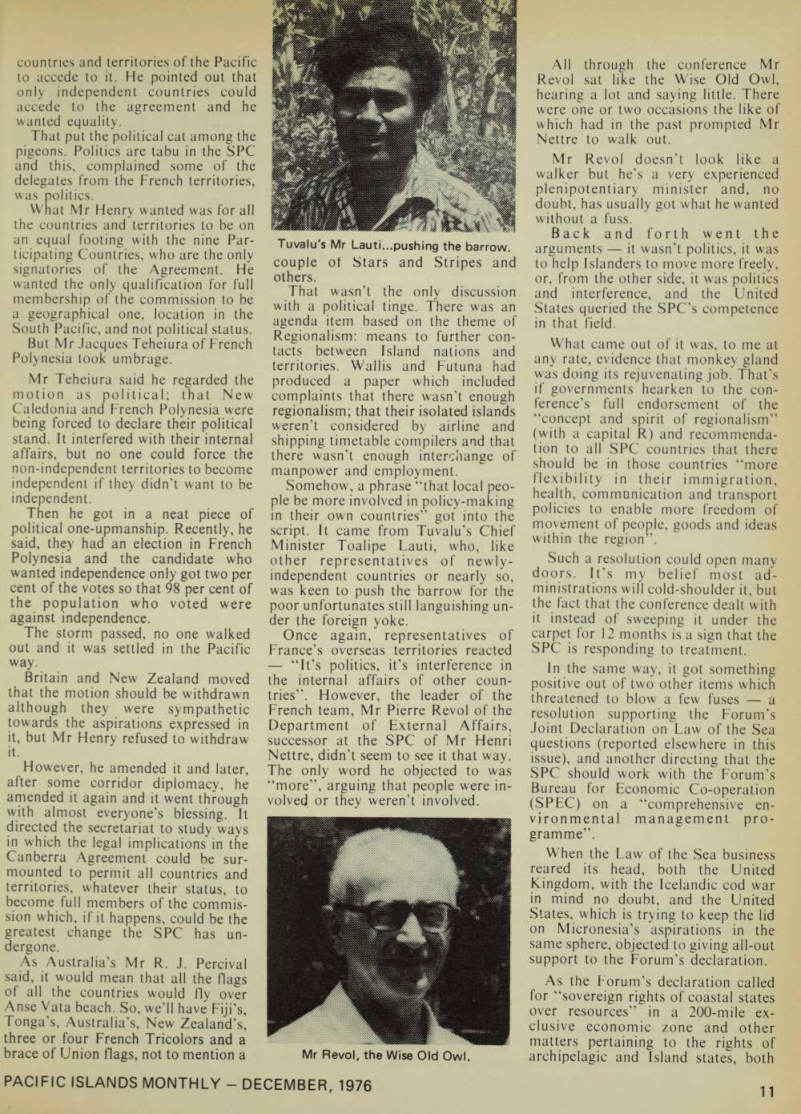
Somehow, a phrase “that local peo ple be more involved in policy-making in their own countries” got into the script. It came from Tuvalu’s Chief Minister Toalipe Lauti, who, like other representatives of newly independent countries or nearly so, was keen to push the barrow for the poor unfortunates still languishing un der the foreign yoke.
Once again, representatives of France’s overseas territories reacted “It’s politics, it’s interference in the internal affairs of other coun tries”. However, the leader of the French team, Mr Pierre Revol of the Department of External Affairs, successor at the SPC of Mr Henri Nettre, didn’t seem to see it that way.
The only word he objected to was “more”, arguing that people were in volved or they weren’t involved.
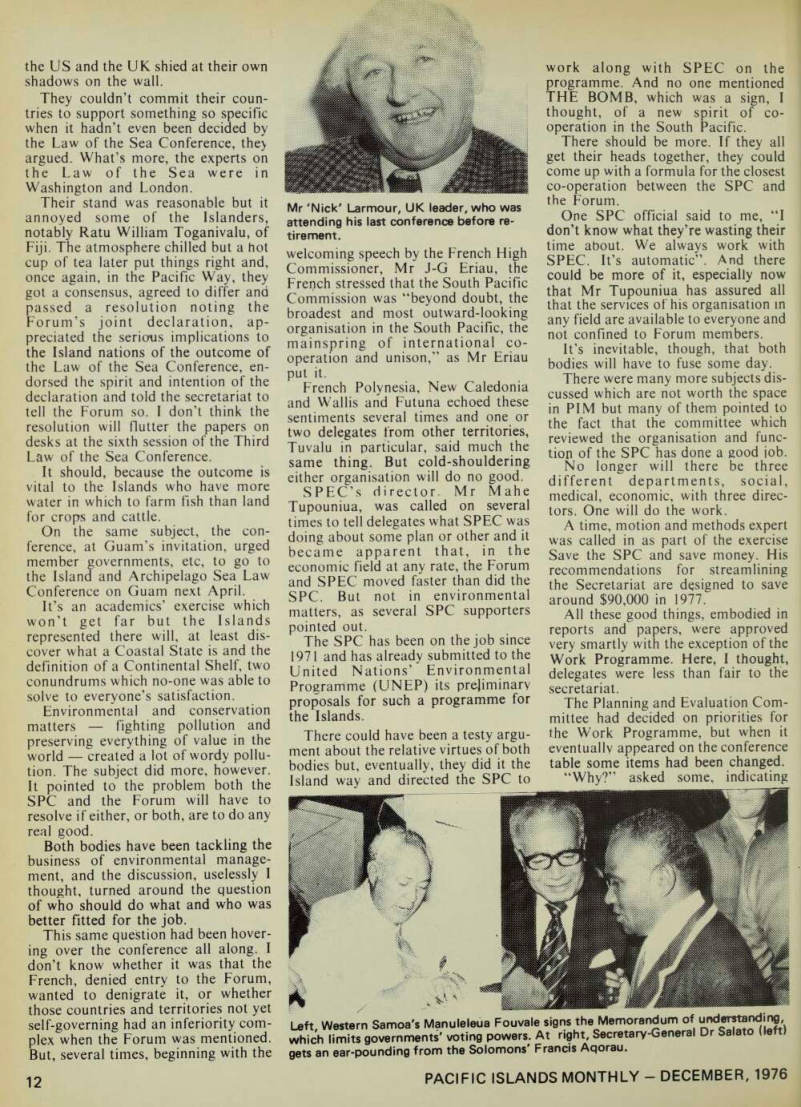
All through the conference Mr Revol sat like the Wise Old Owl, hearing a lot and saying little. There were one or two occasions the like of which had in the past prompted Mr Nettre to walk out.
Mr Revol doesn’t look like a walker but he’s a very experienced plenipotentiary minister and, no doubt, has usually got what he wanted without a fuss.
Back and forth went the arguments it wasn’t politics, it was to help Islanders to move more freely, or, from the other side, it was politics and interference, and the United States queried the SPC’s competence in that field.
What came out of it was, to me at any rate, evidence that monkey gland was doing its rejuvenating job. That’s if governments hearken to the con ference’s full endorsement of the “concept and spirit of regionalism” (with a capital R) and recommenda tion to all SPC countries that there should be in those countries “more flexibility in their immigration, health, communication and transport policies to enable more freedom of movement of people, goods and ideas within the region”.
Such a resolution could open many doors. It’s my belief most ad ministrations will cold-shoulder it, but the fact that the conference dealt with it instead of sweeping it under the carpet for 12 months is a sign that the SPC is responding to treatment.
In the same way, it got something positive out of two other items which threatened to blow a few fuses a resolution supporting the Forum’s Joint Declaration on Law of the Sea questions (reported elsewhere in this issue), and another directing that the SPC should work with the Forum’s Bureau for Economic Co-operation (SPEC) on a “comprehensive en vironmental management pro gramme”.
When the Law of the Sea business reared its head, both the United Kingdom, with the Icelandic cod war in mind no doubt, and the United States, which is trying to keep the lid on Micronesia’s aspirations in the same sphere, objected to giving all-out support to the Forum’s declaration.
As the Forum’s declaration called for “sovereign rights of coastal states over resources” in a 200-mile ex clusive economic zone and other matters pertaining to the rights of archipelagic and Island states, both
Tuvalu's Mr Lauti...pushing the barrow.
Mr Revol, the Wise Old Owl.
the US and the UK shied at their own shadows on the wall.
They couldn’t commit their coun tries to support something so specific when it hadn’t even been decided by the Law of the Sea Conference, the> argued. What’s more, the experts on the Law of the Sea were in Washington and London.
Their stand was reasonable but it annoyed some of the Islanders, notably Ratu William Toganivalu, of Fiji. The atmosphere chilled but a hot cup of tea later put things right and, once again, in the Pacific Way, they got a consensus, agreed to differ and passed a resolution noting the Forum’s joint declaration, ap preciated the serious implications to the Island nations of the outcome of the Law of the Sea Conference, en dorsed the spirit and intention of the declaration and told the secretariat to tell the Forum so. I don’t think the resolution will flutter the papers on desks at the sixth session of the Third Law of the Sea Conference.
It should, because the outcome is vital to the Islands who have more water in which to farm fish than land for crops and cattle.
On the same subject, the con ference, at Guam’s invitation, urged member governments, etc, to go to the Island and Archipelago Sea Law Conference on Guam next April.
It’s an academics’ exercise which won’t get far but the Islands represented there will, at least dis cover what a Coastal State is and the definition of a Continental Shelf, two conundrums which no-one was able to solve to everyone’s satisfaction.
Environmental and conservation matters fighting pollution and preserving everything of value in the world created a lot of wordy pollu tion. The subject did more, however.
It pointed to the problem both the SPC and the Forum will have to resolve if either, or both, are to do any real good.
Both bodies have been tackling the business of environmental manage ment, and the discussion, uselessly I thought, turned around the question of who should do what and who was better fitted for the job.
This same question had been hover ing over the conference all along. I don’t know whether it was that the French, denied entry to the Forum, wanted to denigrate it, or whether those countries and territories not yet self-governing had an inferiority com plex when the Forum was mentioned.
But, several times, beginning with the
welcoming speech by the French High Commissioner, Mr J-G Eriau, the French stressed that the South Pacific Commission was “beyond doubt, the broadest and most outward-looking organisation in the South Pacific, the mainspring of international co operation and unison,” as Mr Eriau put it.
French Polynesia, New Caledonia and Wallis and Futuna echoed these sentiments several times and one or two delegates from other territories, Tuvalu in particular, said much the same thing. But cold-shouldering either organisation will do no good.
SPEC’s director. Mr Mahe Tupouniua, was called on several times to tell delegates what SPEC was doing about some plan or other and it became apparent that, in the economic field at any rate, the Forum and SPEC moved faster than did the SPC. But not in environmental matters, as several SPC supporters
pointed out.
The SPC has been on the job since 1971 and has already submitted to the United Nations’ Environmental Programme (UNEP) its preliminary proposals for such a programme for the Islands.
There could have been a testy argu ment about the relative virtues of both bodies but, eventually, they did it the Island way and directed the SPC to
work along with SPEC on the programme. And no one mentioned THE BOMB, which was a sign, I thought, of a new spirit of co operation in the South Pacific.
There should be more. If they all get their heads together, they could come up with a formula for the closest co-operation between the SPC and the Forum.
One SPC official said to me, “I don’t know what they’re wasting their time about. We always work with SPEC. It’s automatic”. And there could be more of it, especially now that Mr Tupouniua has assured all that the services of his organisation in any field are available to everyone and not confined to Forum members.
It’s inevitable, though, that both bodies will have to fuse some day.
There were many more subjects dis cussed which are not worth the space in PIM but many of them pointed to the fact that the committee which reviewed the organisation and func tion of the SPC has done a good job.
No longer will there be three different departments, social, medical, economic, with three direc tors. One will do the work.
A time, motion and methods expert was called in as part of the exercise Save the SPC and save money. His recommendations for streamlining the Secretariat are designed to save around $90,000 in 1977.
All these good things, embodied in reports and papers, were approved very smartly with the exception of the Work Programme. Here, I thought, delegates were less than fair to the secretariat.
The Planning and Evaluation Com mittee had decided on priorities for the Work Programme, but when it eventually appeared on the conference table some items had been changed.
“Why?” asked some, indicating
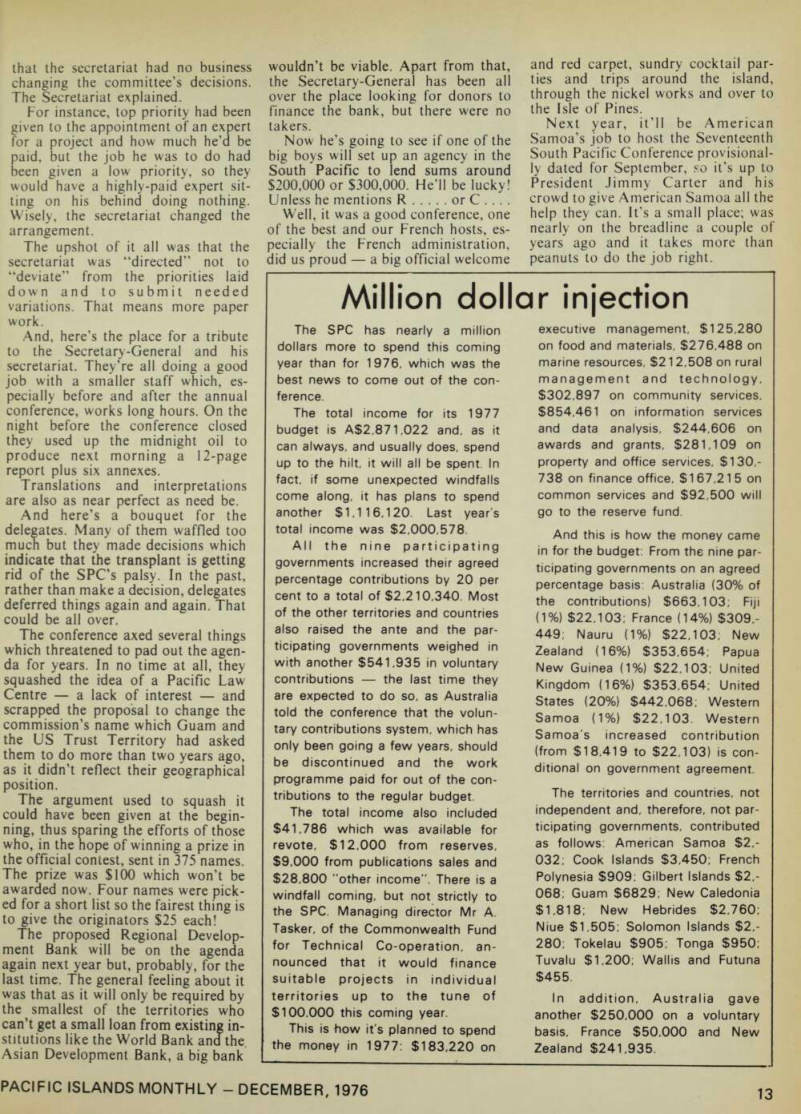
Mr 'Nick' Larmour, UK leader, who was attending his last conference before re tirement.
Left, Western Samoa's Manuleleua Fouvale signs the Memorandum of undemanding, which limits governments' voting powers. At right, Secretary-General Dr Salato (left) gets an ear-pounding from the Solomons Francis Aqorau.
that the secretariat had no business changing the committee’s decisions.
The Secretariat explained.
For instance, top priority had been given to the appointment of an expert for a project and how much he’d be paid, but the job he was to do had been given a low priority, so they would have a highly-paid expert sit ting on his behind doing nothing.
Wisely, the secretariat changed the arrangement.
The upshot of it all was that the secretariat was “directed” not to “deviate” from the priorities laid down and to submit needed variations. That means more paper work.
And, here’s the place for a tribute to the Secretary-General and his secretariat. They’re all doing a good job with a smaller staff which, es pecially before and after the annual conference, works long hours. On the night before the conference closed they used up the midnight oil to produce next morning a 12-page report plus six annexes.
Translations and interpretations are also as near perfect as need be.
And here’s a bouquet for the delegates. Many of them waffled too much but they made decisions which indicate that the transplant is getting rid of the SPC’s palsy. In the past, rather than make a decision, delegates deferred things again and again. That could be all over.
The conference axed several things which threatened to pad out the agen da for years. In no time at all, they squashed the idea of a Pacific Law Centre a lack of interest and scrapped the proposal to change the commission’s name which Guam and the US Trust Territory had asked them to do more than two years ago, as it didn’t reflect their geographical position.
The argument used to squash it could have been given at the begin ning, thus sparing the efforts of those who, in the hope of winning a prize in the official contest, sent in 375 names.
The prize was $lOO which won’t be awarded now. Four names were pick ed for a short list so the fairest thing is to give the originators $25 each!
The proposed Regional Develop ment Bank will be on the agenda again next year but, probably, for the last time. The general feeling about it was that as it will only be required by the smallest of the territories who can’t get a small loan from existing in stitutions like the World Bank and the Asian Development Bank, a big bank
wouldn’t be viable. Apart from that, the Secretary-General has been all over the place looking for donors to finance the bank, but there were no takers.
Now he’s going to see if one of the big boys will set up an agency in the South Pacific to lend sums around $200,000 or $300,000. He’ll be lucky!
Unless he mentions R or C . . . .
Well, it was a good conference, one of the best and our French hosts, es pecially the French administration, did us proud a big official welcome
and red carpet, sundry cocktail par ties and trips around the island, through the nickel works and over to the Isle of Pines.
Next year, it’ll be American Samoa’s job to host the Seventeenth South Pacific Conference provisional ly dated for September, so it’s up to President Jimmy Carter and his crowd to give American Samoa all the help they can. It’s a small place; was nearly on the breadline a couple of years ago and it takes more than peanuts to do the job right.