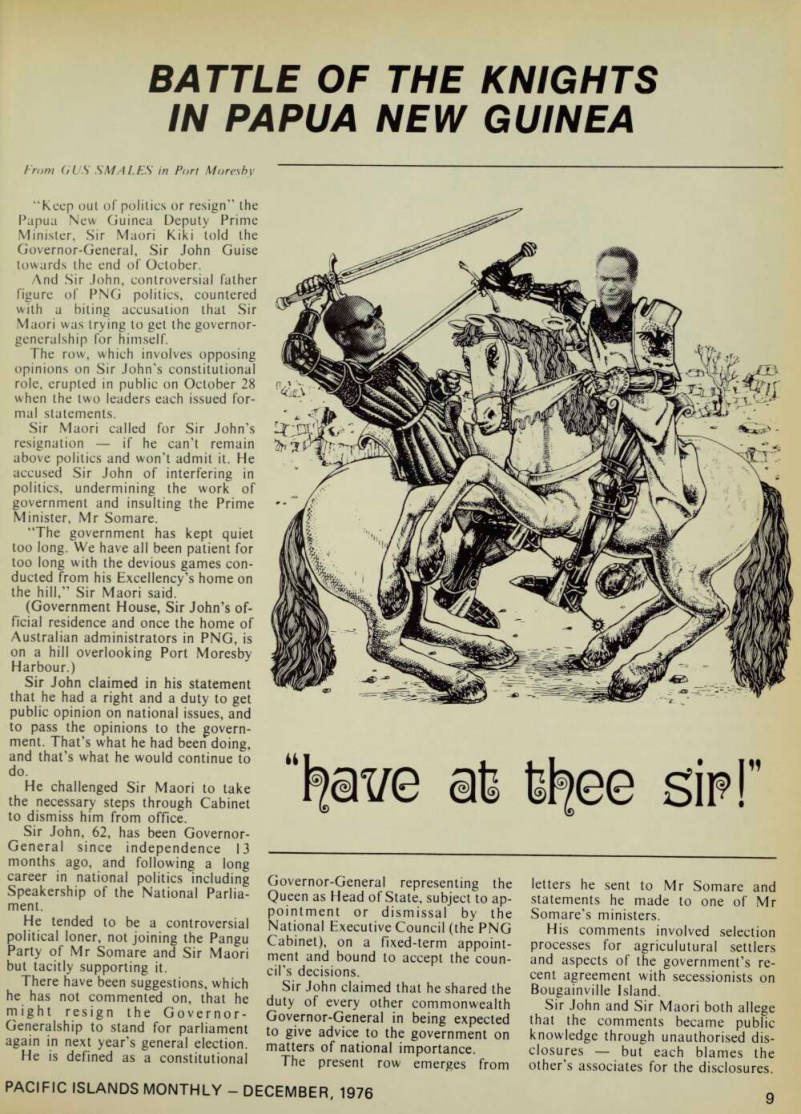
"have at thee sip!"
Battle Of The Knights
In Papua New Guinea
From (iUS SMALES in Port Moresby “Keep out of politics or resign” the Papua New Guinea Deputy Prime Minister, Sir Maori Kiki told the Governor-General, Sir John Guise towards the end of October.
And Sir John, controversial father figure of PNG politics, countered with a biting accusation that Sir Maori was trying to get the governor generalship for himself.
The row, which involves opposing opinions on Sir John’s constitutional role, erupted in public on October 28 when the two leaders each issued for mal statements.
Sir Maori called for Sir John’s resignation if he can’t remain above politics and won’t admit it. He accused Sir John of interfering in politics, undermining the work of government and insulting the Prime Minister, Mr Somare.
“The government has kept quiet too long. We have all been patient for too long with the devious games con ducted from his Excellency’s home on the hill,” Sir Maori said. (Government House, Sir John’s of ficial residence and once the home of Australian administrators in PNG, is on a hill overlooking Port Moresby Harbour.) Sir John claimed in his statement that he had a right and a duty to get public opinion on national issues, and to pass the opinions to the govern ment. That’s what he had been doing, and that’s what he would continue to do.
He challenged Sir Maori to take the necessary steps through Cabinet to dismiss him from office.
Sir John, 62, has been Governor- General since independence 13 months ago, and following a long career in national politics including Speakership of the National Parlia ment.
He tended to be a controversial political loner, not joining the Pangu Party of Mr Somare and Sir Maori but tacitly supporting it.
There have been suggestions, which he has not commented on, that he might resign the Governor- Generalship to stand for parliament again in next year’s general election.
He is defined as a constitutional
letters he sent to Mr Somare and statements he made to one of Mr Somare’s ministers.
His comments involved selection processes for agriculutural settlers and aspects of the government’s re cent agreement with secessionists on Bougainville Island.
Sir John and Sir Maori both allege that the comments became public knowledge through unauthorised dis closures but each blames the other’s associates for the disclosures.
Governor-General representing the Queen as Head of State, subject to ap pointment or dismissal by the National Executive Council (the PNG Cabinet), on a fixed-term appoint ment and bound to accept the coun cil’s decisions.
Sir John claimed that he shared the duty of every other commonwealth Governor-General in being expected to give advice to the government on matters of national importance.
The present row emerges from
"have at thee sip!"