Clancy Lowers The Boom
p. 59 · Read in the full issue
On Bougainville Copper
Mr Pat Clancy, the Australian communist trade union leader banned from Papua New Guinea until recent ly, called in September for the nationalisation of the Bougainville copper mine.
He told mining and other unionists at a meeting only 20 miles from the mine that Australia had treated Papua New Guineans as “pawns and less than human”. Now that PNG was politically independent, it was be ing “savagely exploited” by a new colonialism the neo-colonialism of the multi-national economic machine.
He advocated the immediate set ting of a target date for the PNG Government to take over the Bougainville mine. He said he presumed “the conservative govern ment of Papua New Guinea would want to pay compensation”, but added: “My view is nationalisation without compensation”.
He urged unionists to have a close look at the wages they were getting and then to compare them with those of workers at the Mount Isa mine in Australia. The copper was being sold at the same price from the two mines, but wages on Bougainville were five times less than those at Mount Isa, he said.
The Bougainville mine is 20 per cent owned by the PNG Government.
The remaining ownership traces through Conzinc Riotinto of Australia to the United Kingdom Conzinc Riotinto group.
Mr Clancy said that PNG should think about seeking help from the socialist countries. With their help, PNG would no longer fear “the power of the multinational capitalist com panies”, he claimed.
Mr Clancy is federal secretary of the Australian Building Workers’ In dustrial Union, and president of the Socialist Party of Australia.
His application to visit PNG was at first refused, but he was allowed in after Bougainville unionists had threatened to strike over the issue at the mine and in other businesses.
The conference at which he spoke was on the theme “Alternative
answers to the problems of capitalism in developing countries”.
Among decisions taken at the con ference was one declaring that the Bougainville Mining and General
Workers’ Union should seek affilia tion with the communist-dominated World Federation of Trade Unions.
The conference also decided that the union should seek membership of the PNG Trade Union Congress.
Unionists believe a clash of in terests could be involved because of the inherently anti-communist stand of the PNG body. The chairman of the PNGTUC, Mr Tony Ha, said that a close examination of the double af filiation proposal would be necessary because of the possible clash. He said he “could not totally agree” to a socialist involvement in PNG or its unions.
He would agree to union help from socialist countries, however, if it could be shown to have some benefits for the unions’ community involvement in
Png.
Tony lla... couldn't totally agree with a socialist involvement.
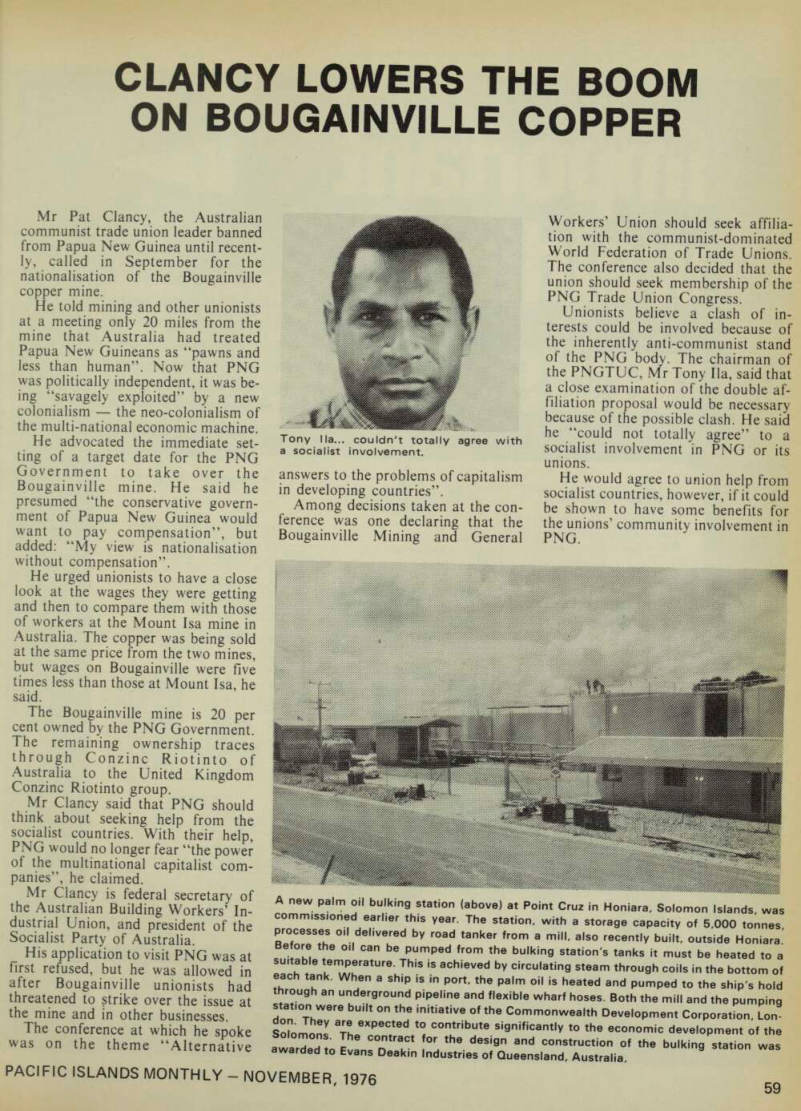
A new palm oil bulking station (above) at Point Cruz in Honiara, Solomon Islands was commissioned earlier this year. The station, with a storage capacity of 5,000 tonnes, processes oil delivered by road tanker from a mill, also recently built, outside Honiara.
Before the oil can be pumped from the bulking station's tanks it must be heated to a suitable temperature. This is achieved by circulating steam through coils in the bottom of each tank. When a ship is in port, the palm oil is heated and pumped to the ship's hold through an underground pipeline and flexible wharf hoses. Both the mill and the pumping station were built on the initiative of the Commonwealth Development Corporation, Lon don. They are expected to contribute significantly to the economic development of the Solomons. The contract for the design and construction of the bulking station was awarded to Evans Deakin Industries of Queensland, Australia.