Papua New Guinea Looks
pp. 55-57 · Read in the full issue

Business
For A Place In The Sun
By Anne Macgregor
In an effort to find its place in the international tourism sun, Papua New Guinea is pulling out all the stops to find out what it is, and where its going.
The recently-formed Office of Tourism has been put together to reflect the determination of Labour, Commerce and Industry Minister Gavera Rea, to get tourism moving and fast. In his recent budget speech to Parliament, Mr Rea promised to deliver a National Tourism Plan by March, 1977, and the Office of Tourism has been told to give this work priority over all else.
The tourism blueprint will cover all aspects of development, clearly defin ing the economic and social im plications of this octopus-like in dustry. The Pidgin phrase easy-easy seems to be the government’s philosophy while seeking develop ment. The push is for quality rather than quantity in all things par ticularly tourism.
The national tourism plan is ex pected to be completed in draft by December, though, already, the in dustry has indicated confidence in the country’s tourism future.
Travelodge Pty Ltd has begun work on its Mary Street site in Port Moresby, the national capital and in ternational gateway. The completion date is, currently, mid-1978.
The tri-arc, 10-storied, luxury
structure will provide the city with a much-needed 186 rooms. In addition to accommodation, the proposed hotel will feature a special functions room which will be capable of handl ing medium to large conference groups.
Davara House’s managing director Jack Woodward has put his hotel chain’s cards on the table with the re cent purchase of the city’s newest hotel the Islander. This acquisition should prove to be Davara’s trump as the Islander, situated in the new city centre, and the Davara Motel, oc cupying a prominent spot on the city’s main beach and recreation area, are complementary facilities, offering holidaymakers and business travellers a choice for their money.
Air Niugini, the national carrier, is no longer the fledgling airline of Melanesia. Rather, it’s a full grown Bird of Paradise with real potential for success in the Pacific, in contrast to the agonies now being experienced by its island counterparts to the east.
Air Niugini operates international services between Port Moresby and Australian ports, and Manila in the Philippines. A new service to Japan will be introduced early next year and rights to Indonesia have been secured.
Other negotiations are in the pipeline, for example, PNG seeks to expand its gateways north and west.
With expansionist dreams, the company’s plan for additional routes and its aggressive marketing programme augurs well for the tourist industry.
The Bird of Paradise airline is currently sitting in an economic Utopia, still running in the black while operating its international ser vices as well as efficient, high-yield domestic runs: a claim not many government airlines can boast.
Air Niugini will complete its wet lease Boeing 720 arrangement with
Tempair in February, 1977. The Transport Ministry has announced that the airline will buy a Qantas Boe ing 707 aircraft, with many extras, at a bargain, all-up price of SAS million.
Sources close to Air Niugini believe it will not be long before a second Boe ing 707 is added to the fleet.
To increase the tourist flow, Air Niugini’s general manager, Bryan Grey, has instituted incentive fares for groups, both internally and inter nationally. Weekend “opportunity” discounts will boost domestic tourism, as well as placing international wholesalers in a more competitive position when drawing up tour packages.
Third-level airline operators are ex periencing financial difficulties as government freight contracts are rationalised, and movement of per sonnel curtailed. However, Panga Airways, formerly Crowley Airways, is blossoming under the able hand of general manager, John Cruickshank who keeps a sharp eye on all tourism possibilities.
Panga has moved into first position in providing tourist services, now that Talair, once the mainspring of tourism with its tour subsidiary Talco
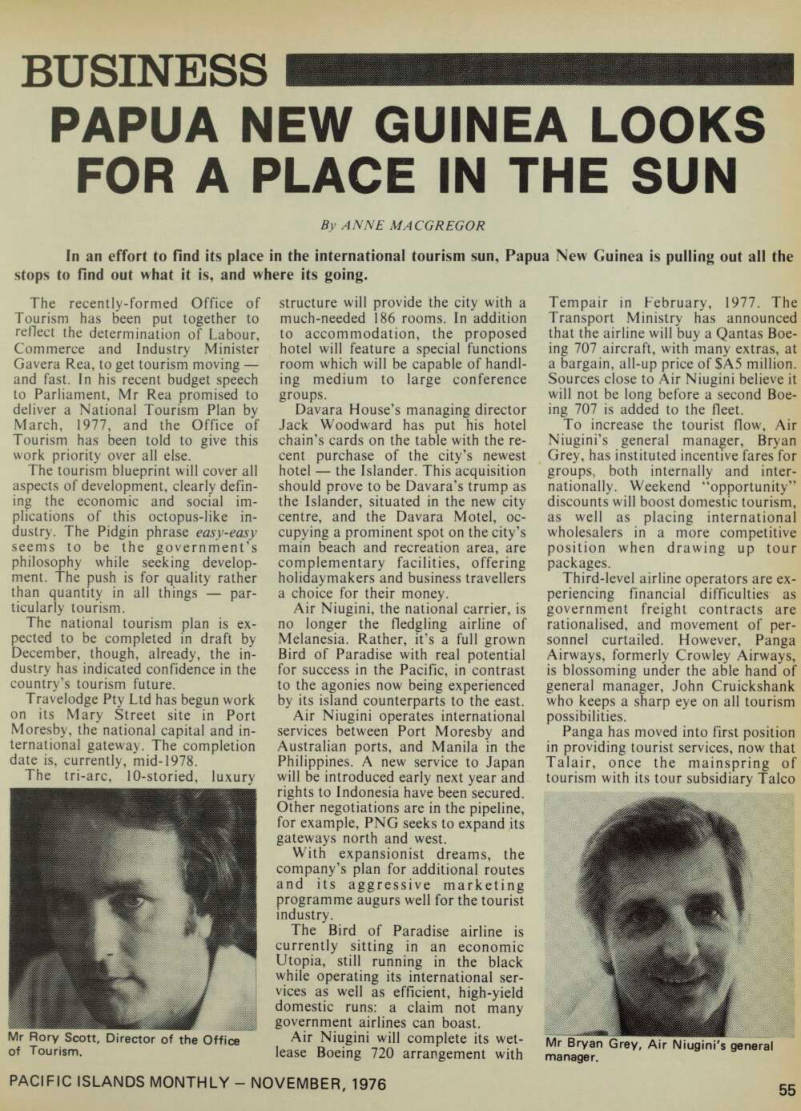
Mr Rory Scott, Director of the Office of Tourism.
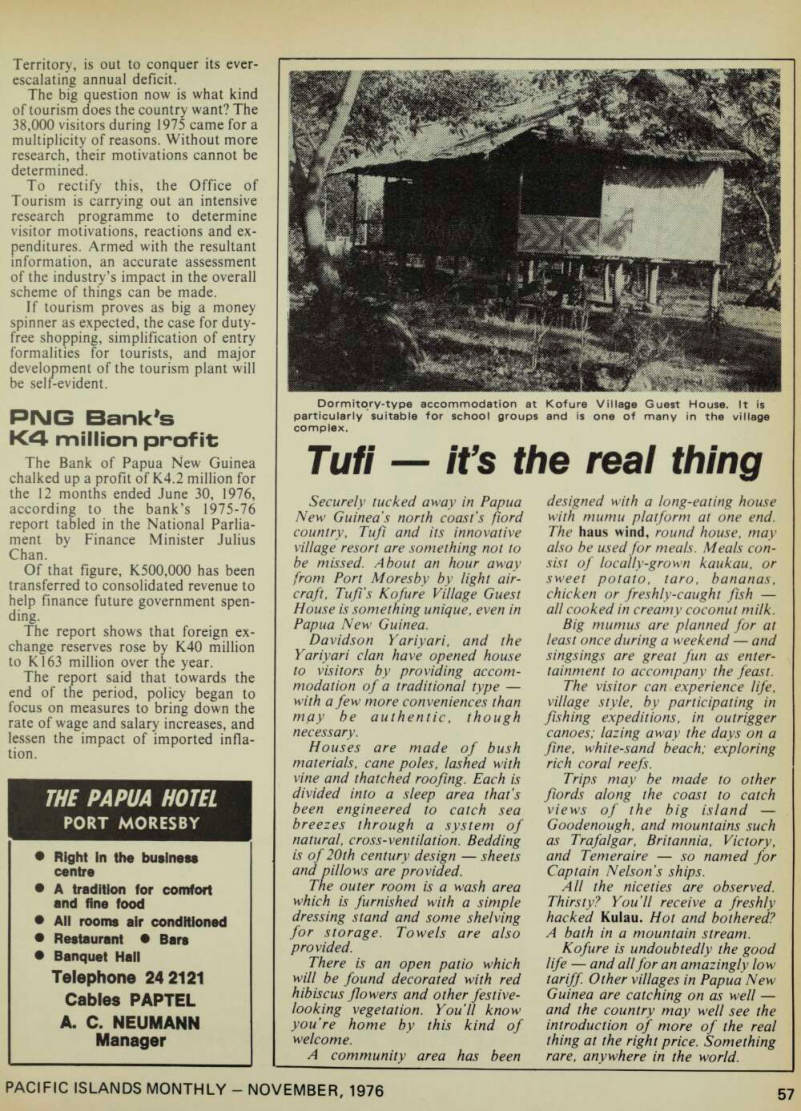
Mr Bryan Grey, Air Niugini's general manager.
Territory, is out to conquer its ever escalating annual deficit.
The big question now is what kind of tourism does the country want? The 38,000 visitors during 1975 came for a multiplicity of reasons. Without more research, their motivations cannot be determined.
To rectify this, the Office of Tourism is carrying out an intensive research programme to determine visitor motivations, reactions and ex penditures. Armed with the resultant information, an accurate assessment of the industry’s impact in the overall scheme of things can be made.
If tourism proves as big a money spinner as expected, the case for duty free shopping, simplification of entry formalities for tourists, and major development of the tourism plant will be self-evident,
PNG Bank's
K 4 million profit:
The Bank of Papua New Guinea chalked up a profit of K 4.2 million for the 12 months ended June 30, 1976, according to the bank’s 1975-76 report tabled in the National Parlia ment by Finance Minister Julius Chan.
Of that figure, K 500,000 has been transferred to consolidated revenue to help finance future government spen ding.
The report shows that foreign ex change reserves rose by K4O million to K 163 million over the year.
The report said that towards the end of the period, policy began to focus on measures to bring down the rate of wage and salary increases, and lessen the impact of imported infla tion.