A New Hebridean Paradise -
pp. 50-52 · Read in the full issue
A New Hebridean Paradise plus the gates of Hell
By Joan Cobb
Paradise has always tended to be a trifle elusive, which is why, if a bit tends to hove in view it’s best to grab it fast more especially if it’s an island, which is always high on Paradise lists. Islands do tend even tually to get too well-known and over crowded and Paradise takes off for elsewhere.
Right now, Paradise is sitting pret ty in a whole scattering of islands not too far off the Australian coast and so far generally overflown by tourists heading resolutely for Suva and points north. Just a slight deviation off that route will bring you down in Port Vila in the middle of the New Hebrides, neatly sandwiched between Fiji and Noumea and just about an hour’s flight from both. You may plan to move on; you won’t.
Although, more often than not these days, there is a cruise ship in Port Vila’s harbour, the passengers don’t get much further than the town’s main street, which is in teresting, but not unusual, and a welcoming hotel swimming pool or two. The outer islands take second place to duty-free shopping, and local history and politics come nowhere.
This is a pity, because every island has a different flavour, partly because each island’s interests are so different and the whole is rather oddly owned anyway.
Since 1906 officially, and somewhat before that unofficially, the French and British have administered them jointly. This national merger has not produced anything like an inter national flavour, but it has resulted in two of everything.
In Port Vila, there are two Resident Commissioners with their two official launches, two law courts to try you depending on whether you’d rather be hanged or guillotined, two national anthems, two school systems and two languages besides the local dialects. If you’ve got time for local politics and conflicting interests there’s plenty there to talk about.
But politics, of course, mean little to the casual paradise seeker; anyway there’s almost too much of everything else. The harbour sporting a growing flotilla of international boats bites deep inland; sailing across it to some hideaway or an island lying snugly in a bay around the coast, swarms of flying fish skitter off to safety in front of you. You can sail your life away up there while all the time each tropic day slips gradually into each tropic night through unhurried mornings, blazing noondays and soft evenings.
On the Port Vila lagoon, where the town’s most evocative hotels are built, phrases that the mind has waited years to use come surfacing at the cocktail hour. At dusk, when the red has drained from the hibiscus and the poincianas, you can find new meanings for phrases like “seduced by silence”. Silence up there means the sudden, strange stillness of nearby water, slate blue when the sun has gone and made more still by the sound of surf against the reef a mile away.
Or it could be a broken silence as a fish plops cleanly in the shallows or a
paddle dips in and out to send some canoe-commuting villager homeward, Or again, it could be the silence of still air, disturbed as a thousand insects explode outwards in a beam of light like effervescing champagne bubbles, while a bat dips and hiccups through them, trailing silver as he passes. The moment, as they say, is everything, If you can leave the hotel and the lagoon beside it, the quickest way around all the islands is by Air Melanesiae’s 10-seater Islanders. You can book yourself on and off them locally. Islanders are little, low planes, conferring the same sort of immediate intimacy on their oc cupants that a car does. You sit carefully behind the pilot, two by two, and if you get the co-pilot’s seat, feel obliged to acknowledge the propeller’s starting after one or two take-offs, in the approved “thumbs up” airforce way.
The Islanders fly low, wheels down like an eagle about to take its prey, and plunge confidently in and out of cloud and squalls, emerging from time to time into searing tropic suns that turn the sea from a sullen pewter
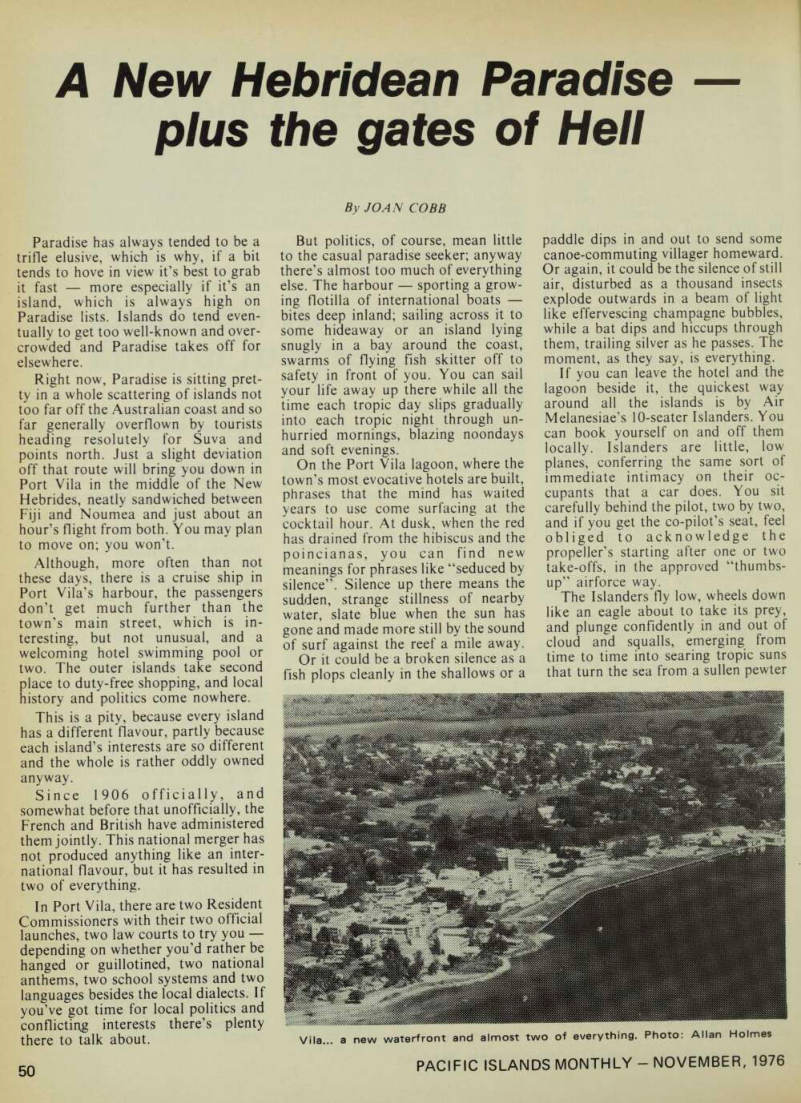
Vila... a new waterfront and almost two of everything. Photo: Allan Holmes
into an iridescent, swishing peacock’s tail.
This sea floats a series of islands on its surface that are only a little less than perfect. From turquoise sea level to 6000 ft mist-shrouded volcanoes you never knew existed; each scrap of land seems to have soaked up every green in the universe to stain the cascade of jungle that explodes over every inch of it.
Starred with palm tops, whole watersheds of vine and creeper flow down to smother yet another foot of territory, seemingly while you look at it. Endlessly advancing vegetation winds breathlessly round every clump of tree until, from above, the whole landscape seems made up of bunches of trussed up asparagus stalks, or con stantly upended emerald jellies.
Where there are roads they keep to the shorelines, criss-crossing inland in the rare places like Espiritu Santo or parts of Efate where there is land flat enough to put them. Otherwise there are few, not nearly enough to reach the hundreds of scraps of broderie anglaise that mark the beaches, the rivers that dive landward from the coast, or all those tiny, perfect green shaded lagoons nicked into every island’s shoreline.
But the islands all have an airfield, island-size. The daily plane sweeps in to them from the ocean, past a bare, untended windsock (“They didn’t have that there last time” says the pilot) and onto the bumpy, grassy runways of the landing fields. When a ’plane stops it sinks wheel deep into the turf and waits for someone to turn up. In a comparatively busy airport like Tanna’s there is a kitchen-sized terminal and usually a welcoming party in both French and English.
In the smaller ones, the Landrover containing someone clued up about arrival times can come a good five minutes later. It scarcely seems to matter.
The strips are flat, shaved patches in the coconut palms. At Walaha, on Aoba, the strip starts at the shoreline and climbs immediately uphill.
“You ought to watch a plane land there,” said one British official. “It disappears at the water’s edge altogether and by the time it tears up the rise it seems to have come straight out of the sea. It’s just surprising it’s not trailing seaweed.”
Once down, everything comes out of the back of the Islanders. Boxes, cartons, cases, bottles of water for the French who can’t seem to live without
the authentic home-grown stuff; something stronger for the British; beer and mail for everyone. Someone offloads a rooster on one strip, coiled around a stick like a tomato plant.
“What else do you get?” I asked the pilot.
“A pig once,” he said. “It was in the back with its head poking out of a bag for the whole trip. And once, memorably, a coconut crab.”
They sell these crabs on market days in large, leg-roped bundles like gigantic tethered artichokes. This one, however, wasn’t tethered and it got into the fuselage. The pilot said it really took some getting out and the passengers didn’t seem to care much for it.
Obviously, a pilot never knows what he’ll be asked to bring or buy. At Lonoroe on Pentecost mine hailed the New Hebridean attendant at take-off.
“All right,” he called, “two guitar strings next trip.”
Most northerly and largest of the island is Espiritu Santo. Santo has an odd name-link with Australia. The islands were sighted by Europeans for the first time in 1606 when Pedro Fer nandez de Quiros, who thought he’d found the Great South called them Australia del Espiritu Santo.
The northern island still retains the last two names. The whole group, however, received its present name from Cook who sailed through them in 1774, thought they looked like the northern coast of Scotland, and called them the New Hebrides.
Santo is the flattest island with a war-time airport and a harbour that gave haven to the Allied fleets in the Pacific War. Today, there are rusting scraps of that fleet still around, but Santo has mostly settled down to producing coconuts and meat. There
is, in fact, a flourishing beef industry up there and a special brand of New Hebridean cowboy.
But if islands like Santo have their benignly rural side, there are others like Tanna which resolutely don’t.
Tanna is one of the most southerly of the group with pockets of general resistance to the 20th century. Though dotted with French and English schools, the villages are primitive and there are places the busy 19th century missionaries are reputed to have miss ed. They call it primitive Tanna and entice the tourist there with the un likely lure of a volcano-climb preceding lunch.
Arguably, no tourist claiming sani ty climbs a volcano at any time, es pecially one that constantly rumbles threateningly, grumbles, mutters, sneers and hiccups and during its less polite belchings, tosses out a stream of very nasty-looking rocks that thump and hiss their way downwards with complete disregard for any tourist toiling up.
Tropics, doubtless, suspend com monsense and certainly it suspended mine. I arrived at Tanna in a rainstorm, hardly able to read either “Bienvenue” or “Welcome” on the terminal roof. The Islander landed and took off later in a wall of water a foot before its nose and navigated the airstrip by some form of racial memory.
It takes, however, more than rain to deter a tourist or a determined guide, so we set off. Tanna in the sunlight, each twist and turn of road opening up more views to seaward, is beautiful. In the rain, the whole land runs liquid chocolate, the vegetation brushes the Landrover’s window like a constantly soaked fringe of hair while the trees, befurred from roots to
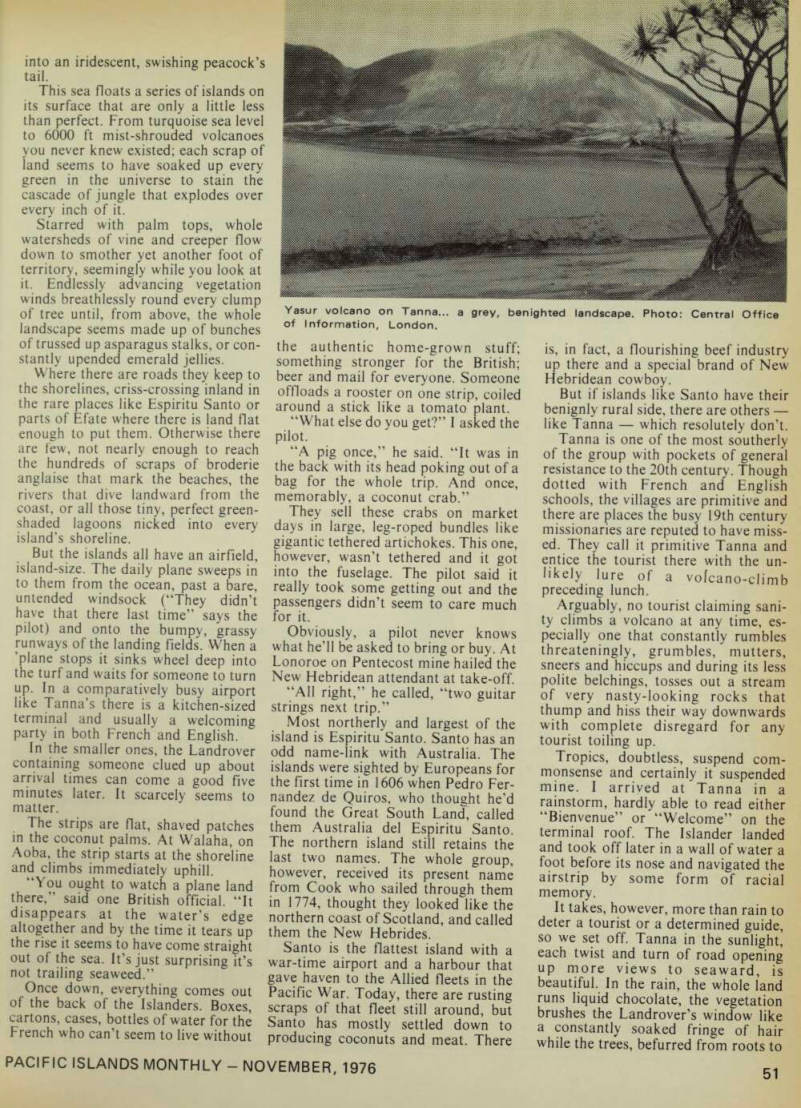
Yasur volcano on Tanna... a grey, benighted landscape. Photo: Central Office of Information, London.
crowns, press down on every side. No self-respecting New Hebridean treetrunk likes to be caught naked, and ferns sprout from every surface.
When the Landrover emerged from all of this, it ran on to a grey, benighted landscape, swept bare of all but the dogged, angular pandanus clumps defying, with some success, the volcano’s general blight. Yasur, the volcano, is a fairly new one by volcanic standards and growing. Its past eruptions have left the valley one
huge, desolate and strangely-exciting sea of dark grey ash, with a grey lake squarely set within it.
The nearby village practises the cargo cult, punctuating its official wait for the white man’s expected plane-borne gifts, with a growing business escorting tourists to their volcano’s summit. Village guides tear up the volcano’s grey, shifting shoulders, dodging expertly the lumps of rocky innards tossed up at the sky above them.
They provide, chiefly, some sort of insubstantial cover for the tourists coming up behind them and treading page-like in their Wenceslassian steps.
It’s hard work for those, like me, who normally don’t climb mountains a puffing, panting slog during which I sucked in two flies in my cons tant fight for breath and my deter mination never to let the guide, and his undoubted nose for rocks which just might be damaging, get more than one arm’s length away. It’s an exciting climb most days, and once up there at the top amid the rain and steam and flying rocks, it is primitive Tanna indeed and it’s worth the ef fort. But coming down is easier.
“Back to the hotel for lunch” I told the driver when we reached the safety of the Landrover again. But Tanna hasn’t got a hotel. We drove across the flat, grey plain again, circled one quite promising pandanus clump toilets one side, dinner the other and set up a picnic on a hibiscus table cloth on the Landrover’s back.
There was no sound there at all while we ate; just the hiss of rain and the mindless rumblings of the volcano filling up our whole front horizon.
When we left it was as unmodified, fascinating and primitive as ever.
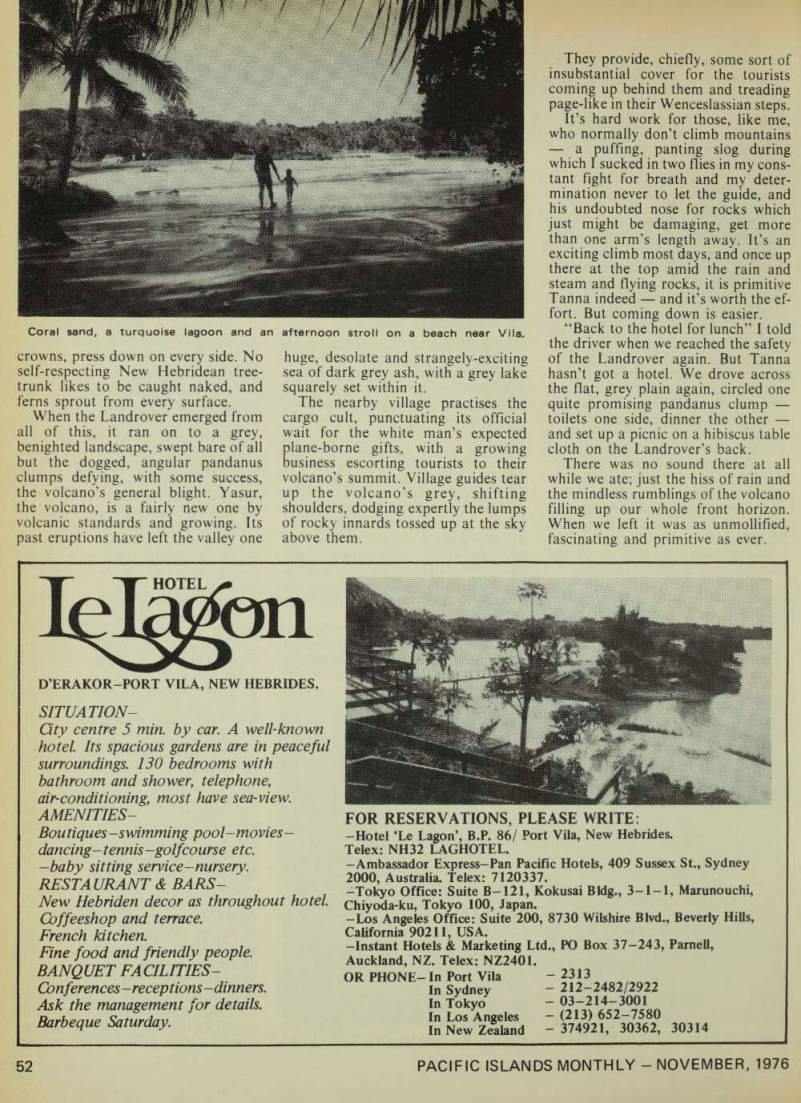
Coral sand, a turquoise lagoon and an afternoon stroll on a beach near Vila.