Time’S Running Out In
pp. 10-11 · Read in the full issue
Tahiti But For Whom?
By Al Prince in Papeete
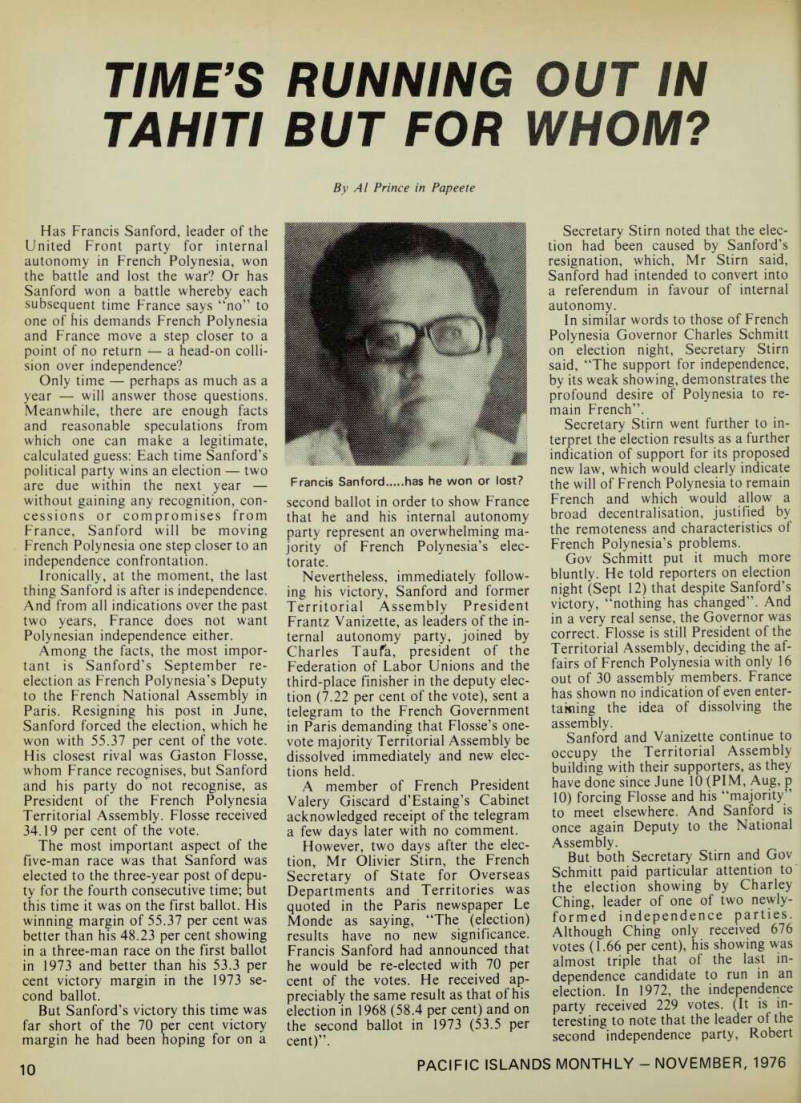
Has Francis Sanford, leader of the United Front party for internal autonomy in French Polynesia, won the battle and lost the war? Or has Sanford won a battle whereby each subsequent time France says “no” to one of his demands French Polynesia and France move a step closer to a point of no return a head-on colli sion over independence?
Only time perhaps as much as a year will answer those questions.
Meanwhile, there are enough facts and reasonable speculations from which one can make a legitimate, calculated guess: Each time Sanford’s political party wins an election two are due within the next year without gaining any recognition, con cessions or compromises from France, Sanford will be moving French Polynesia one step closer to an
independence confrontation.
Ironically, at the moment, the last thing Sanford is after is independence.
And from all indications over the past two years, France does not want Polynesian independence either.
Among the facts, the most impor tant is Sanford’s September re election as French Polynesia’s Deputy to the French National Assembly in Paris. Resigning his post in June, Sanford forced the election, which he won with 55.37 per cent of the vote.
His closest rival was Gaston Flosse, whom France recognises, but Sanford and his party do not recognise, as President of the French Polynesia Territorial Assembly. Flosse received 34.19 per cent of the vote.
The most important aspect of the five-man race was that Sanford was elected to the three-year post of depu ty for the fourth consecutive time; but this time it was on the first ballot. His winning margin of 55.37 per cent was better than his 48.23 per cent showing in a three-man race on the first ballot in 1973 and better than his 53.3 per cent victory margin in the 1973 se cond ballot.
But Sanford’s victory this time was far short of the 70 per cent victory margin he had been hoping for on a
second ballot in order to show France that he and his internal autonomy party represent an overwhelming ma jority of French Polynesia’s elec torate.
Nevertheless, immediately follow ing his victory, Sanford and former Territorial Assembly President Frantz Vanizette, as leaders of the in ternal autonomy party, joined by Charles Taufa, president of the Federation of Labor Unions and the third-place finisher in the deputy elec tion (7.22 per cent of the vote), sent a telegram to the French Government in Paris demanding that Flosse’s one vote majority Territorial Assembly be dissolved immediately and new elec tions held.
A member of French President Valery Giscard d’Estaing’s Cabinet acknowledged receipt of the telegram a few days later with no comment.
However, two days after the elec tion, Mr Olivier Stirn, the French Secretary of State for Overseas Departments and Territories was quoted in the Paris newspaper Le Monde as saying, “The (election) results have no new significance.
Francis Sanford had announced that he would be re-elected with 70 per cent of the votes. He received ap preciably the same result as that of his election in 1968 (58.4 per cent) and on the second ballot in 1973 (53.5 per cent)”.
Secretary Stirn noted that the elec tion had been caused by Sanford’s resignation, which, Mr Stirn said, Sanford had intended to convert into a referendum in favour of internal autonomy.
In similar words to those of French Polynesia Governor Charles Schmitt on election night, Secretary Stirn said, “The support for independence, by its weak showing, demonstrates the profound desire of Polynesia to re main French”.
Secretary Stirn went further to in terpret the election results as a further indication of support for its proposed new law, which would clearly indicate the will of French Polynesia to remain French and which would allow a broad decentralisation, justified by the remoteness and characteristics of French Polynesia’s problems.
Gov Schmitt put it much more bluntly. He told reporters on election night (Sept 12) that despite Sanford’s victory, “nothing has changed”. And in a very real sense, the Governor was correct. Flosse is still President of the Territorial Assembly, deciding the af fairs of French Polynesia with only 16 out of 30 assembly members. France has shown no indication of even enter taining the idea of dissolving the assembly.
Sanford and Vanizette continue to occupy the Territorial Assembly building with their supporters, as they have done since June 10 (PIM, Aug, p 10) forcing Flosse and his “majority” to meet elsewhere. And Sanford is once again Deputy to the National Assembly.
But both Secretary Stirn and Gov Schmitt paid particular attention to the election showing by Charley Ching, leader of one of two newly formed independence parties.
Although Ching only received 676 votes (1.66 per cent), his showing was almost triple that of the last in dependence candidate to run in an election. In 1972, the independence party received 229 votes. (It is in teresting to note that the leader of the second independence party, Robert
Francis Sanford...has he won or lost?
Cahn, supported Sanford in the latest election.) On election night, Gov Schmitt’s first interpretation of the results was that 97.61 per cent of the votes cast were, in effect, against independence.
However, some of Sanford’s sup porters feel that the tripling of the in dependence vote in four years is quite significant, if not dangerous to San ford’s present plans.
The independence party showing is even more significant when taking into consideration the number of new voters who will be joining the elec torate in the coming years. Studies have been made showing that by 1980, nearly half of the population of French Polynesia will be under 15.
The voting age is 18.
Gov Schmitt also noted on election night that the voter turnout was less than in either of the two rounds of the 1973 election. A total of 40,598 per sons, or 64.71 per cent, of the 62,732 registered voters voted. In 1973, the turnout for the first ballot was 70.3 per cent, and 72.2 per cent for the se cond ballot.
Looking ahead, there are two more elections scheduled within the next year municipal elections in March 1977, and, if the Territorial Assembly is not dissolved first, assembly elec tions in September, 1977. Sanford’s party will be out to win both.
Le Journal de Tahiti, a local French-language newspaper, wrote a story shortly after the latest election, speculating on how Sanford’s internal autonomy party would have done had the election been for Territorial Assembly members rather than for the deputy to the French National Assembly. Le Journal prefaced the story by saying there is certainly nothing scientific about comparing the two elections.
However, Le Journal said that, bas ed on Sanford s showing throughout French Polynesia, the internal autonomy party would have ended up with 18 seats for a three-vote majori ty. Flosse’s Gaullist, pro-French party would have finished with nine seats and Taufa’s party would have ended up with three seats.
In the deputy election, of the five general voting areas Leeward Islands, Windward Islands, Mar quesas, Tuamotu-Gambier and Australs Flosse outpolled Sanford only in the Marquesas. On the island of Tahiti, Flosse won only three of the 12 voting areas. This included a very narrow victory in his own city of
Pirae, where he is mayor. In Pirae, Flosse got 1,938 votes to Sanford’s 1,005.
Thus, Sanford has won the battle the election. But he has not im pressed France sufficiently enough to get the Territorial Assembly dissolv ed.
Sanford’s next area of attack could be the new statute that France and French Polynesia have been arguing about now for almost two years ever since Secretary Stirn’s last visit here. The new statute would change the relationship between France and
French Polynesia. The only thing that has not been agreed upon is how.
Theoretically, Secretary Stirn has been due to arrive here on more than one occasion since last summer with a new proposed status in other words, one different from the one he presented here in March, 1975.
But Sanford’s main target for the moment is the dissolution of the Territorial Assembly, saying he refuses to discuss any new statute un til that is done and new elections are held.
Time will tell, but time may also be running out.