What The Hokulea’S
pp. 8-9 · Read in the full issue
Voyage Was All About
From BEN R. FINNEY in Honolulu
Three short years ago Charles T.
Holmes, Herbert K. Kane and I form ed the Polynesian Voyaging Society to undertake research into Polynesian voyaging by building a reconstruction of a large double-canoe and then sail ing it to Tahiti and return in the closest to traditional Polynesian style as we could manage in this modern age.
With the help of countless con tributors in Hawaii, throughout the Pacific and in more than a few coun tries elsewhere in the world, and many willing hands, we built Hokule’a, and between May 1 and July 26 of this year we sailed it to Tahiti and return just like we said we would do.
Because, however, some observers object to our use of modern materials (which had been fully announced in our literature and in PIM, May, 1974, p2l) and are offended by our use of an escort vessel for documentation and safety, and others were bothered by the human failings which led to the in advertent transmission to the canoe of our position south of Hawaii, and also led to a regrettable conflict among the crew on the first leg of the voyage, our accomplishment has been greeted with more than its fair share of criticism. (See “Hokule’a does it but ‘it wasn’t pure Polynesian’ say the critics” PIM, Aug, pp 8-10.) Rather than attempt to meet each point of criticism, I would like to clear the air by detailing the nature of the Hokule’a experiment for those readers who would like a glimpse of what the voyage was really about.
One, perhaps unwilling, progenitor of the project was the late Andrew Sharp who, in 1956, published An cient Voyagers in the Pacific in which he severely criticised uncritical accep tance of the idea that Polynesians could have intentionally explored and colonised their island realm.
Polynesia was settled accidentally, by a long series of fortuitous landfalls by canoes drifting before wind and current as well as canoes crammed with exiles seeking randomly for a new home, claimed Sharp and with
this pronouncement the battle was on.
In the controversy that followed, one thing became clear. Since the ear ly European explorers neglected to systematically describe the voyaging canoes they saw and their perfor mance, and since these craft have since disappeared from Polynesian waters, we really know very little about how well Polynesian canoes sailed a crucial point when claims are being made for and against Polynesian voyaging capabilities.
To gain needed information on canoe performance in 1966, a group of students and I built Nalehia, a 40foot long double-canoe modelled after a traditional Hawaiian craft, and tested her in Hawaiian waters. We found her to be a stable and seakindly vessel that sailed very well downwind and across the wind and that could make good up to about 75 degs into the wind, despite her round bottom and small Polynesian sprit sail (features which caused many a yachtsman to predict that we would not be able to sail to windward at all).
The demonstration of Nalehia’s limited, though definite windward ability, was important, as it is windward ability that allows sailors to go where they wish, which, in the con text of the controversy over Polyne sian voyaging, would tend to lend weight to arguments that the Polynesians may have exerted some control over their settlement destiny.
We then applied our findings to the legendary voyaging route between Tahiti and Hawaii, and hypothesised that such a voyage was well within the capabilities of a Polynesian double canoe. The leg from Tahiti up to Hawaii would have been the easiest as a canoe would sail with beam winds most of the way. The return to Tahiti would, however, have been more dif ficult because of the necessity of mak ing 400 or so miles of “easting” against wind and current, although our calculations showed that if a canoe could sail consistently 75 deg into the wind, it would just make Tahiti. The round-trip voyage of over 5,000 miles, we concluded, may well
have been the longest regularly-sailed sea road in Polynesia and may well have been the finest example of blue water sailing by Stone-age man.
Later, Hokule’a was conceived and built to test the relationship of theory to reality by actually making the hypothesised voyage. Hokule’a was carefully designed to represent par ticularly in hull shape, sail-plan and weight an ancient voyage canoe. We never hid our inability to secure or duplicate traditional materials. We said that, although the experiment will tell us nothing directly about the strength and durability of ancient materials, Hokule’a was planned as a performance-accurate replica of an ancient canoe.
The real test for Hokule’a was the windward voyage from Hawaii to Tahiti.
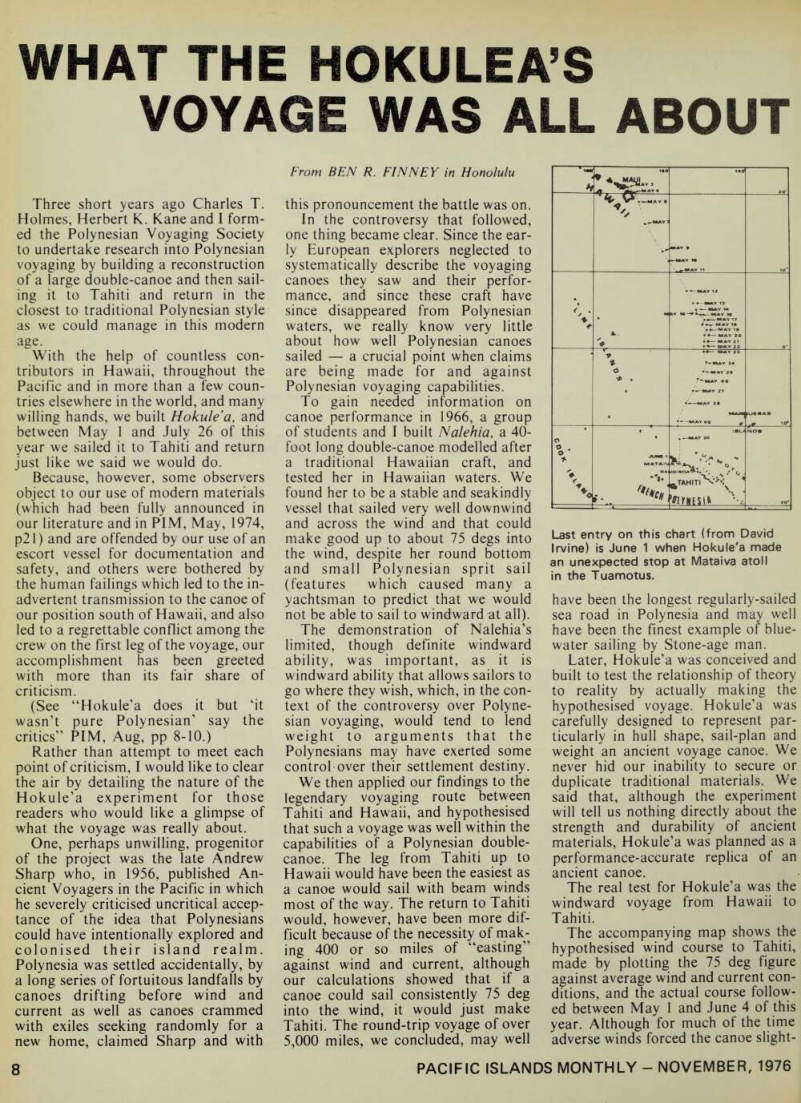
The accompanying map shows the hypothesised wind course to Tahiti, made by plotting the 75 deg figure against average wind and current con ditions, and the actual course follow ed between May 1 and June 4 of this year. Although for much of the time adverse winds forced the canoe slight
Last entry on this chart (from David Irvine) is June 1 when Hokule'a made an unexpected stop at Mataiva atoll in the Tuamotus.
ly to the west of the hypothesised route, the two tracks are remarkably parallel.
Despite NE tradewinds with a marked easterly component which tended to head us, we did make good “easting” from Hawaii until we entered the doldrums at about 6 deg north of the equator. We were then plagued by calms and light airs for a week before breaking out, but receiv ed an expected boost to the east provided by the equatorial counter current flowing strongly east in this covergence zone between the two tradewind belts.
South of the doldrums we en countered several days of light SSE wind that again pushed us too far west for comfort. Hokule’a is a heavy vessel (25,000 lb displacement fully loaded) with a relatively-small sail area (around 675 sq ft).
While this combination is fine for heavy tradewinds, Hokule’a slows to a crawl in light airs and loses much of her ability to point to windward. Thus these light headwinds forced her to oc casion onto a SW course which, if continued, would have taken her to the Cook Islands well west of Tahiti.
Fortunately, both wind speed and direction improved and we started heading right for Tahiti until the afternoon of May 31, when the wind shifted from SE to ENE allowing us to take a SE heading which brought us into the Tuamotus, as hypothesis ed. After ascertaining that we had reached Mataiva (which we learned by simply asking startled Mataivan “What is the name of your atoll?”), and after resting a day and a half, we had an easy sail to Tahiti.
The yacht Meotai followed us for
safety (a precaution heartily approved by the US Coast Guard, which had the right to stop our departure if they ascertained there was a safety problem) and for film documentation and the tracking required for the navigation experiment.
We carried no compass, sextant or other navigational devices as we wish ed to investigate the efficiency of the Polynesian non-instrument navigation system over this long route. Without the Meotai to track us we would have been in the position of knowing that we had reached our objective, but ig norant as to exactly where we had been and therefore in the dark as to whether or not we reached Tahiti because of, or in spite of, our navigational efforts.
Pius Piailug, a traditional Microne sian navigator from Satawal, in the Carolines, was our navigator and sail ing master, and was assisted by Rodo Williams, a Tahitian sea captain whose special job was to pilot us through the reefs of the Tuamotus, and New Zealander David Lewis whose job was to document the navigation process.
The navigation task was not as dif ficult as it might seem, as we had a large target to aim for: a hit anywhere along the screen of Tuamotu atolls that extend several hundreds of miles eastwards from Tahiti would enable us, once we found out which island we had reached, to island-hop our way to Tahiti.
Furthermore, we did not really have to precisely set a course by the stars, sun or swells, as we really had no option other than to sail as close to the wind as possible to make the Tuamotus east of Tahiti. In fact, for
most of the journey Hokule’a sailed herself at a more or less constant angle to the wind (which varied somewhat with wind intensity).
Under Piailug’s direction, steering sweeps and paddles were raised out of the water, the canoe was trimmed by redistributing weight and adjusting the sails so that she would automatically sail at the best possible angle to the wind. Thus the navigation problem was to calculate where the wind was taking us, and both Williams and Lewis provided some startling ac curate dead-reckoning positions along the way, although we were frankly in doubt as to what island we had hit un til our query was answered by: “It is Mataiva!”
That tape cassettes transferred from the Meotai, that were supposed to contain only personal messages, twice accidentally included tape recorded readings of newspaper ar ticles giving our position, certainly flawed our navigation experiment.
However, although critics may not believe us, we maintained that the im precise position descriptions (for ex ample, “Hokule’a is now 940 miles south of Hawaii . . .”) which were a day or two old by the time they reach ed us, could not have been very useful to Piailug (who apparently never heard them), an expert navigator who was carefully tracking our latitudinal position at the time by observing the angle of Polaris above the horizon (we were north of the equator at the time).
Let us not dwell too much on this problem for, however exotic naviga tion without instruments might seem, the real test on the voyage was of the canoe and its ability to sail to windward and thus reach Tahiti.
Two other subsidiary experiments were also undertaken, more for cultural revival and popular education than for scientific purposes.
We attempted to subsist on dried fish, dried bananas, hard taro poi and other traditional voyaging foods, but because of the spoilage of the taro poi and the lack of full dedication among the crew concerning the utility of the exercise, we supplemented our rations by drawing from the stores of the Meotai some modern Polynesian voyaging foods rice and corned beef primarily.
Our attempt to carry Polynesian animals and plants was, in contrast, a popular success. A pig, two chickens and a dog thrived on the fare and sur vived the ride well.
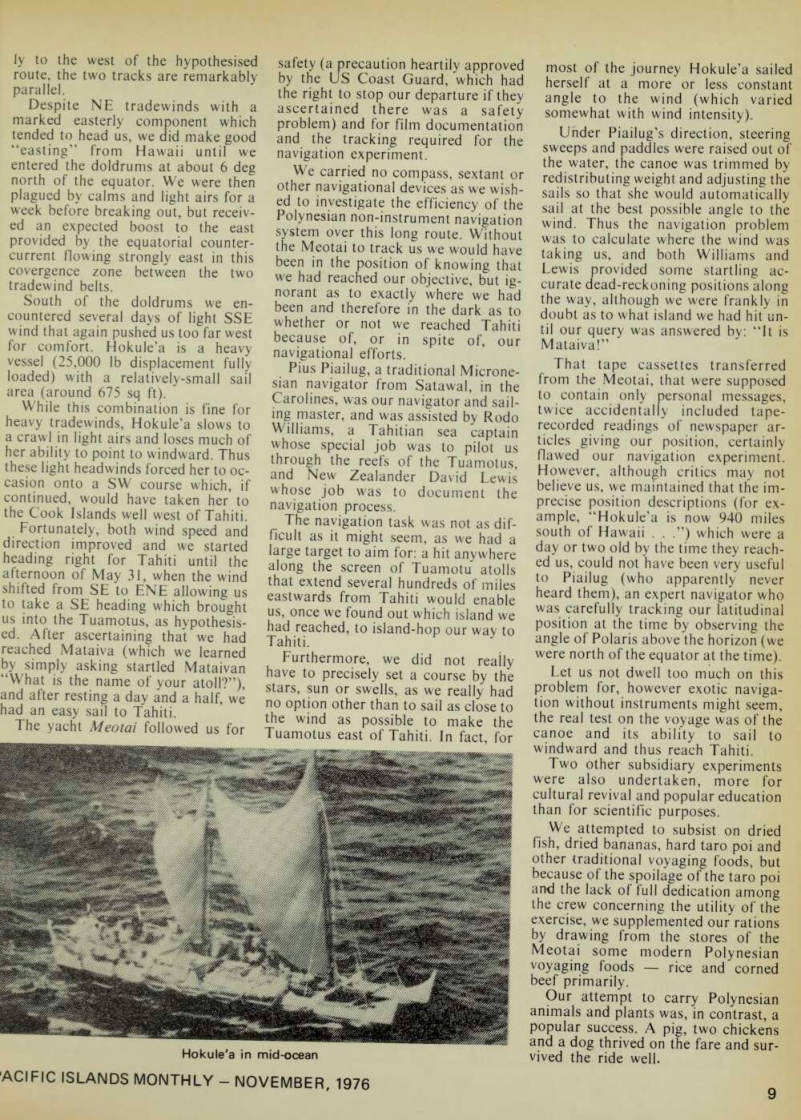
Hokule'a in mid-ocean