How The Melanesians
pp. 59-61 · Read in the full issue
Changed Port Moresby
Some years ago, Canon lan Stuart gave us his Port Moresby, Yesterday and Today, a comprehensive survey written in an easy, informal style which masked the fact that a great deal of patient and meticulous research had gone into its prepara tion. Now we have a second major work on Port Moresby, Nigel Oram’s Colonial Town to Melanesian City: Port Moresby 1884-1974. lan Stuart was content to give us an account of the colonial town and the Europeans who made it and lived in it.
Nigel Oram covers the same ground again, but, as his title indicates, makes his major theme the impact on the city of the ever-growing Melane sian element in its population.
He begins, even further back than lan Stuart, with an account of the Port Moresby area and its people in the immediate pre-contact period, and then goes on to describe the period 1873-1888, covering the arrival of the first missionaries, the proclamation of the Protectorate and, four years later, the annexation to the British Crown.
The two short chapters in which this ground is covered are marvels of suc cinctness and accuracy, marred only by the intrusion of a slip of the pen, or perhaps a printer’s gremlin, into a footnote to page 23, where the Somare government is given the credit for having been in office for 34 years!
Two fairly lengthy chapters on the period 1889-1941 and a short one on the Wartime Interlude 1942-45 cover much the same ground as lan Stuart’s book. But at this point, as lan Stuart prepares to round off his story, Nigel Oram gets into his stride, and the remaining two-thirds of his book are devoted to the period 1946-1974.
I must confess that I found the se cond third of the book, dealing with Port Moresby’s post-war expansion and the characteristics and social organisation of its population, rather heavy going. This indigestibility is due in part to the plethora of statistics with which we are bombarded Moreover, many of them take the form of percentages, a type of
Books
statistic of which I am always profoundly suspicious.
In addition, both here and in other parts of the book there is a tendency to use the jargon of social anthropology. This will not cause Nigel Oram’s academic colleagues any worry, but one hopes that this im portant book is going to be read by many non-academic readers involved in the problems of urbanisation.
Such readers would probably welcome a footnote to page 156 ex plaining the meanings of the words “affinal” and “cognatic”; while they will be completely mystified by the sentence “In terms of Tonnies’s
dichotomy, European relationships are of a gesellschafl rather than gemeinschaft type”.
However, a bit of gobble-de-gook here and there is amply atoned for by bon mots such as “Happily, un realistic administrative policies were tempered by inefficiency”. Nicely put!
The remaining chapters on Race Relations, Shelter (ie Housing), The Administration of Port Moresby 1945-1974, and finally Administrative* Institutions and Urban Society are uniformly excellent. I myself was es pecially interested in the chapter on housing, as I became involved in this aspect of urbanisation during my eight years in the House of Assembly as member for Moresby.
Nigel Oram modestly plays down the very major part he himself has taken in re-shaping our thinking on Port Moresby’s problems during his years here, first with the New Guinea Research Unit of the ANU and later as a Fellow of the University of Papua New Guinea.
One of Nigel Oram’s major con-
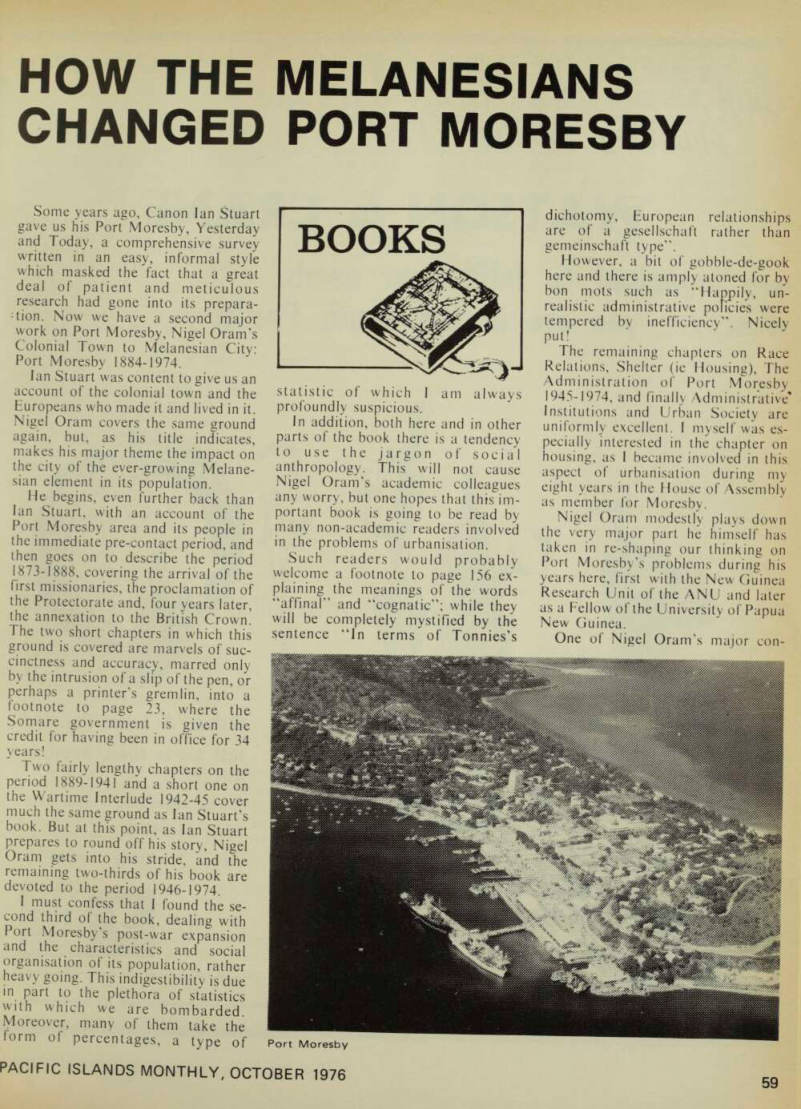
Port Moresby
Port Moresby
cerns has been the de-centralisation of municipal government to the “ward” level. While some progress has been made in this direction, the process is far from complete, and in particular the idea of using the ward organisa tion as a unit in the maintenance of law and order has been shied away from. Perhaps one day we shall realise that Nigel Oram was right about this, as he has been about so many things.
This is a book which should be “read, marked and inwardly digested” by all who are involved in any aspect of urbanisation, whether in Port Moresby or the Pacific or anywhere else in the developing world.
Our thanks must go to Nigel Oram for writing it, and to the ANU Press for giving it to us in so attractive a format a pleasant change indeed from those “way out” dust jackets which this press has been inflicting on us during the last few years.
Percy Chatterton
(Colonial Town To Melanesian City: Port
MORESBY 1884-1974. By Nigel Oram. Published by Australian National University Press, Canberra, ACT $10.95.)