Magazine
pp. 54-57 · Read in the full issue
Tough Times For All In
New Guinea’S Gold Rush
Nearly half a century has gone by since the New Guinea goldrush days which changed the life-style of so many people in the hitherto inaccessible parts of the country.Labour recruiters toured the villages and brought strange,new ideas to the people. They found themselves working for wages in the company of white men. Bert Weston,once a labour recruiter and now living in New South Wales,tells his story below of the goldrush days when attitudes were so much different from those expressed in today's independent Papua New Guinea.
By Bert Weston
Until the opening of the Ldie Creek goldfield area in the late 1920 s the recruit ment of native labour on the coast from the Papuan border up to and around the Huon Gulf had not been very intensive; there were no copra plantations except at Malahang and Singaua near Lae, both of limited output, and planters in New Bri tain and New Ireland had no need to go so far afield for their workers.
Some recruiting was done up the Markham Valley. Natives from its open grassy plains were tall and healthy, arrogant but good and cheerful workers if properly treated and handled. However, to come across by schooner from New Bri tain as a prelude to tramping up the Markham Valley had one drawback the lack of a safe anchorage in which to leave the vessel pending return to Lae with a line of recruits.
The first influx of miners and adven turers to Ldie Creek, Wau and Salamaua, after news of the richness of the field had leaked out, was largely made up of planta tion owners from other parts of the Man dated Territory. Copra prices were not good and with prospects of rewards for the early birds many of these men headed for Salamaua in plantation schooners with some of their labourers.
However, more and more prospective gold miners began to arrive from Papua and Australia and of course these men did not have the advantage of owning a line of “boys” to work as carriers of their stores and tools from the coast to Wau as a prelude to switching over to active mining work on a claim.
Realising that it was hopeless to attempt mining without native labour, there began a scramble for labourers. Those with money were able to “buy” a team from recruiters and from miners’ agents such as Gregor Macdonald and Clem Hendry at Salamaua.
Those without capital, and there were many of those, had to sally forth into the
interior and do their own recruiting. Few of the dwellers around the coastal areas of the Huon Gulf wanted to exchange the easy life of fishing and the warm sun for the hard work of pack-carrying for days in arduous conditions between Salamaua and Wau and working in near-freezing weather at Kaindi, as they called Edie Creek.
Large numbers of recruits began to arrive from the Sepik, Wewak and Aitape districts. These were collected by professional recruiters whose story was that “boys” were wanted for good and easy jobs with an employer named kom pani. With no idea as to their destination or fate, they were marched aboard schooners, and later, steamers and shipped around to Salamaua for acquisition by eager employers. With no way of escaping and heading hundreds of miles back home,
they either resigned themselves to mining
and carrying or else died by the dozen from cold and malnutrition.
The Upper Markham area became the favourite hunting ground for labour and some of the more successful miners became noted as Markham specialists.
They could move into an area where others had failed to get a single recruit and return to Lae with several dozen willing natives.
Among these men were Tex Thomas, Bill Chapman, Jack Murcutt, Snowy Thomp son, Bill Simpson and myself.
It was good strategy to enter an area one jump ahead of an administration patrol of ficer on the annual collection of head tax, or when tribal warfare was threatening or in progress, and, better, still, when a previously closed area was thrown open for
prospecting and recruiting.
In the villages along the valley floor, which had been supplying recruits for gold mining for some time, there was little finesse required. After a spell back in village life most former “workboys” were ready to re-engage for a further term es pecially with a miner whoni they knew and liked and whose reputation for being a generous employer was well known.
However, back in the mountains and off the beaten track in villages not previously recruited from it was necessary to really work to entice “boys” to enlist.
A supply of trade goods such as bush knives, tomahawks, mirrors, mouth
organs, jews harps, razor blades, cheap
calico, beads, salt, matches and shillings were a must. And then, it was useless un less one had a “boy” who could turn im tok as an interpreter together with a “boss boy” skilled in putting across an im pressive tale with the accent on “impress”.
On arrival at such a village, it was a matter for the recruiter to settle himself in whatever hut or shelter was available; the headman would soon appear and would at once be sweetened up with a handful of coins and some trade goods and then it would be left to the “boss boy” to circulate and spread the story of the wonders of the outside world in the way of cars and ships, houses and shops.
From time to time over a period of several days, a hesitant volunteer would be brought along and the deal clinched by placing a few shillings in his hand. This was regarded as closing the deal irrevocably and with much weeping and
wailing on the pari of female relatives he would finally march out with his new owner and fellow recruits quite happily.
Second thoughts often crept in when the party emerged from the familiar moun tains into the grasslands of the valley and this was when chains and padlocks were at times brought into use on the way down to Lae to prevent homesick ones from doing a night-time-break back home.
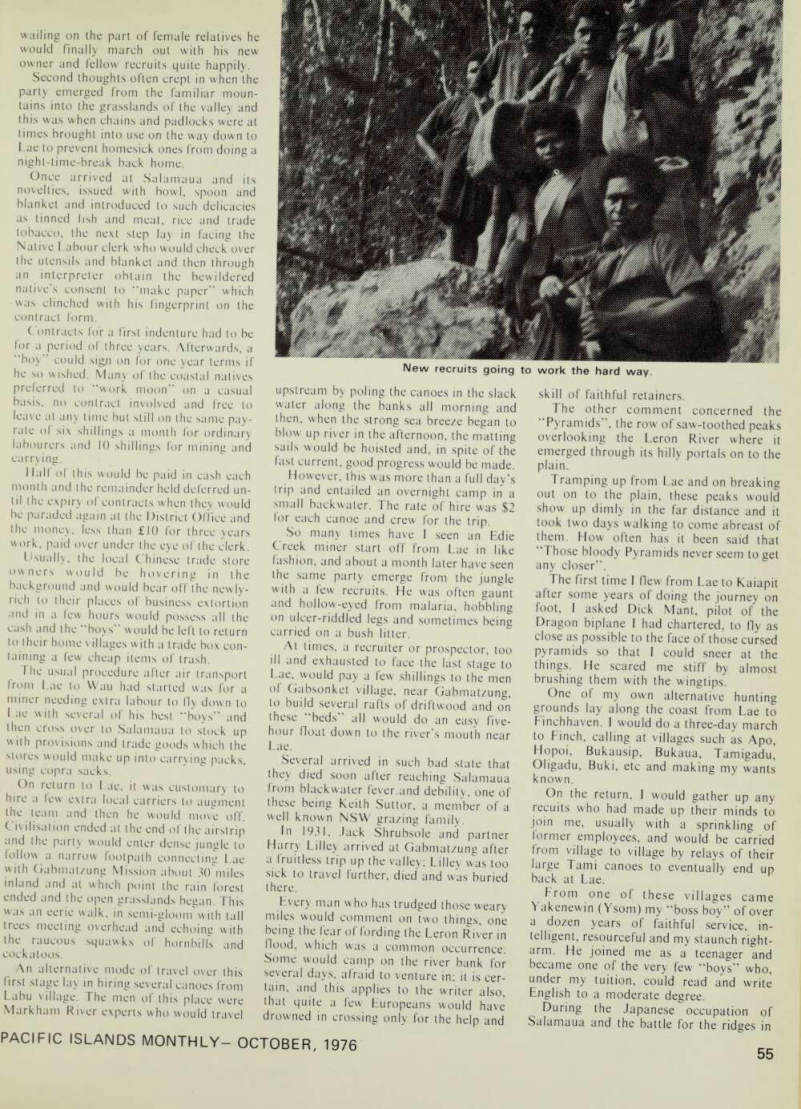
Once arrived at Salamaua and its novelties, issued with bowl, spoon and blanket and introduced to such delicacies as tinned (ish and meat, rice and trade tobacco, the next step lay in facing the Native Labour clerk who would check over the utensils and blanket and then through an interpreter obtain the bewildered native s consent to “make paper” which was clinched with his fingerprint on the contract form.
Contracts lor a first indenture had to be lor a period ol three years. Afterwards, a “boy” could sigyi on for one year terms if he so wished. Many of the coastal natives preferred to “work moon” on a casual basis, no contract involved and free to leave at any lime but still on the same pay rate ol six shillings a month for ordinary labourers and 10 shillings for mining and
carrying.
Hall of this would be paid in cash each month and the remainder held deferred un til the expiry of contracts when they would be paraded again at the District Office and the money, less than £lO for three years work, paid over under the eye of the clerk.
Usually, the local Chinese trade store owners would be hovering in the background and would bear off the newly rich to their places of business extortion and in a few hours would possess all the cash and the “boys” would be left to return to their home villages with a trade box con taining a few cheap items of trash.
The usual procedure after air transport from Lae to Wau had started was for a miner needing extra labour to fly down to Lae with several ol his best “boys” and then cross over to Salamaua to slock up with provisions and trade goods which the stores would make up into carrying packs, using copra sacks.
On return to Lae, it was customary to hire a lew extra local carriers to augment the team and then he would move off.
Civilisation ended at the end of the airstrip and the party would enter dense jungle to follow a narrow footpath connecting Lae with Gabmal/ung Mission about 30 miles inland and at which point the rain forest ended and the open grasslands began. This was an eerie walk, in semi-gloom with tall trees meeting overhead and echoing with the raucous squawks of horn hi lls and cockatoos.
An alternative mode of travel over this first stage lay in hiring several canoes from Labu village. The men of this place were Markham River experts who would travel
upstream by poling the canoes in the slack water along the banks all morning and then, when the strong sea breeze began to blow up river in the afternoon, the matting sails would be hoisted and, in spite of the last current, good progress would be made.
However, this was more than a full day’s trip and entailed an overnight camp in a small backwater. The rate of hire was $2 for each canoe and crew for the trip.
So many limes have I seen an Edie Creek miner start off from Lae in like lashion, and about a month later have seen the same parly emerge from the jungle with a few recruits. He was often gaunt and hollow-eyed from malaria, hobbling on ulcer-riddled legs and sometimes being carried on a bush litter.
At times, a recruiter or prospector, too ill and exhausted to face the last stage to Lae, would pay a few shillings to the men of Gabsonket village, near Gabmatzung, to build several rafts of driftwood and on these “beds” all would do an easy five hour float down to the river's mouth near Lae.
Several arrived in such bad state that they died soon after reaching Salamaua Irom blackwaler fever.and debility, one of these being Keith Suitor, a member of a well known NSW grazing family.
In 1931, Jack Shrubsole and partner
Harry Lilley arrived at Gabmatzung after
a fruitless trip up the valley; Lilley was too sick to travel further, died and was buried there.
Every man who has trudged those weary miles would comment on two things, one being the fear of fording the Leron River in flood, which was a common occurrence.
Some would camp on the river bank for several days, afraid to venture in; it is cer tain, and this applies to the writer also, that quite a few Europeans would have drowned in crossing only for the help and
skill of faithful retainers.
The other comment concerned the “Pyramids”, the row of saw-toothed peaks overlooking the Leron River where it emerged through its hilly portals on to the plain.
Tramping up from Lae and on breaking out on to the plain, these peaks would show up dimly in the far distance and it took two days walking to come abreast of them. How often has it been said that “Those bloody Pyramids never seem to get any closer”.
The first time I flew from Lae to Kaiapit after some years of doing the journey on foot, I asked Dick Mant, pilot of the Dragon biplane I had chartered, to fly as close as possible to the face of those cursed pyramids so that 1 could sneer at the things. He scared me stiff by almost brushing them with the wingtips.
One of my own alternative hunting grounds lay along the coast from Lae to Finchhaven. I would do a three-day march to Finch, calling at villages such as Apo,
Hopoi, Bukausip, Bukaua, Tamigadu,
Oligadu, Buki, etc and making my wants known.
On the return, I would gather up any recuits who had made up their minds to join me, usually with a sprinkling of former employees, and would be carried from village to village by relays of their large Tami canoes to eventually end up back at Lae.
From one of these villages came Yakenewin (Ysom) my “boss boy” of over a dozen years of faithful service, in telligent, resourceful and my staunch right arm. He joined me as a teenager and became one of the very few “boys” who, under my tuition, could read and write English to a moderate degree.
During the Japanese occupation of Salamaua and the battle for the ridges in
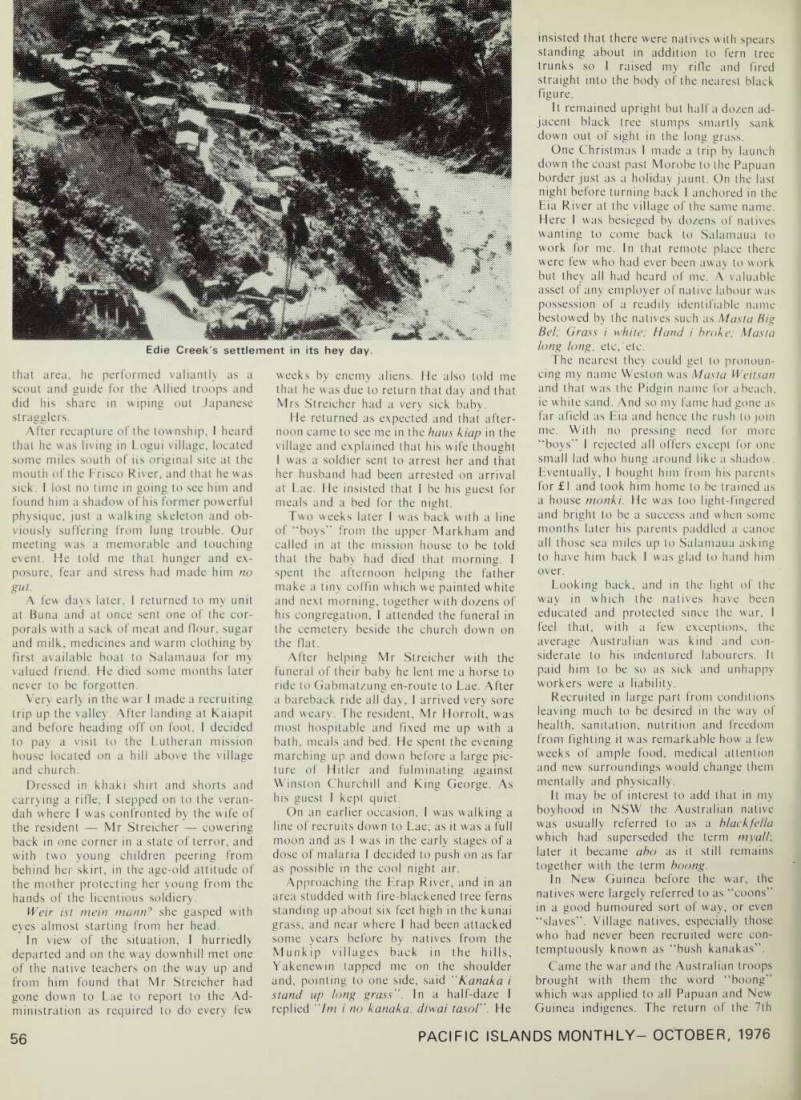
Mew recruits going to work the hard way.
that area, he performed valiantly as a scout and guide for the Allied troops and did his share in wiping out Japanese
stragglers.
After recapture of the township, I heard that he was living in Logui village, located some miles south of its original site at the mouth of the Erisco River, and that he was sick. I lost no time in going to see him and found him a shadow of his former powerful physique, just a walking skeleton and ob viously suffering from lung trouble. Our meeting was a memorable and touching event. He told me that hunger and ex posure, fear and stress had made him no gut.
A few days later. I returned to my unit at Buna and at once sent one of the cor porals with a sack of meat and flour, sugar and milk, medicines and warm clothing by first available boat to Salamaua for my valued friend. He died some months later never to be forgotten.
Very early in the war I made a recruiting trip up the valley. After landing at Kaiapit and before heading off on foot, I decided to pay a visit to the Lutheran mission house located on a hill above the village and church.
Dressed in khaki shirt and shorts and carrying a rifle, I stepped on to the veran dah where I was confronted by the wife of the resident Mr Streicher cowering back in one corner in a state of terror, and with two young children peering from behind her skirt, in the age-old attitude of the mother protecting her young from the hands of the licentious soldiery.
Weir ist mein mann? she gasped with eyes almost starting from her head.
In view of the situation, I hurriedly departed and on the way downhill met one of the native teachers on the way up and from him found that Mr Streicher had gone down to Lae to report to the Ad ministration as required to do every few
weeks by enemy aliens. He also told me that he was due to return that day and that Mrs Streicher had a very sick baby.
He returned as expected and that after noon came to see me in the haus kiap in the village and explained that his wife thought I was a soldier sent to arrest her and that her husband had been arrested on arrival at Lae. He insisted that I be his guest for meals and a bed for the night.
Two weeks later I was back with a line of “boys” from the upper Markham and called in at the mission house to be told that the baby had died that morning. I spent the afternoon helping the father make a tiny coffin which we painted white and next morning, together with dozens of his congregation, I attended the funeral in the cemetery beside the church down on the flat.
After helping Mr Streicher with the funeral of their baby he lent me a horse to ride to Gabmatzung en-route to Lae. After a bareback ride all day, I arrived very sore and weary. The resident, Mr Horrolt, was most hospitable and fixed me up with a bath, meals and bed. He spent the evening marching up and down before a large pic ture of Hitler and fulminating against Winston Churchill and King George. As his guest I kept quiet.
On an earlier occasion, 1 was walking a line of recruits down to Lae; as it was a full moon and as I was in the early stages of a dose of malaria I decided to push on as far as possible in the cool night air.
Approaching the Erap River, and in an area studded with fire-blackened tree ferns standing up about six feet high in the kunai grass, and near where I had been attacked some years before by natives from the Munkip villages back in the hills, Yakenewin lapped me on the shoulder and, pointing to one side, said “Kanaka i stand up long grass". In a half-daze I replied “Im i no kanaka, diwai tasol’’. He
insisted that there were natives with spears standing about in addition to fern tree trunks so I raised my rifle and fired straight into the body of the nearest black
figure.
It remained upright but half a dozen ad jacent black tree stumps smartly sank down out of sight in the long grass.
One Christmas I made a trip by launch down the coast past Morobe to the Papuan border just as a holiday jaunt. On the last night before turning back I anchored in the Eia River at the village of the same name.
Here I was besieged by dozens of natives wanting to come back to Salamaua to work for me. In that remote place there were few who had ever been away to work but they all had heard of me. A valuable asset of any employer of native labour was possession of a readily identifiable name bestowed by the natives such as Masta Big Bel: Grass i white: Hand i broke: Masta
long long, etc, etc.
The nearest they could get to pronoun cing my name Weston was Masta Weitsan and that was the Pidgin name for a beach, ie white sand. And so my fame had gone as far afield as Eia and hence the rush to join me. With no pressing need for more “boys” I rejected all offers except for one small lad who hung around like a shadow.
Eventually, I bought him from his parents for £1 and took him home to be trained as a house monki. He was 100 light-fingered and bright to be a success and when some months later his parents paddled a canoe all those sea miles up to Salamaua asking to have him back 1 was glad to hand him over.
Looking back, and in the light of the way in which the natives have been educated and protected since the war, I feel that, with a few exceptions, the average Australian was kind and con siderate to his indentured labourers. It paid him to be so as sick and unhappy workers were a liability.
Recruited in large part from conditions leaving much to be desired in the way of health, sanitation, nutrition and freedom from fighting it was remarkable how a few weeks of ample food, medical attention and new surroundings would change them mentally and physically.
It may be of interest to add that in my boyhood in NSW the Australian native was usually referred to as a hlackfella which had superseded the term myall ; later it became aho as it still remains together with the term hoong.
In New Guinea before the war, the natives were largely referred to as “coons” in a good humoured sort of way, or even “slaves”. Village natives, especially those who had never been recruited were con temptuously known as “bush kanakas”.
Came the war and the Australian troops brought with them the word “boong” which was applied to all Papuan and New Guinea indigenes. The return of the 7th
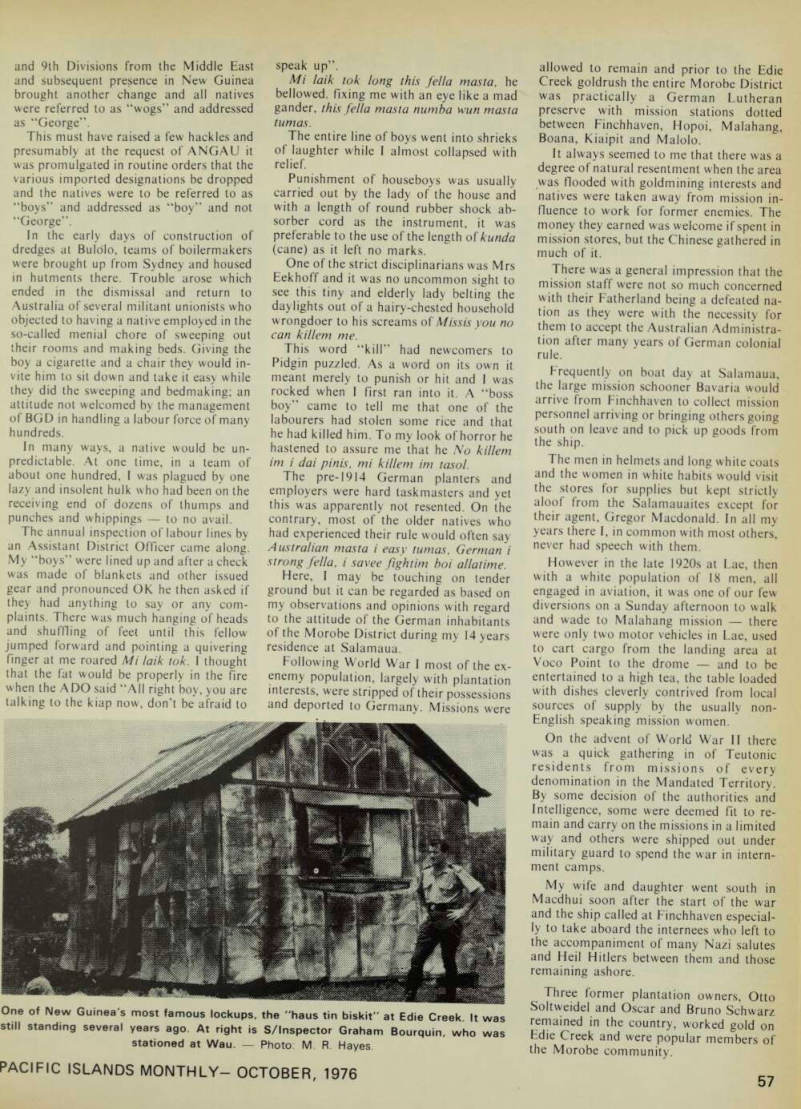
Edie Creek's settlement in its hey day.
and 9th Divisions from the Middle East and subsequent presence in New Guinea brought another change and all natives were referred to as “wogs” and addressed as “George”.
This must have raised a few hackles and presumably at the request of ANGAU it was promulgated in routine orders that the various imported designations be dropped and the natives were to be referred to as “boys” and addressed as “boy” and not “George”.
In the early days of construction of dredges at Buldlo, teams of boilermakers were brought up from Sydney and housed in hutments there. Trouble arose which ended in the dismissal and return to Australia of several militant unionists who objected to having a native employed in the so-called menial chore of sweeping out their rooms and making beds. Giving the boy a cigarette and a chair they would in vite him to sit down and take it easy while they did the sweeping and bedmaking; an attitude not welcomed by the management of BCD in handling a labour force of many hundreds.
In many ways, a native would be un predictable. At one time, in a team of about one hundred, I was plagued by one lazy and insolent hulk who had been on the receiving end of dozens of thumps and punches and whippings to no avail.
The annual inspection of labour lines by an Assistant District Officer came along.
My “boys” were lined up and after a check was made of blankets and other issued gear and pronounced OK he then asked if they had anything to say or any com plaints. There was much hanging of heads and shuffling of feet until this fellow jumped forward and pointing a quivering finger at me roared Mi laik tok. I thought that the fat would be properly in the fire when the ADO said “All right boy, you are talking to the kiap now, don’t be afraid to
speak up”.
Mi laik tok long this fella masta, he bellowed, fixing me with an eye like a mad gander, this fella masta numba wun masta tumas.
The entire line of boys went into shrieks of laughter while I almost collapsed with relief.
Punishment of houseboys was usually carried out by the lady of the house and with a length of round rubber shock ab sorber cord as the instrument, it was preferable to the use of the length o fkunda (cane) as it left no marks.
One of the strict disciplinarians was Mrs Eekhoff and it was no uncommon sight to see this tiny and elderly lady belting the daylights out of a hairy-chested household wrongdoer to his screams of Missis you no can killem me.
This word “kill” had newcomers to Pidgin puzzled. As a word on its own it meant merely to punish or hit and 1 was rocked when I first ran into it. A “boss boy” came to tell me that one of the labourers had stolen some rice and that he had killed him. To my look of horror he hastened to assure me that he No killem im i dai pints, mi killem im tasol.
The pre-1914 German planters and employers were hard taskmasters and yet this was apparently not resented. On the contrary, most of the older natives who had experienced their rule would often say A ustralian masta i easy tumas, German i strong fella, i savee fightim boi allatime.
Here, I may be touching on tender ground but it can be regarded as based on my observations and opinions with regard to the attitude of the German inhabitants of the Morobe District during my 14 years residence at Salamaua.
Following World War I most of the ex enemy population, largely with plantation interests, were stripped of their possessions and deported to Germany. Missions were
allowed to remain and prior to the Edie Creek goldrush the entire Morobe District was practically a German Lutheran preserve with mission stations dotted between Finchhaven, Hopoi, Malahang, Boana, Kiaipit and Malolo.
It always seemed to me that there was a degree of natural resentment when the area was flooded with goldmining interests and natives were taken away from mission in fluence to work for former enemies. The money they earned was welcome if spent in mission stores, but the Chinese gathered in much of it.
There was a general impression that the mission staff were not so much concerned with their Fatherland being a defeated na tion as they were with the necessity for them to accept the Australian Administra tion after many years of German colonial rule.
Frequently on boat day at Salamaua, the large mission schooner Bavaria would arrive from Finchhaven to collect mission
personnel arriving or bringing others going
south on leave and to pick up goods from
the ship.
The men in helmets and long white coats and the women in white habits would visit the stores for supplies but kept strictly aloof from the Salamauaites except for their agent, Gregor Macdonald. In all my years there I, in common with most others, never had speech with them.
However in the late 1920 s at Lae, then with a white population of 18 men, all engaged in aviation, it was one of our few diversions on a Sunday afternoon to walk and wade to Malahang mission there were only two motor vehicles in Lae, used to cart cargo from the landing area at Voco Point to the drome and to be entertained to a high tea, the table loaded with dishes cleverly contrived from local sources of supply by the usually non- English speaking mission women.
On the advent of World War II there was a quick gathering in of Teutonic residents from missions of every denomination in the Mandated Territory.
By some decision of the authorities and Intelligence, some were deemed fit to re main and carry on the missions in a limited way and others were shipped out under military guard to spend the war in intern ment camps.
My wife and daughter went south in Macdhui soon after the start of the war and the ship called at Finchhaven especial ly to take aboard the internees who left to the accompaniment of many Nazi salutes and Heil Hitlers between them and those remaining ashore.
Three former plantation owners, Otto Soltweidel and Oscar and Bruno Schwarz remained in the country, worked gold on Edie Creek and were popular members of the Morobe community.
One of New Guinea s most famous lockups, the "haus tin biskit" at Edie Creek. It was still standing several years ago. At right is S/lnspector Graham Bourquin, who was stationed at Wau. Photo: M R Hayes.