'those Reds'
pp. 45-47 · Read in the full issue
Australia’s man and 'those Reds'
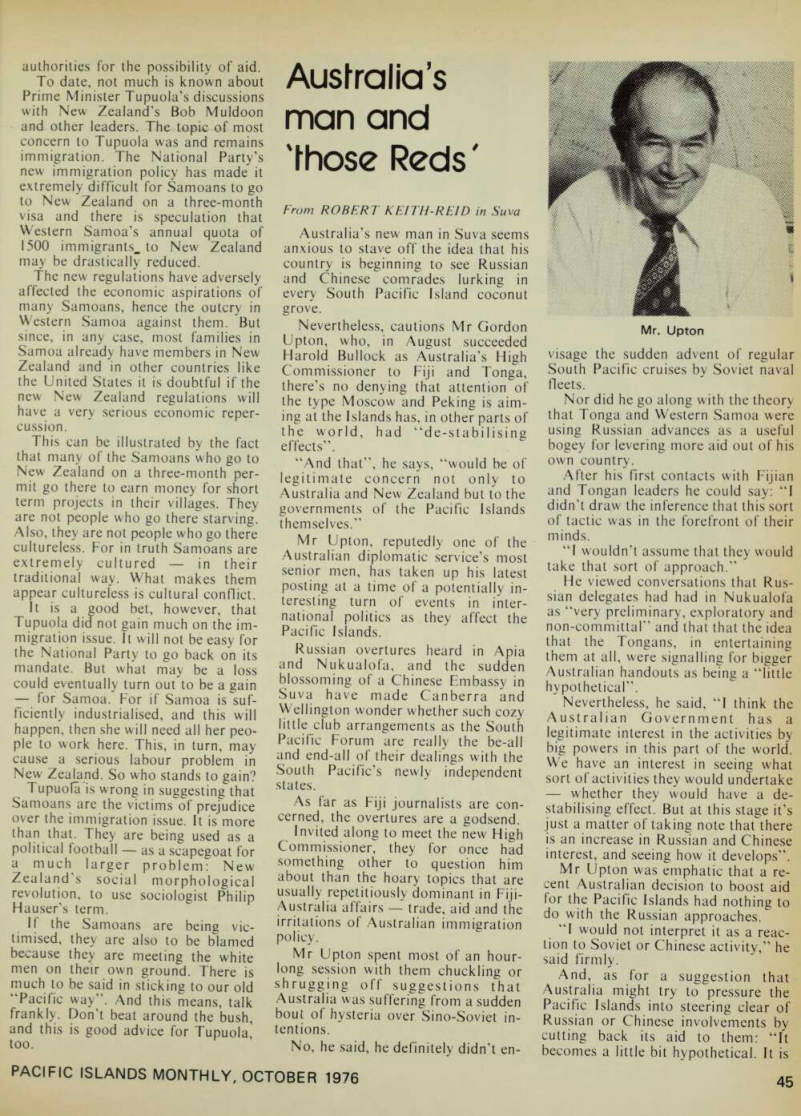
From ROBERT KEITH-REID in Suva Australia’s new man in Suva seems anxious to stave off the idea that his country is beginning to see Russian and Chinese comrades lurking in every South Pacific Island coconut grove.
Nevertheless, cautions Mr Gordon Upton, who, in August succeeded Harold Bullock as Australia’s High Commissioner to Fiji and Tonga, there’s no denying that attention of the type Moscow and Peking is aim ing at the Islands has, in other parts of the world, had “de-stabilising effects”.
“And that”, he says, “would be of legitimate concern not only to Australia and New Zealand but to the governments of the Pacific Islands themselves.”
Mr Upton, reputedly one of the Australian diplomatic service’s most senior men, has taken up his latest posting at a time of a potentially in teresting turn of events in inter national politics as they affect the Pacific Islands.
Russian overtures heard in Apia and Nukualofa, and the sudden blossoming of a Chinese Embassy in Suva have made Canberra and Wellington wonder whether such cozy little club arrangements as the South Pacific Forum are really the be-all and end-all of their dealings with the South Pacific’s newly independent states.
As far as Fiji journalists are con cerned, the overtures are a godsend.
Invited along to meet the new High Commissioner, they for once had something other to question him about than the hoary topics that are usually repetitiously dominant in Fiji- Australia affairs trade, aid and the irritations of Australian immigration
policy.
Mr Upton spent most of an hour long session with them chuckling or shrugging off suggestions that Australia was suffering from a sudden bout of hysteria over Sino-Soviet in tentions.
No, he said, he definitely didn’t en-
visage the sudden advent of regular South Pacific cruises by Soviet naval fleets.
Nor did he go along with the theory that Tonga and Western Samoa were using Russian advances as a useful bogey for levering more aid out of his own country.
After his first contacts with Fijian and Tongan leaders he could say: “I didn't draw the inference that this sort of tactic was in the forefront of their minds.
“I wouldn’t assume that they would take that sort of approach.”
He viewed conversations that Rus sian delegates had had in Nukualofa as “very preliminary, exploratory and non-committal” and that that the idea that the Tongans, in entertaining them at all, were signalling for bigger Australian handouts as being a “little hypothetical”.
Nevertheless, he said, “I think the Australian Government has a legitimate interest in the activities by big powers in this part of the world.
We have an interest in seeing what sort of activities they would undertake whether they would have a de stabilising effect. But at this stage it’s just a matter of taking note that there is an increase in Russian and Chinese interest, and seeing how it develops”.
Mr Upton was emphatic that a re cent Australian decision to boost aid for the Pacific Islands had nothing to do with the Russian approaches.
“I would not interpret it as a reac tion to Soviet or Chinese activity,” he said firmly.
And, as for a suggestion that Australia might try to pressure the Pacific Islands into steering clear of Russian or Chinese involvements by cutting back its aid to them: “It becomes a little bit hypothetical. It is
Mr. Upton
a long way from anything like that happening. We, as of this moment, are expecting Australian aid to in crease, and nothing has happened, and we don’t really foresee anything happening, that would make us change this view.”
As far as Australia was concerned, there was nothing tangible in either Russian or Chinese moves to worry about.
And even if there were, he didn’t think they would make the South Pacific a place of more importance to Australia than it already was.
But the High Commissioner ad mitted that Australia’s mind was more bent towards the Pacific Islands than had been the case. The Islands were in an arc that was getting more priority now that such preoccupations as Vietnam had gone.
For their part, he imagined that the small countries regarded Australia “as a country which must play its part in solving development problems in this part of the world”.
During his term in Suva, Mr Upton expects to see defence co-operation activities with Fiji expanded.
This year, he pointed out, more than 20 Fiji military men had gone to Australia for training and a RAN lieutenant-commander had been posted to the fledgling naval squadron established in Fiji to patrol fishery zones.
Did he think Australia might like something from Fiji in the way of facilities to enable the Australian Navy and Air Force to extend the range of their patrols?
“It’s premature to speculate on those sort of things,” was his reply.
“Certainly there has been no dis cussions along these lines to my knowledge. I think at this stage it is a very speculative and hypothetical question. 1 really couldn’t comment.”
He was careful to point out that when it came to thinking about the Pacific Islands, Australia’s new Prime Minister, Malcolm Fraser, had, despite pressing domestic political worries, made a point of attending the South Pacific Forum meeting at Rotorua last March as his first overseas trip as PM.
Furthermore, regular meetings between top Australian and Fiji civil servants inaugurated this year to iron out some of the problems between the two countries was an arrangement Canberra had “with really no one else”.
Mr Upton’s record in his country’s
diplomatic services stretches back 31 years and bears out the story of his seniority in it.
He’s served in North America, Asia and Europe. More recent ap pointments were High Commissioner to Sri Lanka from 1966 to 1970, and deputy head of mission in London.
Before arriving in Suva he was number-two man in Washington.
It could be theorised that his arrival in Suva from Washington, London and Colombo is a bit of a comedown for him.
On the other hand perhaps Canberra, sensing that the pace of South Seas diplomacy might be hot ting up, might have decided that a
senior man in Suva is needed to help counter any possible sinister moves.
The city’s diplomatic circles are certainly becoming more entertaining.
For a start the Chinese appear to have brought in cold war tactics.
The American Embassy asked the Chinese to its big 200th independence wing-ding but they did not even acknowledge the invitation, let alone turn up at the reception.
Soon afterwards, the Embassy of the People’s Republic held its first reception in Suva's New Peking Restaurant and the Americans were not invited. US Charge D’Af faires Vance Hall was reportedly vex ed at the snub.