W. Samoa is putting a bigger
pp. 43-45 · Read in the full issue
foot in New Zealand’s door
From FELISE VA’A in Apia
From the look of things, Prime Minister Tupuola Efi is determined to make a mark for himself in the field of foreign relations. This is all evident in recent government decisions and operations.
Since Tupuola come to power, the government has recognised the Soviet Union and Egypt. Last year, the Tamasese government recognised Communist China.
And now plans for a Western Samoa High Commission in Wellington, and a consular office in Auckland are in the final stages. Both of these will be established before the year is out. When Finance Minister Vaovasamanaia Filipo presented his supplementary budget to parliament recently, $51,000 was provided to pay salaries and other expenses at the high commission. The property had already been bought by a previous government.
Observers are wondering why the government is bent on establishing diplomatic posts in New Zealand.
After all, New Zealand, under the Treaty of Friendship, is doing a superb job of representing Western Samoa in the international arena.
And this applies to Samoan affairs in New Zealand, too. Also, why spend so much money on these posts, as Tupuola himself has admitted, when the country is in such poor financial condition?
The big question mark for many of the Western countries is Western Samoa’s attitude towards the Soviet Union. Recently, a Russian delega tion headed by G. V. Zhigalov, deputy minister of the USSR Ministry of Fisheries, visited Western Samoa to discuss areas of co-operation between the two countries. So far, not much is known about the nature of the talks, especially as both parties decline to comment. Fisheries, however, played a prominent part. A communique released after the talks stated that “the parties have noted the presence of mutual interests for co-operation as
well as a possibility to conclude an agreement on co-operation in the field of fisheries on equal and mutually beneficial grounds”.
At a parliamentary reception for him in New Zealand in July, Tupuola spelt out his policy on relations with foreign powers. Said he: “China and Russia are realities which even we in the Pacific, small as we are, need to relate to. But I would like to make the point that when we relate to actual or potential realities, we are not thereby expending all and tried relationships”.
He is, obviously, referring to New Zealand, Australia, Britain and other Western powers. Recognition of the communist countries does not involve the severance of friendly ties with Western countries, he is saying.
Tupuola is thereby putting himself in the conservative tradition of Western Samoan foreign policy. It is a realistic approach. However, one wonders how communist influence would eventual ly begin to tell on future development of Samoan foreign policy.
In the same speech, Tupuola referred to the close ties between Western Samoa and New Zealand.
There are differences between the two countries, he said, but these were healthy. He added; “We tend to look on these differences as a family affair.
And I want to serve notice on whoever entertains notions of exploiting a family difference, it is bad judgment for an outsider to interfere”.
Tupuola is certainly right about the closeness of the ties between the two countries. In aid, for instance, New Zealand gives Western Samoa grant assistance of more than WS$2 million a year, and this is expected to in crease.
However, it is poor judgment on Tupuola’s part to call New Zealand and Western Samoa “a family”. Both are separate countries with separate interests. Both have separate traditions and separate destinies. New Zealand is aiming to be a highly developed country, with the conse quences that go with it. Western Samoa is aiming to hold on to its rich cultural traditions within the framework of progress. The Treaty of Friendship is a two-faced weapon: it helps Western Samoa but it also perpetuates the secret objectives of New Zealand imperialism.
It is the two-faced nature of the treaty that Bob Muldoon is ex ploiting. On immigration, for in stance, remarks that the Samoans should be sent back to their coconuts could be construed as that Samoans should be sent back to the colonies.
Western Samoa’s relations with Australia are also very close.
Australia currently gives aid to Western Samoa of more than $2 million a year. Australian aid has been instrumental in the development of the reading programme, which is still continuing and will extend beyond the present decade. More recently, Australia has made available WS$2 million for a vehicular ferry to be delivered in mid-1977 and WS$5 million for a workshop complex near Apia. The Samoan Government is planning to ask for more aid for agricultural development. Already, a $1.5 million cocoa rehabilitation and development project has been presented to the Australian
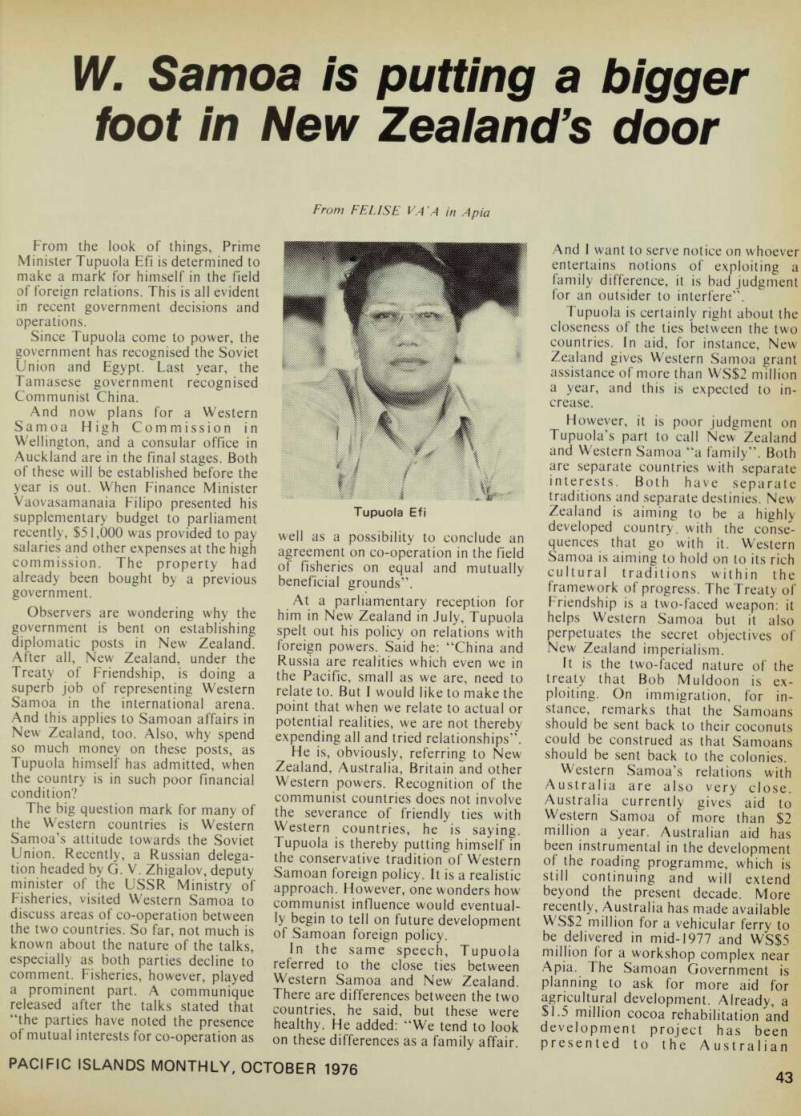
Tupuola Efi
authorities for the possibility of aid.
To date, not much is known about Prime Minister Tupuola’s discussions with New Zealand’s Bob Muldoon and other leaders. The topic of most concern to Tupuola was and remains immigration. The National Party’s new immigration policy has made it extremely difficult for Samoans to go to New Zealand on a three-month visa and there is speculation that Western Samoa’s annual quota of 1500 immigrants, to New Zealand may be drastically reduced.
The new regulations have adversely affected the economic aspirations of many Samoans, hence the outcry in Western Samoa against them. But since, in any case, most families in Samoa already have members in New Zealand and in other countries like the United States it is doubtful if the new New Zealand regulations will have a very serious economic reper cussion.
This can be illustrated by the fact that many of the Samoans who go to New Zealand on a three-month per mit go there to earn money for short term projects in their villages. They are not people who go there starving.
Also, they are not people who go there cultureless. For in truth Samoans are extremely cultured in their traditional way. What makes them appear cultureless is cultural conflict.
It is a good bet, however, that Tupuola did not gain much on the im migration issue. It will not be easy for the National Party to go back on its mandate. But what may be a loss could eventually turn out to be a gain for Samoa. For if Samoa is suf ficiently industrialised, and this will happen, then she will need all her peo ple to work here. This, in turn, may cause a serious labour problem in New Zealand. So who stands to gain?
Tupuola is wrong in suggesting that Samoans are the victims of prejudice over the immigration issue. It is more than that. They are being used as a political football as a scapegoat for a much larger problem: New Zealand s social morphological revolution, to use sociologist Philip Hauser’s term.
If the Samoans are being vic timised, they are also to be blamed because they are meeting the white men on their own ground. There is much to be said in sticking to our old “Pacific way”. And this means, talk frankly. Don’t beat around the bush, and this is good advice for Tupuola, too.