’Quakes, sharks two of the
pp. 33-35 · Read in the full issue
The President Coolidge
’Quakes, sharks two of the risks in this salvage job
From lAN McINTYRE in Vila Work has begun on the salvage of oil trapped in the sunken World War II American troopship, President Coolidge, which is lying on her side in the Second Channel at Santo in the New Hebrides. A Fiji-based firm. Salvage Pacific Ltd, work ing under contract to the condominium ad ministration began salvage operations in mid-July and pumping began about 10
days later.
A British Government grant of $60,000 was made available to the condominium for the salvage of the estimated 850 tons of bunkering oil that for some time now has been leaking from the sunken hull and polluting the shores and beaches of Santo.
Salvage Pacific Ltd did a survey on the wreck in 1974 at the request of the joint ad ministration. During the survey operations a severe earthquake was experienced which resulted in a large spillage from ruptured fuel tanks. The stench from the oil is well remembered by local residents who, although they regard the sunken vessel as something of a national monument, are pleased that after many years of haggling and inactivity something at last is being done to eliminate the threat to their fishing areas and beaches.
Previous salvage attempts by commer cial interests have resulted only in the removal of the twin propellers and their spare blades. The method used to sever these from the hull blasting with ex plosives and several earthquakes have caused severe corrosion and a rapid deterioration of the hull.
The President Coolidge sank in Oc tober, 1942, after hitting one of her own mines. She was clearing Santo harbour en route from America to the Solomon Island battlefields. On board were about 5000 troops plus crew and a cargo of war materials, jeeps, trucks, cranes, bulldozers together with several complete mobile field hospitals and advanced and highly-secret radar installations.
In a recognised feat of seamanship the captain ran the ship ashore after the mine had torn a hole below the waterline in the blower recess of the aft boiler room a most vulnerable strike.
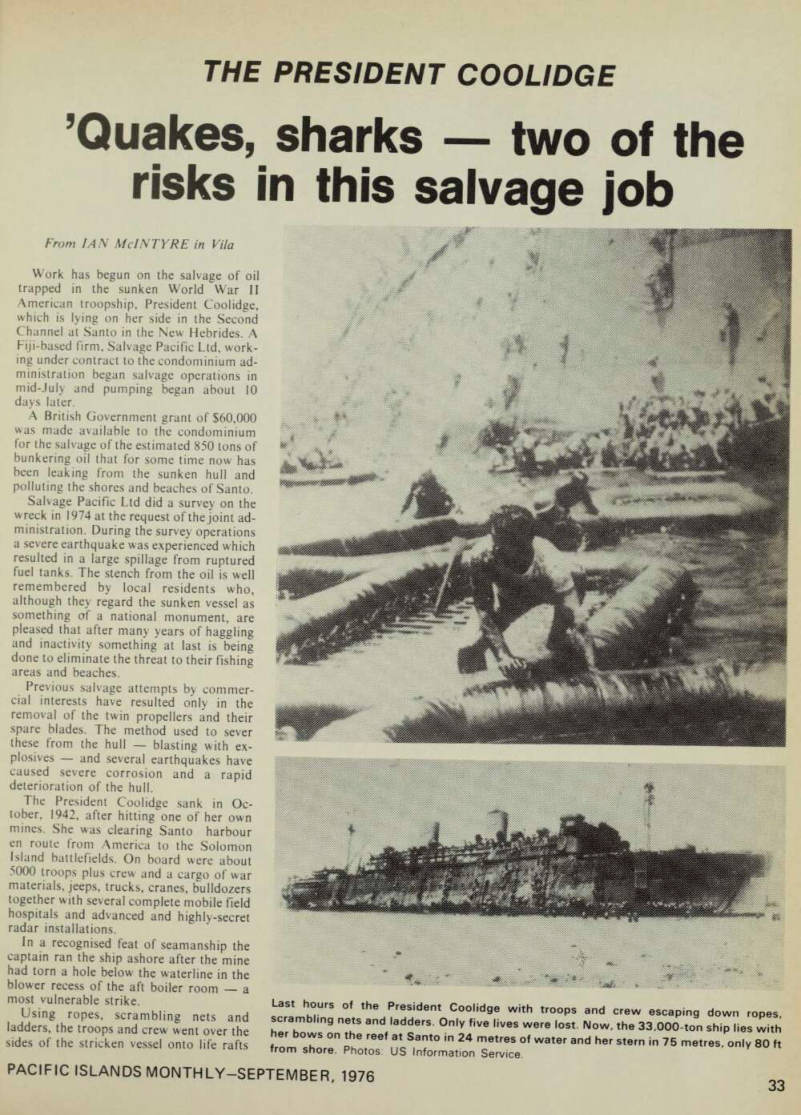
Using ropes, scrambling nets and ladders, the troops and crew went over the sides of the stricken vessel onto life rafts
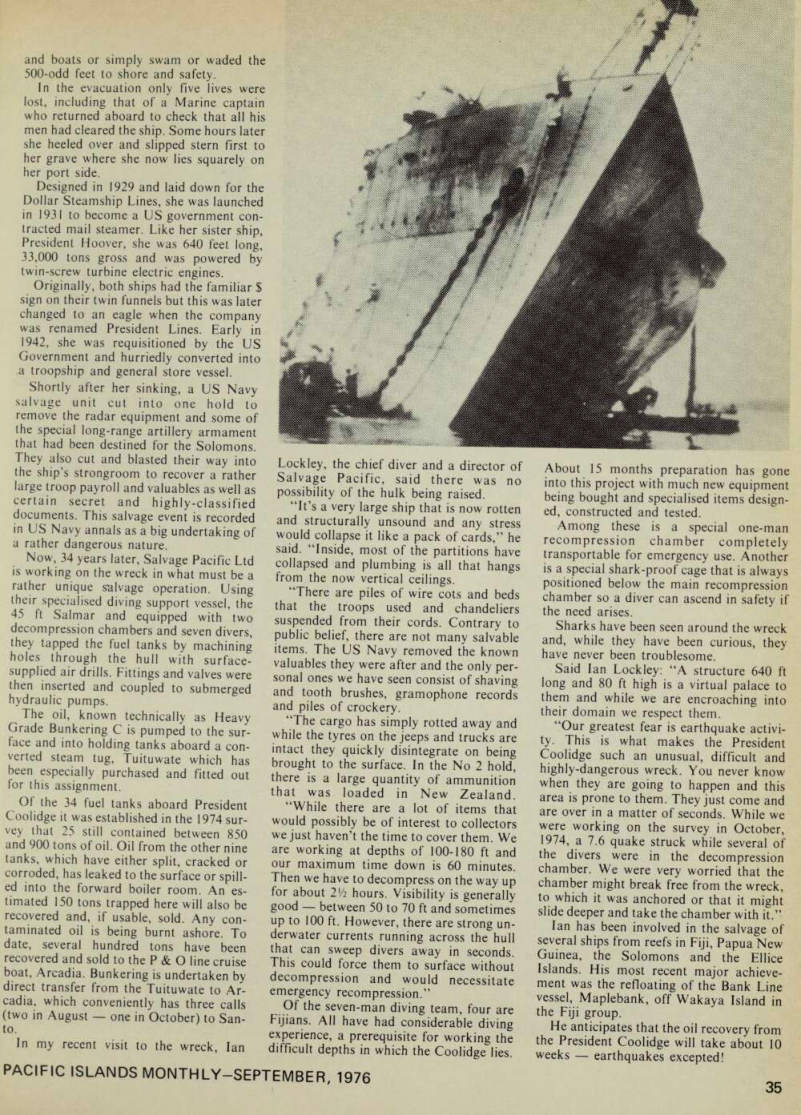
Last hours of the President Coolidge with troops and crew escaping down ropes, scrambling nets and ladders. Only five lives were lost. Now, the 33,000-ton ship lies with her ows on the reef at Santo in 24 metres of water and her stern in 75 metres, only 80 ft from shore. Photos: US Information Service.
and boats or simply swam or waded the 500-odd feet to shore and safety.
In the evacuation only five lives were lost, including that of a Marine captain who returned aboard to check that all his men had cleared the ship. Some hours later she heeled over and slipped stern first to her grave where she now lies squarely on her port side.
Designed in 1929 and laid down for the Dollar Steamship Lines, she was launched in 1931 to become a US government con tracted mail steamer. Like her sister ship, President Hoover, she was 640 feet long, 33,000 tons gross and was powered by twin-screw turbine electric engines.
Originally, both ships had the familiar $ sign on their twin funnels but this was later changed to an eagle when the company was renamed President Lines. Early in 1942, she was requisitioned by the US Government and hurriedly converted into a troopship and general store vessel.
Shortly after her sinking, a US Navy salvage unit cut into one hold to remove the radar equipment and some of the special long-range artillery armament that had been destined for the Solomons.
They also cut and blasted their way into the ship’s strongroom to recover a rather large troop payroll and valuables as well as certain secret and highly-classified documents. This salvage event is recorded in US Navy annals as a big undertaking of a rather dangerous nature.
Now, 34 years later, Salvage Pacific Ltd is working on the wreck in what must be a rather unique salvage operation. Using their specialised diving support vessel, the 45 ft Salmar and equipped with two decompression chambers and seven divers, they tapped the fuel tanks by machining holes through the hull with surface supplied air drills. Fittings and valves were then inserted and coupled to submerged
hydraulic pumps.
The oil, known technically as Heavy Grade Bunkering C is pumped to the sur face and into holding tanks aboard a con verted steam tug, Tuituwate which has been especially purchased and fitted out for this assignment.
Of the 34 fuel tanks aboard President Coolidge it was established in the 1974 sur vey that 25 still contained between 850 and 900 tons of oil. Oil from the other nine tanks, which have either split, cracked or corroded, has leaked to the surface or spill ed into the forward boiler room. An es timated 150 tons trapped here will also be recovered and, if usable, sold. Any con taminated oil is being burnt ashore. To date, several hundred tons have been recovered and sold to the P & O line cruise boat, Arcadia. Bunkering is undertaken by direct transfer from the Tuituwate to Ar cadia, which conveniently has three calls (two in August one in October) to San to.
In my recent visit to the wreck, lan
Lockley, the chief diver and a director of Salvage Pacific, said there was no possibility of the hulk being raised.
“It’s a very large ship that is now rotten and structurally unsound and any stress would collapse it like a pack of cards,” he said. “Inside, most of the partitions have collapsed and plumbing is all that hangs from the now vertical ceilings.
“There are piles of wire cots and beds that the troops used and chandeliers suspended from their cords. Contrary to public belief, there are not many salvable items. The US Navy removed the known valuables they were after and the only per sonal ones we have seen consist of shaving and tooth brushes, gramophone records and piles of crockery.
“The cargo has simply rotted away and while the tyres on the jeeps and trucks are
intact they quickly disintegrate on being
brought to the surface. In the No 2 hold, there is a large quantity of ammunition that was loaded in New Zealand.
“While there are a lot of items that would possibly be of interest to collectors we just haven’t the time to cover them. We are working at depths of 100-180 ft and our maximum time down is 60 minutes.
Then we have to decompress on the way up for about IVi hours. Visibility is generally good between 50 to 70 ft and sometimes up to 100 ft. However, there are strong un derwater currents running across the hull that can sweep divers away in seconds.
This could force them to surface without decompression and would necessitate emergency recompression.”
Of the seven-man diving team, four are Fijians. All have had considerable diving experience, a prerequisite for working the difficult depths in which the Coolidge lies.
About 15 months preparation has gone into this project with much new equipment
being bought and specialised items design
ed, constructed and tested.
Among these is a special one-man recompression chamber completely transportable for emergency use. Another is a special shark-proof cage that is always positioned below the main recompression chamber so a diver can ascend in safety if the need arises.
Sharks have been seen around the wreck and, while they have been curious, they have never been troublesome.
Said lan Lockley: “A structure 640 ft long and 80 ft high is a virtual palace to them and while we are encroaching into their domain we respect them.
“Our greatest fear is earthquake activi ty. This is what makes the President Coolidge such an unusual, difficult and highly-dangerous wreck. You never know when they are going to happen and this area is prone to them. They just come and are over in a matter of seconds. While we were working on the survey in October, 1974, a 7.6 quake struck while several of the divers were in the decompression chamber. We were very worried that the chamber might break free from the wreck, to which it was anchored or that it might slide deeper and take the chamber with it.” lan has been involved in the salvage of several ships from reefs in Fiji, Papua New Guinea, the Solomons and the Ellice Islands. His most recent major achieve ment was the refloating of the Bank Line vessel, Maplebank, off Wakaya Island in the Fiji group.
He anticipates that the oil recovery from the President Coolidge will take about 10 weeks earthquakes excepted!