News
pp. 30-31 · Read in the full issue
The
In A
Nutshell
Fiji Strikers Arrested
Three days after the start of a strike which closed the Fiji Sugar Corporation's mills at Lautoka, Rarawai, Penang and Labasa in late July at the height of the crushing season, police arrested all of ficials of the Sugar Milling Staff Officers’
Association, which called the strike. They were charged with causing an illegal strike, having failed to give notice of the strike, which was in protest against rejection of union claims for back-dated pay increases and a 10 per cent production bonus. The government claimed that a sympathy strike by the 3000-member strong Fiji Sugar and General Workers’ Union was also illegal. Fiji suffered from a rash of strikes in July. Seventy postal workers at Suva went on strike about an alleged lack of staff. They went back to work three days later after conciliation procedures were invoked.
The future of the Emperor gold mine at Vatukoula lay in the balance when the Fiji Mineworkers’ Union called a 24-hour stoppage in a dispute involving the transfer of 22 surface workers to underground min ing. Two days later, the Emperor chair man, Mr J. Reid, said the company might be forced to close the mine, which would involve dismissal of up to 1000 workers.
Between 500 and 600 would continue in employment in subsidiary companies. His board had given him a mandate to close the mine if he felt the situation warranted such action. Emperor was in the throes of a recession, partly caused by low gold prices and partly because it had to contend with irresponsible trade union actions. Ad ditional wage increases now would further jeopardise the company’s viability.
Bah Ba!
The Ba Town Council in Fiji recently tried to ban newspaper coverage of the an nual inter-district soccer tournament, and sought Supreme Court injunctions to en force the ban. The council also wanted to ban Radio Fiji. Mr Justice Kermode gave the council short shrift. He described the council’s action as a clear attempt to muz zle the news media from exercising their fundamental rights of free speech and ex pression.
The council claimed the newspapers and radio would make a substantial profit at the expense of the council, which would be a violation of an agreement between the council and the Fiji Football Association, and the council “would suffer incalculable loss or damage’’. The media had threaten ed to publish information about the tour nament without the council’s consent.
Mr Justice Kermode was mild in rejec ting the case against the newspaper. Others would consider the council’s application staggering, and that to prevent coverage of an event of national importance would be scandalous. Mr Justice Kermode ruled, however, the council could refuse to allow a broadcast from within the ground, and that the newspapers could not sell newspapers in the ground without the council’s permission. The council and Radio Fiji reached an agreement to allow direct broadcast commentaries on play.
Bang-Bang
France exploded two nuclear devices un derground at Mururoa Atoll on July 10 and 22. The French Defence Ministry said later the tests were carried out in “satisfac tory conditions”. Nothing was said about the strength of the devices. France has now made five underground tests at Mururoa, following a series of aerial detonations.
Pitcairn’S Big Blow
It’s been one blow after another on Pit cairn Island. A fire destroyed the islanders’ main electricity generator in June. Then, for 24 hours in July’s first week, a storm blasted the island with winds up to 80 mph.
Roofs of six houses were blown away or damaged. Tom Christian, the radio of ficer, told the Voice of Prophecy, the Seventh-day Adventist radio centre in California, in his weekly broadcast, that termites weakened the wooden supports of houses and damage could be severe in a storm. Banana trees were also blown over and many mangoes and oranges were blown from the trees. There were no in juries.
Police Probe
Mr Ulualofaiga Talamaivao Niko, once a policemen in Western Samoa and now that country’s Minister of Justice, Police, and Youth and Cultural Affairs, has ordered a full inquiry into the running of
the Department of Police and Prisons, but he was quick to deny a suggestion the in quiry was because of past differences he had with the Commissioner of Police, Mr Lavea Unasa Lio. But he did admit he had resigned from the police because he was dissatisfied with some aspects of the
department’s work.
He said the department’s work needed complete reappraisal in the light of new problems caused by changing cir cumstances. Higher standards would need to be imposed to protect the public against the sophisticated acts of educated criminals. The police had to be equipped to deal with more educated youths and adults, both local and from overseas.
Mr Ulualofaiga mentioned harmful drugs as one of the bad effects from in creased communications with the outside world. He said a full inquiry by an in dependent commission was the only fair way to start a complete reorganisation of the depa:tment. To make that fresh start, the government needed to know the strengths and weaknesses of the depart ment.
*Anoe Trip
A 74ft Gilbe;tese outrigger canoe, which left Tarawa on May 23, arrived at Lautoka in Fiji 47 days later on July 9 with a cew of 13. Mr Jim Siers, a New Zealand photographer, who planned the building of the canoe and the voyage, has accepted an offer to have the canoe housed in the museum in Wellington. He said the ven ture was to show such voyages could have been made by Micronesians before the arrival of Europeans in the Pacific. On the 1,500 mile voyage, the canoe called at Abemama and Tabiteuea in the Gilberts, and at Rotuma. It ran through a storm, which lasted 24 hours. The storm broke one of the two masts and the canoe sprang leaks in the hull. Mr Siers intends to re main in Fiji for some time seeking support for another canoe venture. This will in volve construction of a Fijian drua (double canoe) for a long ocean voyage.
Chiefly Row
A row is looming in the Cook Islands over the election and formal installation, with customary ceremonies, of Toua Paitai as the new Vakatini Ariki. Members of the Ui Rangalire, of Vakatini, are objecting to Toua Paitai holding the title. They claim that certain members of the tribe took on themselves the sole responsibility of elec ting the title holder, without proper con sideration for the custom and feelings of the Kopu Ariki and all the Ui Rangatire of Vakatini. The objectors say they intend to hold'a full investigation and decide on the rightful successor to the title. They said they did not recognise or accept the elec tion of Toua Paitai. The election had to have the majority backing of the Kopu Ariki and Aringa Mana of the tribe.
H-Bomb Clean-Up
A sub-committee of the US Senate has approved a SUSS million appropriation for the “cleaning up” of Enewetak Atoll in the Marshall Islands, scene of the first US hydrogen bomb tests in 1954. The project could eventually cost 10 times that amount, according to Washington observers.
The appropriation was urged by the
chairman of the Sub-Committee on Military Construction, Senator Mike Mansfield (Democrat, Montana) who said the US had “a moral responsibility to the Enewetakese who were exiles from their atoll in 1947 so the US could conduct nuclear testing there”. It is believed US military personnel stationed in Hawaii could be involved in the work.
Oil Search
Webb Tonga, oil prospecting firm in Tonga, is optimistic at the prospect of locating oil following tests on rocks taken from the exposed reef on the west coast of ’Eua. The tests showed the rock structure was of oil-bearing type, the president of Webb Tonga, Mr Birdsong, said. The tests and also the fact that oil seepages existed in Tonga, made him very enthusiastic.
Webb Tonga will send shipping vibrator trucks to Tonga soon to make an inland seismic survery of Tongatapu. This procedure will precede the drilling of ex ploratory holes.
Holy Junket
Tonga celebrated the 150th anniversary of the arrival of Christian missionaries, the Revs John Thomas and John Hutchinson with a series of thanksgiving ceremonies, and traditional feasting and entertainment.
King Taufa’ahau Tupou spoke to the peo ple of the kingdom over Radio Tonga when he opened festivities with a sermon.
He said many benefits had flowed from the advent of Christianity in Tonga, including the emancipation of the Tongan people in 1862 by King George Tupou. A special commemoration service was held at the place where Thomas and Hutchinson land ed. More than 20,000 people attended this service at which the preacher was the Rev.
A. Harold Wood. At Kolovai, the same day, the king laid the foundation stone of the new Free Wesleyan Church building.
There were also commemoration ser vices for missionaries who arrived before Thomas and Hutchinson. There were the first missionaries from the London Missionary Society, tradesmen, not ministers, who landed in 1797 and whose intentions were misunderstood. After three were massacred during a faction war, the remainder left. The Rev. Walter Lawry, a Wesleyan minister, arrived in 1822 from Sydney, but made little headway, before his wife’s ill-health and orders from Lon don compelled him to leave in 1823. Early
in 1826, two Tahitians, Hape and Tafeta, called at Nukualofa on the way to Fiji.
They built a church and soon had a con gregation of 300.
The Rev Peter K. Davis opened the
sesqui-centenary church at Sopu-’o-Taufa,
Kolomotu’a. The Rev Cecil F. Gribble preached at a commemoration service near the place where the LMS missionaries landed.
Rough Rugby
Fiji’s Under 23 Rugby team returned home after an unsuccessful seven-match tour of Tonga (three matches won and four lost), claiming, to put it mildly, the Tongans were no gentlemen on the field. In fact, they claimed the Tongans were more interested in playing the man rather than the ball. Several of them said they suffered serious injuries which would put them out of action for the rest of the season. In some matches the spectators took part in brawls.
They said they did not retaliate because Fijians did not do that sort of thing. And noting the attitude of spectators, they wise ly considered it would be foolhardy to do anything which could inflame passions.
For the record, the seven matches resulted, Fiji scores first: Western Districts Under 23, 15-22; Eastern Districts, Under 23, 15-3; Tonga Under 23, 6-7; Ha’apai, 8- 7; Vavau, 11-9; Town District Under 23, 12-14; Tonga Under 23, 0-4.
Western Samoa, in New Zealand, also had an unsuccessful tour from a playing point of view, but there were no reports of violence. On their first major overseas tour, the Western Samoans played eight matches, and lost seven, most by substan tial margins. They scored 45 points, but
had 176 scored against them. Results, Western Samoa score first: Horowhenua, 6-17;- Buller, 24-10; Hawkes Bay, 0-38; Poverty Bay, 3-28; Counties, 4-24; Maoris, 0-19; Taranaki, 0-16; Maoris, 8-24.
New Voice
A new weekly newspaper appeared in Noumea in early July L’Unite (Unity).
The weekly opposes official French ad ministration policy and supports socialist aims, suggesting it could be the new organ of Alain Bernut’s Parti Socialisle Caledo nien. The paper, which made its first appearance on the eve of a South Pacilic visit by French socialist parliamentarian Alain Vivien, provides some lively debate and sharp criticism of the Caledonian scene at a time when most of the local press, under the guidance of the French ad ministration, is avoiding serious debate and keeping the Caledonians absorbed with pages of sport, motor accident horrors and dramas before the local law courts.
A Muldoon Gesture
The New Zealand Prime Minister and Minister of Finance, Mr Robert Muldoon, gave the Pacific Islands tourist industry a boost in his budget, which he brought down late in July. He exempted travellers only going as far as the Cook Islands, Fiji, the Tokelaus, Niue, Tonga and Western Samoa from a new 10 per cent foreign travel tax. This should help to make the Islands more competitive with places such as the Queensland Gold Coast, Singapore, Malaysia, Thailand and Hong Kong in at tracting tourists from New Zealand, par ticularly those on budget-priced holidays.
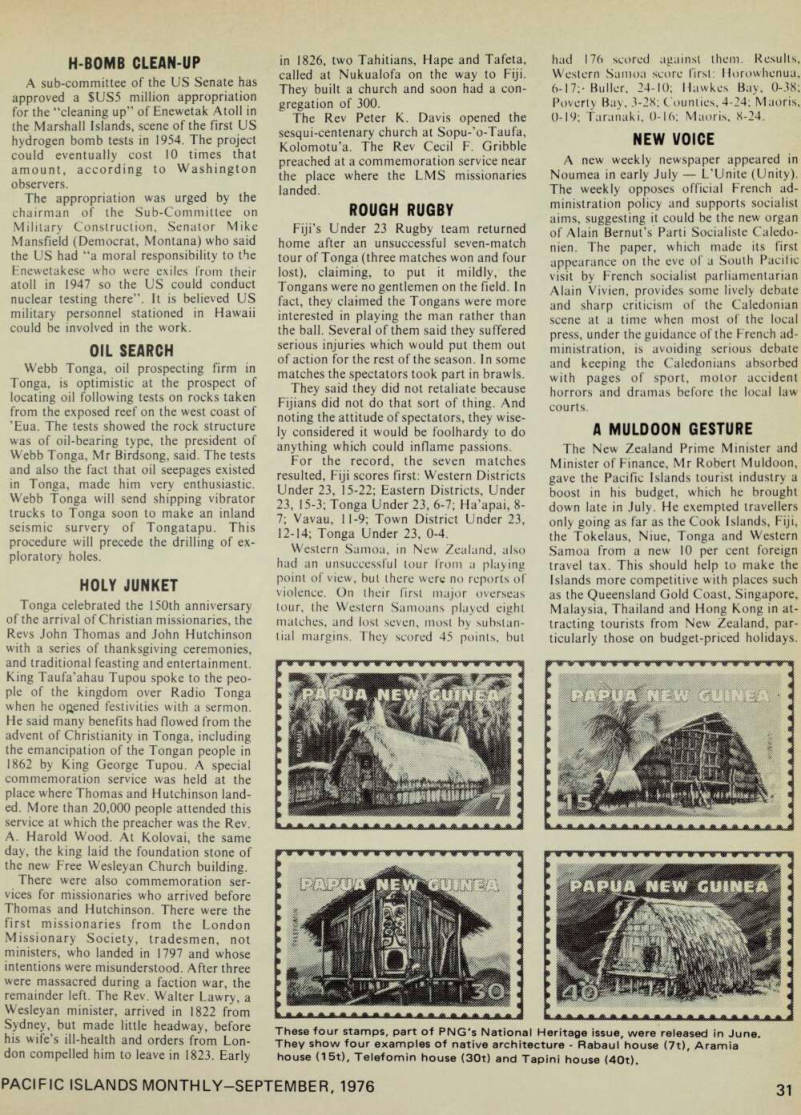
These four stamps, part of PNG's National Heritage issue, were released in June.
They show four examples of native architecture - Rabaul house (7t), Aramia house (15t), Telefomin house (30t) and Tapini house (40t).