Norfolk at the crossroads: which
pp. 11-12 · Read in the full issue
way to go from here?
From FRANCIS ROLLEY in Kingston
After taking up his appointment on September 4, Norfolk Island’s new Ad ministrator, one-time Australian Navy Lieutenant-Commander and Secret Ser vice Agent Desmond Vincent O’Leary, faces a formidable challenge. Never, until a month ago, having set foot on the island, his main task during a two-year posting, if it runs full term, could be to implement the imminently expected recommendations of Sir John Nimmo’s Royal Commission into the island’s future status and constitutional relationship to Australia.
Canberra is not bound to adopt the com mission’s suggestions, either in whole or even part, but when Senator Reg Withers as Minister for Administrative Services the department with mainland authority over Norfolk at present says “the island is entering one of the most important periods in its history” most of the 1600 residents fear some changes are inevitable.
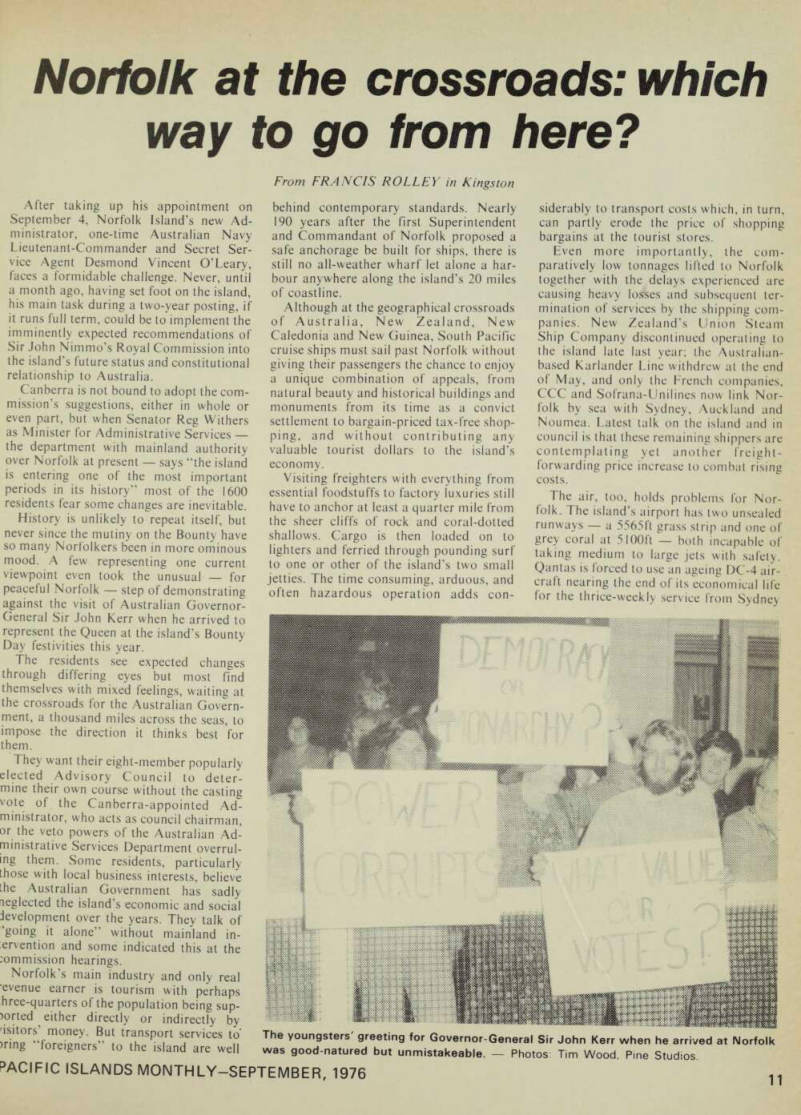
History is unlikely to repeat itself, but never since the mutiny on the Bounty have so many Norfolkers been in more ominous mood. A few representing one current viewpoint even took the unusual for peaceful Norfolk step of demonstrating against the visit of Australian Governor- General Sir John Kerr when he arrived to represent the Queen at the island’s Bounty Day festivities this year.
The residents see expected changes through differing eyes but most find themselves with mixed feelings, waiting at the crossroads for the Australian Govern ment, a thousand miles across the seas, to impose the direction it thinks best for them.
They want their eight-member popularly elected Advisory Council to deter mine their own course without the casting vote of the Canberra-appointed Ad ministrator, who acts as council chairman, or the veto powers of the Australian Ad
ministrative Services Department overrul
ing them. Some residents, particularly those with local business interests, believe the Australian Government has sadly neglected the island’s economic and social Jevelopment over the years. They talk of ‘going it alone” without mainland in dention and some indicated this at the
:ommission hearings.
Norfolk’s main industry and only real evenue earner is tourism with perhaps hree-quarters of the population being sup
)orted either directly or indirectly by
dsitors money. But transport services to >ring “foreigners” to the island are well
behind contemporary standards. Nearly 190 years after the first Superintendent and Commandant of Norfolk proposed a safe anchorage be built for ships, there is still no all-weather wharf let alone a har bour anywhere along the island’s 20 miles of coastline.
Although at the geographical crossroads of Australia, New Zealand, New Caledonia and New Guinea, South Pacific cruise ships must sail past Norfolk without giving their passengers the chance to enjoy a unique combination of appeals, from natural beauty and historical buildings and monuments from its time as a convict settlement to bargain-priced tax-free shop ping, and without contributing any valuable tourist dollars to the island’s economy.
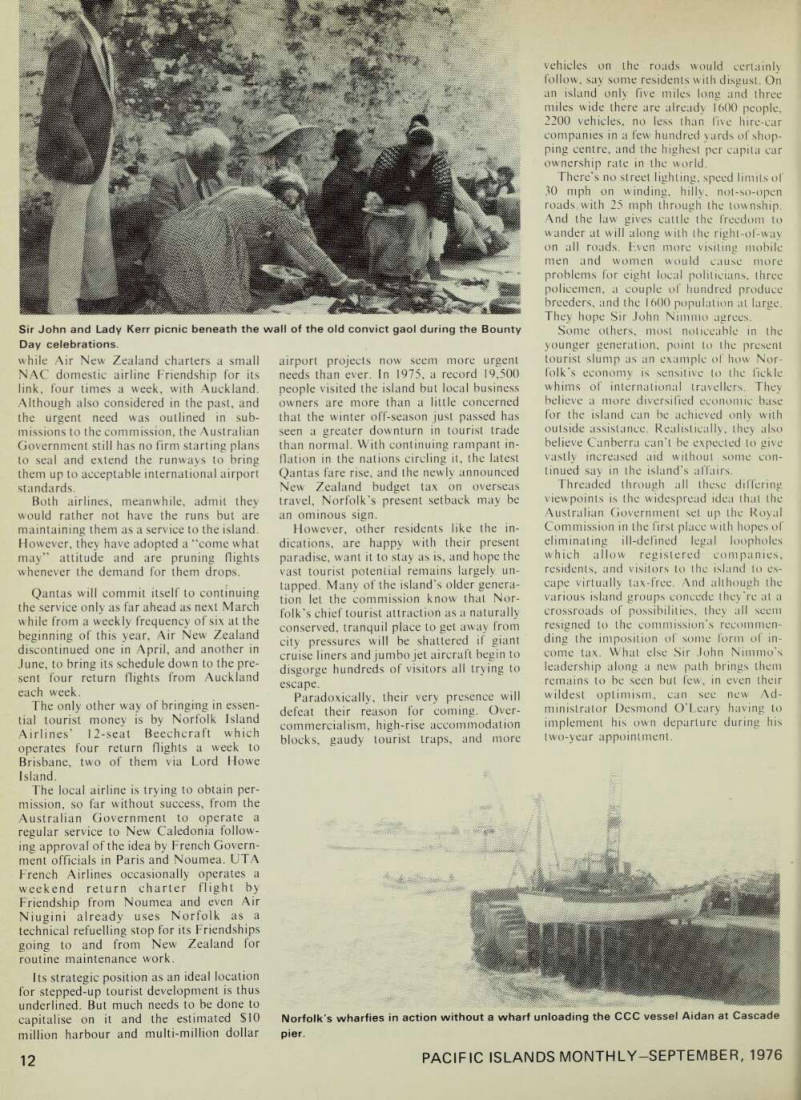
Visiting freighters with everything from essential foodstuffs to factory luxuries still have to anchor at least a quarter mile from the sheer cliffs of rock and coral-dotted shallows. Cargo is then loaded on to lighters and ferried through pounding surf to one or other of the island’s two small jetties. The time consuming, arduous, and often hazardous operation adds con
siderably to transport costs which, in turn, can partly erode the price of shopping bargains at the tourist stores.
Even more importantly, the com paratively low tonnages lifted to Norfolk together with the delays experienced are causing heavy losses and subsequent ter mination of services by the shipping com panies. New Zealand’s Union Steam Ship Company discontinued operating to the island late last year; the Australian based Karlander Line withdrew at the end of May, and only the French companies, CCC and Sofrana-Unilines now link Nor folk by sea with Sydney, Auckland and Noumea. Latest talk on the island and in council is that these remaining shippers are contemplating yet another freight forwarding price increase to combat rising costs.
The air, too, holds problems for Nor folk. The island’s airport has two unsealed runways a 5565 ft grass strip and one of grey coral at 5100 ft both incapable of taking medium to large jets with safely.
Qantas is forced to use an ageing DC-4 air craft nearing the end of its economical life for the thrice-weekly service from Sydney
The youngsters greeting for Governor-General Sir John Kerr when he arrived at Norfolk was good-natured but unmistakeable. Photos; Tim Wood. Pine Studios.
while Air New Zealand charters a small NAG domestic airline Friendship for its link, four times a week, with Auckland.
Although also considered in the past, and the urgent need was outlined in sub missions to the commission, the Australian Government still has no firm starting plans to seal and extend the runways to bring them up to acceptable international airport standards.
Both airlines, meanwhile, admit they would rather not have the runs but are maintaining them as a service to the island.
However, they have adopted a “come what may” attitude and are pruning flights whenever the demand for them drops.
Qantas will commit itself to continuing the service only as far ahead as next March while from a weekly frequency of six at the beginning of this year, Air New Zealand discontinued one in April, and another in June, to bring its schedule down to the pre sent four return flights from Auckland each week.
The only other way of bringing in essen tial tourist money is by Norfolk Island Airlines’ 12-seat Beechcraft which operates four return flights a week to Brisbane, two of them via Lord Howe Island.
The local airline is trying to obtain per mission, so far without success, from the Australian Government to operate a regular service to New Caledonia follow ing approval of the idea by French Govern ment officials in Paris and Noumea. UTA French Airlines occasionally operates a weekend return charter flight by Friendship from Noumea and even Air Niugini already uses Norfolk as a technical refuelling stop for its Friendships going to and from New Zealand for routine maintenance work.
Its strategic position as an ideal location for stepped-up tourist development is thus underlined. But much needs to be done to capitalise on it and the estimated $lO million harbour and multi-million dollar
airport projects now seem more urgent needs than ever. In 1975, a record 19,500 people visited the island but local business owners are more than a little concerned that the winter off-season just passed has seen a greater downturn in tourist trade than normal. With continuing rampant in flation in the nations circling it, the latest Qantas fare rise, and the newly announced New Zealand budget lax on overseas travel, Norfolk’s present setback may be an ominous sign.
However, other residents like the in dications, are happy with their present paradise, want it to stay as is, and hope the vast tourist potential remains largely un tapped. Many of the island’s older genera tion let the commission know that Nor folk’s chief tourist attraction as a naturally conserved, tranquil place to gel away from city pressures will be shattered if giant cruise liners and jumbo jet aircraft begin to disgorge hundreds of visitors all trying to escape.
Paradoxically, their very presence will defeat their reason for coming. Over commercialism, high-rise accommodation blocks, gaudy tourist traps, and more
vehicles on the roads would certainly follow, say some residents with disgust. On an island only five miles long and three miles wide there are already 1600 people, 2200 vehicles, no less than five hire-car companies in a few hundred yards of shop ping centre, and the highest per capita car ownership rate in the world.
There’s no street lighting, speed limits of 30 mph on winding, hilly, not-so-open
roads,with 25 mph through the township.
And the law gives cattle the freedom to wander at will along with the right-of-way on all roads. Even more visiting mobile men and women would cause more
problems for eight local politicians, three
policemen, a couple of hundred produce breeders, and the 1600 population at large.
They hope Sir John Nimmo agrees.
Some others, most noticeable in the younger generation, point to the present tourist slump as an example of how Nor folk’s economy is sensitive to the fickle whims of international travellers. They believe a more diversified economic base for the island can be achieved only with outside assistance. Realistically, they also believe Canberra can’t be expected to give vastly increased aid without some con tinued say in the island’s affairs.
Threaded through all these differing viewpoints is the widespread idea that the Australian Government set up the Royal Commission in the first place with hopes of
eliminating ill-defined legal loopholes
which allow registered companies,
residents, and visitors to the island to es cape virtually tax-free. And although the various island groups concede they’re at a crossroads of possibilities, they all seem resigned to the commission's recommen ding the imposition of some form of in come tax. What else Sir John Nimmo’s leadership along a new path brings them remains to be seen but few, in even their wildest optimism, can see new Ad ministrator Desmond O’Leary having to
implement his own departure during his
two-year appointment.
Sir John and Lady Kerr picnic beneath the wall of the old convict gaol during the Bounty Day celebrations.
Norfolk's wharfies in action without a wharf unloading the CCC vessel Aidan at Cascade pier.