of the House of Henry
pp. 8-10 · Read in the full issue
Cook Islands Politics
Islander examines the rule of the House of Henry
From a COOK ISLANDER in New Zealand
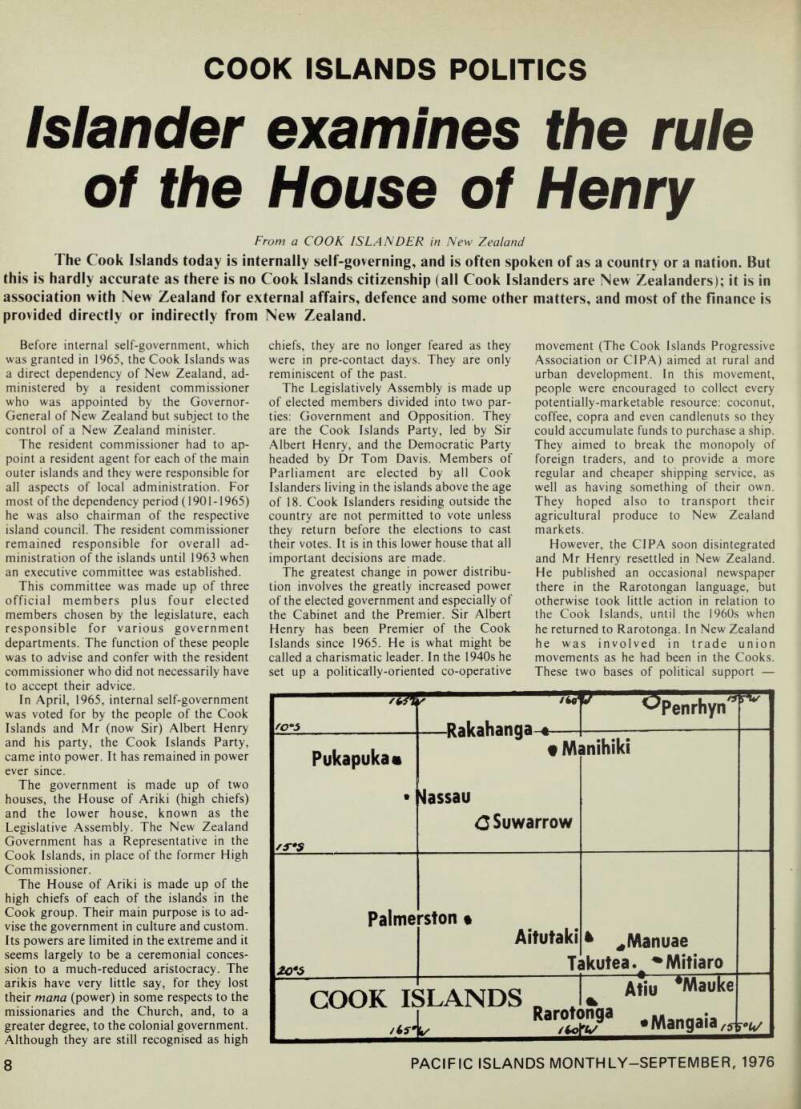
The Cook Islands today is internally self-governing, and is often spoken of as a country or a nation. But this is hardly accurate as there is no Cook Islands citizenship (all Cook Islanders are New Zealanders); it is in association with New Zealand for external affairs, defence and some other matters, and most of the finance is provided directly or indirectly from New Zealand.
Before internal self-government, which was granted in 1965, the Cook Islands was a direct dependency of New Zealand, ad ministered by a resident commissioner who was appointed by the Governor- General of New Zealand but subject to the control of a New Zealand minister.
The resident commissioner had to ap point a resident agent for each of the main outer islands and they were responsible for all aspects of local administration. For most of the dependency period (1901-1965) he was also chairman of the respective island council. The resident commissioner remained responsible for overall ad ministration of the islands until 1963 when an executive committee was established.
This committee was made up of three official members plus four elected members chosen by the legislature, each responsible for various government departments. The function of these people was to advise and confer with the resident commissioner who did not necessarily have to accept their advice.
In April, 1965, internal self-government was voted for by the people of the Cook Islands and Mr (now Sir) Albert Henry and his party, the Cook Islands Party, came into power. It has remained in power ever since.
The government is made up of two houses, the House of Ariki (high chiefs) and the lower house, known as the Legislative Assembly. The New Zealand Government has a Representative in the Cook Islands, in place of the former High Commissioner.
The House of Ariki is made up of the high chiefs of each of the islands in the Cook group. Their main purpose is to ad vise the government in culture and custom.
Its powers are limited in the extreme and it seems largely to be a ceremonial conces sion to a much-reduced aristocracy. The arikis have very little say, for they lost their mana (power) in some respects to the missionaries and the Church, and, to a greater degree, to the colonial government.
Although they are still recognised as high
chiefs, they are no longer feared as they were in pre-contact days. They are only reminiscent of the past.
The Legislatively Assembly is made up of elected members divided into two par ties: Government and Opposition. They are the Cook Islands Party, led by Sir Albert Henry, and the Democratic Party headed by Dr Tom Davis. Members of Parliament are elected by all Cook Islanders living in the islands above the age of 18. Cook Islanders residing outside the country are not permitted to vote unless they return before the elections to cast their votes. It is in this lower house that all important decisions are made.
The greatest change in power distribu tion involves the greatly increased power of the elected government and especially of the Cabinet and the Premier. Sir Albert Henry has been Premier of the Cook Islands since 1965. He is what might be called a charismatic leader. In the 1940 s he set up a politically-oriented co-operative
movement (The Cook Islands Progressive Association or Cl PA) aimed at rural and urban development. In this movement, people were encouraged to collect every potentially-marketable resource; coconut, coffee, copra and even candlenuts so they could accumulate funds to purchase a ship.
They aimed to break the monopoly of foreign traders, and to provide a more regular and cheaper shipping service, as well as having something of their own.
They hoped also to transport their agricultural produce to New Zealand markets.
However, the CIPA soon disintegrated and Mr Henry resettled in New Zealand.
He published an occasional newspaper there in the Rarotongan language, but otherwise took little action in relation to the Cook Islands, until the 1960 s when he returned to Rarotonga. In New Zealand he was involved in trade union movements as he had been in the Cooks.
These two bases of political support
trade unions for the urban workers and co operatives for the rural farmers, were key features of his political strength.
Today people in Rarotonga still, at times, refer to his old co-operative move ment when talking about Sir Albert Henry and often wonder what he did to their money. From the original members of his party in the first elections, some have moved to the opposition side and others have moved the other way, but the percen tage of his support is much reduced.
In the Cabinet today there are the Premier, two Deputy Premiers and five ministers all to govern a total popula tion of 20,000 a small suburb by most standards. The two Deputy Premiers are Mr Tiakana Numanga and Mr Apenera Short, who have been long-standing sup porters of the Premier. The five ministers are Mr Tupui Henry, Mr Geoffrey Henry, Mr William Estall, Dr Joseph Williams and Mr George Ellis.
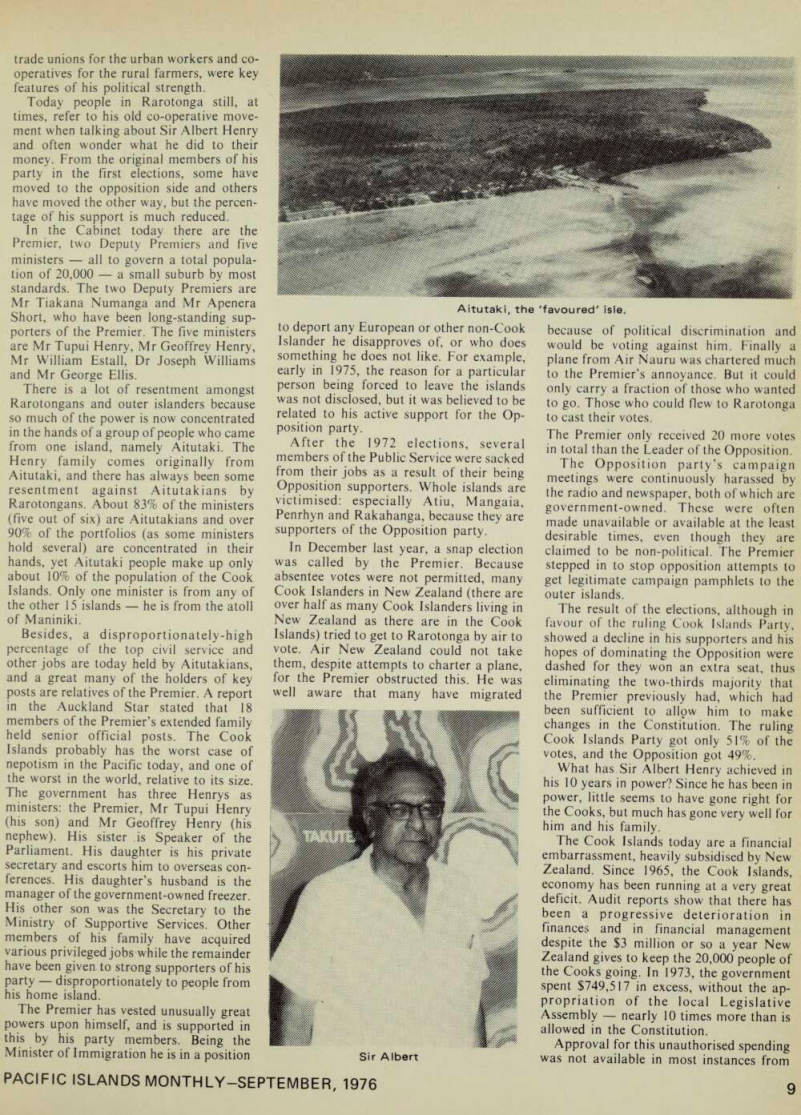
There is a lot of resentment amongst Rarotongans and outer islanders because so much of the power is now concentrated in the hands of a group of people who came from one island, namely Aitutaki. The Henry family comes originally from Aitutaki, and there has always been some resentment against Aitutakians by Rarotongans. About 83% of the ministers (five out of six) are Aitutakians and over 90% of the portfolios (as some ministers hold several) are concentrated in their hands, yet Aitutaki people make up only about 10% of the population of the Cook Islands. Only one minister is from any of the other 15 islands he is from the atoll of Maniniki.
Besides, a disproportionately-high percentage of the top civil service and other jobs are today held by Aitutakians, and a great many of the holders of key posts are relatives of the Premier. A report in the Auckland Star stated that 18 members of the Premier’s extended family held senior official posts. The Cook Islands probably has the worst case of nepotism in the Pacific today, and one of the worst in the world, relative to its size.
The government has three Henrys as ministers; the Premier, Mr Tupui Henry (his son) and Mr Geoffrey Henry (his nephew). His sister is Speaker of the Parliament. His daughter is his private secretary and escorts him to overseas con ferences. His daughter’s husband is the manager of the government-owned freezer.
His other son was the Secretary to the Ministry of Supportive Services. Other members of his family have acquired various privileged jobs while the remainder have been given to strong supporters of his party disproportionately to people from his home island.
The Premier has vested unusually great powers upon himself, and is supported in this by his party members. Being the Minister of Immigration he is in a position
to deport any European or other non-Cook Islander he disapproves of, or who does something he does not like. For example, early in 1975, the reason for a particular person being forced to leave the islands was not disclosed, but it was believed to be related to his active support for the Op position party.
After the 1972 elections, several members of the Public Service were sacked from their jobs as a result of their being Opposition supporters. Whole islands are victimised: especially Atiu, Mangaia,
Penrhyn and Rakahanga, because they are
supporters of the Opposition party.
In December last year, a snap election was called by the Premier. Because absentee votes were not permitted, many Cook Islanders in New Zealand (there are over half as many Cook Islanders living in New Zealand as there are in the Cook Islands) tried to get to Rarotonga by air to vote. Air New Zealand could not take them, despite attempts to charter a plane, for the Premier obstructed this. He was well aware that many have migrated
because of political discrimination and would be voting against him. Finally a plane from Air Nauru was chartered much to the Premier’s annoyance. But it could only carry a fraction of those who wanted to go. Those who could flew to Rarotonga to cast their votes.
The Premier only received 20 more votes in total than the Leader of the Opposition.
The Opposition party’s campaign
meetings were continuously harassed by the radio and newspaper, both of which are government-owned. These were often made unavailable or available at the least desirable times, even though they are claimed to be non-political. The Premier stepped in to stop opposition attempts to get legitimate campaign pamphlets to the outer islands.
The result of the elections, although in favour of the ruling Cook Islands Party, showed a decline in his supporters and his
hopes of dominating the Opposition were
dashed for they won an extra seat, thus eliminating the two-thirds majority that the Premier previously had, which had been sufficient to allow him to make changes in the Constitution. The ruling Cook Islands Party got only 51% of the votes, and the Opposition got 49%.
What has Sir Albert Henry achieved in his 10 years in power? Since he has been in power, little seems to have gone right for the Cooks, but much has gone very well for him and his family.
The Cook Islands today are a financial embarrassment, heavily subsidised by New Zealand. Since 1965, the Cook Islands, economy has been running at a very great deficit. Audit reports show that there has been a progressive deterioration in finances and in financial management despite the $3 million or so a year New Zealand gives to keep the 20,000 people of the Cooks going. In 1973, the government spent $749,517 in excess, without the ap propriation of the local Legislative Assembly nearly 10 times more than is allowed in the Constitution.
Approval for this unauthorised spending was not available in most instances from
Sir Albert
Aitutaki, the 'favoured' isle.
either the Minister of Finance or the Ex ecutive Council as is required by the Constitution. The Premier was Minister of Finance until 1972 when he passed this portfolio to his nephew, Mr Geoffrey Henry.
There were also government orders for coinage totalling $602,340, but here again the auditors found it impossible to confirm that all this money was accounted for. The Cook’s finances have only “improved” when they have received extra special assistance from New Zealand.
For example, the deficit in the ap propriation account was $586,106 at December 31, 1971. The position appeared to “improve” at December 31, 1972, but only because of a special loan of $BOO,OOO from New Zealand. Again at December 31, 1973, a further special loan of $400,000 had to be requested from New Zealand in addition to the extensive grants already provided. The Cook Islands has not been able to repay loan instalments, nor the money owing to the New Zealand Superannuation Fund, for example. But despite this financial crisis, the Cook Islands Government spent $BO,OOO to buy a home for the Premier early this year. The Premier travels far and wide around the globe at great expense to the taxpayer. The Cook Islands Government also pays for state dinners to welcome the Premier home every time he has gone away. Heads of much bigger and more important governments do not do this.
The economy of the Cook Islands has
also suffered. Agricultural productivity
has declined significantly, so that much of the food that could be produced in the Cooks has to be imported today. A new solution is always “on the horizon” but it never materialises. For example, there was talk about copra booming again with the use of a new dryer to increase production, but this died away without action. Then there were promises of financial salvation from peanuts, then tangerines, then pepper. Last year, during the elections.
manganese was claimed to be the coming bonanza, but already it is known that the manganese nodules near the Cooks didn’t contain enough nickel and copper to make it commercially worthwhile. Health has also deteriorated, with a marked drop in standards of water supply and public health services.
There has also been a steady flow of Cook Islanders to New Zealand. Since the opening of the international airport, the figures have jumped markedly. If the pre sent rate continues, half the people of the Cook Islands will have left within four years. People don’t want to grow crops if there is no secure market, as there was un til a regular shipping service provided by the New Zealand Government ceased.
Farmers have been discouraged and the land is left unattended to.
Other people are migrating, many of them well-educated, because the pay is not good or suitable jobs are not available to them. Many go as a result of political vic timisation; they have been by-passed for promotion, or dismissed, or given unat tractive posts, or, seeing what has happen ed to others who vote for the Opposition, they go. Those who have remained are dis proportionately the strong supporters of the Cook Islands Party. Much of this sup port comes from the older section of the population. These old people see Sir Albert Henry as a very good man for he in troduced an old-age pension and his appeal is, particularly, to the older and less
educated people.
Another sector from which he gets sup port is the Church. The Premier claims publicly that he is a good Christian and that his is a Christian government. To rein force this he never forgets to add a short prayer at the end of his speeches, involves ministers of religion in all ceremonies, and quotes freely from the Bible.
He also receives support from sporting people, for this is greatly encouraged as a basis of political support. Mr Hugh Henry is responsible for taking an active part in
this, encouraging clubs and competitions.
Cabinet ministers and party leaders at all levels are encouraged to take an active part in sporting and religious activities, and to associate this with their political party.
What will be the possible changes in the Cooks from 1975 onwards then? Firstly the Cooks could go independent. This was at one time the stated aim of Sir Albert Henry. Most recently, his ostensible reason was so that the Cook Islands could secure widened territorial waters. The sub ject was raised in connection with the Law of the Sea conference in Caracas when he wanted to extend the territorial waters of the Cook Islands to 200 miles to include the manganese deposits found about 150 miles south of Rarotonga.
However, these have now been proved to have no commercial value at this time, so these plans have been abandoned. The Cooks can go independent any time it wishes; in fact two New Zealand Prime Ministers have tried to encourage it. The question is, will they be able to support themselves, as they are so heavily depen dent on New Zealand for finance, skills and outlets to advantageous markets? If they went independent with so few resources and an economy with nothing to back it, the standard of living would drop drastically.
Cook Islanders seem to be almost un animously against independence, at least with the present government in power. Sir Albert himself said he would be a dictator.
So they don’t want to lose their New Zealand citizenship. The next alternative is for integration with New Zealand, with high-quality staff in the fields of ad ministration to help uplift the country from the mess it is now in. This could in clude many Cook Islanders who have left but who would come back if conditions im
proved.
Integration with New Zealand would allow better standards of administration and training for local personnel, until enough locals are fully qualified to fill the posts. The powers of ministers will decrease, but this is essential if progress is to be achieved. To have such wide ministerial powers for what in most coun tries would be a small town or district, is to get oneself out of perspective.
This same delusion of grandeur is shown in having three directors of education to run a tiny, low-quality, school system; and five directors of agriculture for a very small, inefficient and unproductive rural economy. Only when we get a proper perspective and stop trying to make everyone a ‘director’ or a ‘minister’ to such an extent that we Cook Islanders are made to look foolish in front of other nations, can we come to our senses and get our feet on the ground, and concentrate on solid work to lift the economy, the standard of government and the quality of life in the Cook Islands.
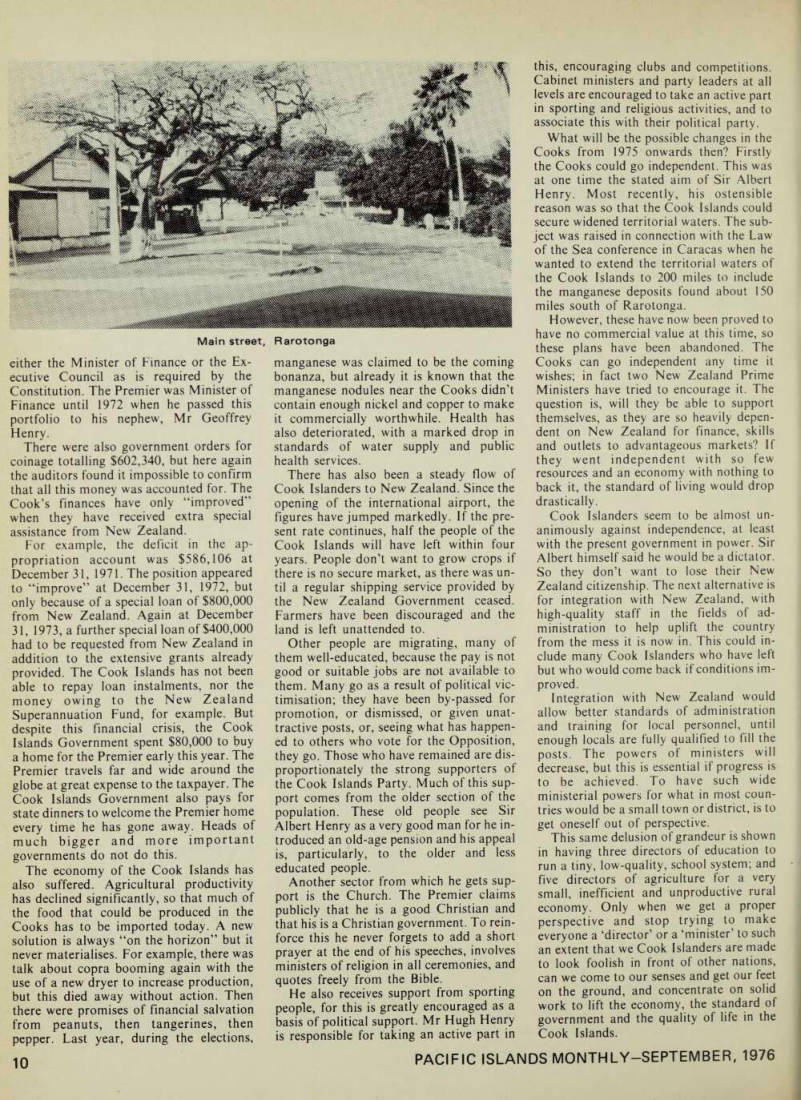
Main street, Rarotonga