Alone And Afloat In
p. 43 · Read in the full issue
The South Pacific
The sea was pretty big and it was blow ing hard a south-easterly trade wind with a lot of rain. The 134 ft luxury schooner, Te Vega, was out of Rarotonga and Tahiti-bound with American tourists on board. 1 was one of the seamen. On that cruise, Te Vega, master Omer Darr, carried a crew of 12, 10 of whom were Polynesians. It was the first week of August, 1958.
Early that morning, all hands were call ed to take care of the whisker stay on the bowsprit, which had fallen into the sea on the leeward side. The ship was run off the wind and we lowered the jib, so that the seas now came from aft. Before this we were close-hauled and this brought the seas crashing right over the fo’c’s'le head and no man could have worked there with
any degree of safety.
it took about an hour for all hands to secure the whisker stay and when we finished it was daylight. The watch had changed and I and Kakao, a Tuamotu boy, were on watch. Kakao had the wheel, and just before he went below, the skipper call ed me over.
“Peter! Mouse the shackles on the whisker stay.”
I went for’ard with a pair of pliers and a length of copper wire. I had to secure the shackle pins to prevent them from working loose. It was normal procedure and a sim ple thing to do. So, with the ship off the wind, I lay in the scupper and started work.
I was halfway through it when Kakao, who couldn't see me from where he was, apparently forgot that 1 was there. He seemed to be putting the ship back on course he certainly put her harder on the wind.
Then a big sea came over and nearly took charge of me. Before I could scram ble out of danger, another big one came over and washed me overboard. I hung on hard enough, but that powerful smash of salt water was too much for me. When I surfaced, the schooner was sliding by me.
“Heave a line!” I yelled.
Kakao both saw and heard me, and heaved a line. But 1 missed it by about six feet. Then Te Vega sailed on, leaving me adrift.
Te Vega had been dismasted in a blow off Tahiti and had been re-rigged as a
'bald-headed' gaff-rigged schooner. That means she had no top-masts. Now she was very heavily rigged. The gear was heavy, she carried 12,000 feet of sail, and the mainsail weighed over a ton. She was fitted out for the tourist trade and her air conditioned cabins had all the mods and cons. Fares were very high, and her owners used her on the Honolulu-Tahili run until the Matson Line cut that trade right out with their big luxury cruise ships, Mariposa and Monterey.
Looking for ways to stay in business, Te Vega’s owners then promoted cruises between Tahiti, the Cook Islands, Tonga and Fiji. The schooner was registered in Monrovia, Liberia, and Hew the Liberian
flag.
On this cruise we sailed from Papeete to Moorea with about 14 paying American passengers, then to Raiatea, Bora Bora, Ailutaki and Rarotonga, reaching the last named port on July 31, 1958. We left the next day for Tahiti, but it was blowing hard and we found we couldn't lay Tahiti, so we fell off for Raiatea, intending to tack to Tahiti from there. That was when we had the trouble with the whisker stay and 1 finished up alone in the heaving wastes of the Pacific.
Just after I missed the line Kakao threw to me, I saw him leave the wheel, run to the companionway and yell down it. The skipper came on deck, then a squall came down and the ship quickly vanished from sight.
I swam around a little and trod water and hoped they were going to come back, looking for me. It was now full daylight.
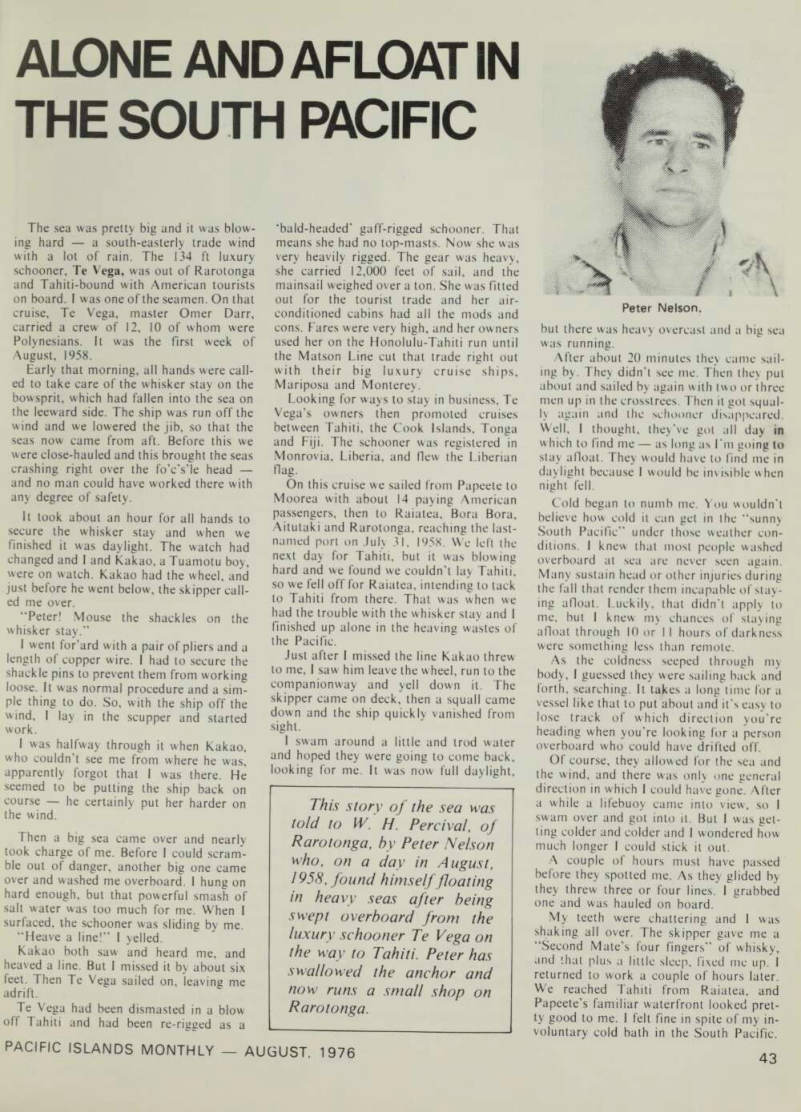
This story of the sea was told to W. H. Percival, of Rarotonga, by Peter Nelson who, on a day in August, 1958, found himself floating in heavy seas after being swept overboard from the luxury schooner Te Vega on the way to Tahiti. Peter has swallowed the anchor and now runs a small shop on Rarotonga.
bul there was heavy overcast and a hig sea
was running.
After about 20 minutes they came sail ing by. They didn't see me. Then they pul about and sailed by again with two or three men up in the crosslrees. Then it got squal ly again and the schooner disappeared.
Well, I thought, they've got all day in which to find me as long as I'm going to stay afloat. They would have to find me in daylight because I would be invisible when night fell.
Cold began to numb me. You wouldn't believe how cold it can gel in the “sunny South Pacific" under those weather con ditions. I knew that most people washed overboard at sea are never seen again.
Many sustain head or other injuries during the fall that render them incapable of slay ing afloat. Luckily, that didn't apply to me, bul I knew my chances of staying afloat through 10 or I I hours of darkness were something less than remote.
As the coldness seeped through my body, I guessed they were sailing back and forth, searching. It takes a long time for a vessel like that to put about and it's easy to lose track of which direction you’re heading when you're looking for a person overboard who could have drifted off.
Of course, they allowed for (he sea and the wind, and there was only one general direction in which I could have gone. After a while a lifebuoy came into view, so I swam over and got into it. But I was get ting colder and colder and I wondered how much longer 1 could stick it out.
A couple of hours must have passed before they spotted me. As they glided by they threw three or four lines. I grabbed one and was hauled on board.
My teeth were chattering and I was shaking all over. The skipper gave me a “Second Male’s four fingers” of whisky, and that plus a little sleep, fixed me up. I returned to work a couple of hours later.
We reached Tahiti from Raiatea, and Papeete’s familiar waterfront looked pret ty good to me. I felt fine in spite of my in voluntary cold bath in the South Pacific.
Peter Nelson.